January seemed a good month to get the knitting machines operating and into production. So 4 projects completed, a couple of these being hybrid machine knitting / hand knitting projects.
The first was a classic merino jumper. This uses Yeoman sport 1 ply in cream. I buy a couple of cones and that gives me a couple of 2 ply jumpers. The result is a jumper that is super soft, fits me, washes well and a useful base under my fine knit cowls.
.JPEG)
I knitted a couple of these many years ago and have only just reluctantly stopped wearing one as it has truly worn out. However, the elbows did not.( The post of 6 April 2020 gives more details of knitting this style of jumper.) I have made a block pattern with fitted sleeves and so I know it fits!
.JPEG)
It might sound simple, but having no pattern on the jumper, there is nowhere to hide and so full concentration is needed during construction.
.JPEG)
After washing the pieces, I block them onto the tissue pattern pieces and then stitch up using a slight zig zag on my normal, Janome, sewing machine. The neck is cut and sew and gives a nice finish.
The second item proved to be more of a challenge. I have been using a shawl cardigan pattern, very much altered over the years from a Posh Frocks pattern. The post of 30 July 2015 shows just one of the many I have knitted to this design.
I last knitted it in Uppingham lambswool NM 2/17 and noticed it bulged at the back at the base of the sleeve insertion. As the yarn was fine, a bit of steam solved the issue. For many years I had knitted this pattern in very fine crepe and have a range of colours to chose from in the wardrobe. Being winter and having some cones of yarn in my collection I thought I would knit this in a thicker yarn still, Uppingham ‘Shetland’ NM 2/11.5
After knitting a strip of tension ranges, I chose the one I thought felt best and knitted a larger tension sample.
No toile was needed as I had knitted this numerous times before.
Yes, there is a big ‘However’ here!
Shapes drawn on the knit leader and in a few snatched hours over a few days, the cardigan was complete, washed and blocked. Trying on time. The slight bulges I had noticed in the finer yarn were magnified in this much thicker and heavier yarn. Reluctantly I decided to recut the sleeves and thought that would solve the problem. It did not. I had been ‘tolerating’ the upper back fit of the cardigan as the overall look and drape with the collar was great.
Grey cardigan back of the neck
.JPEG)
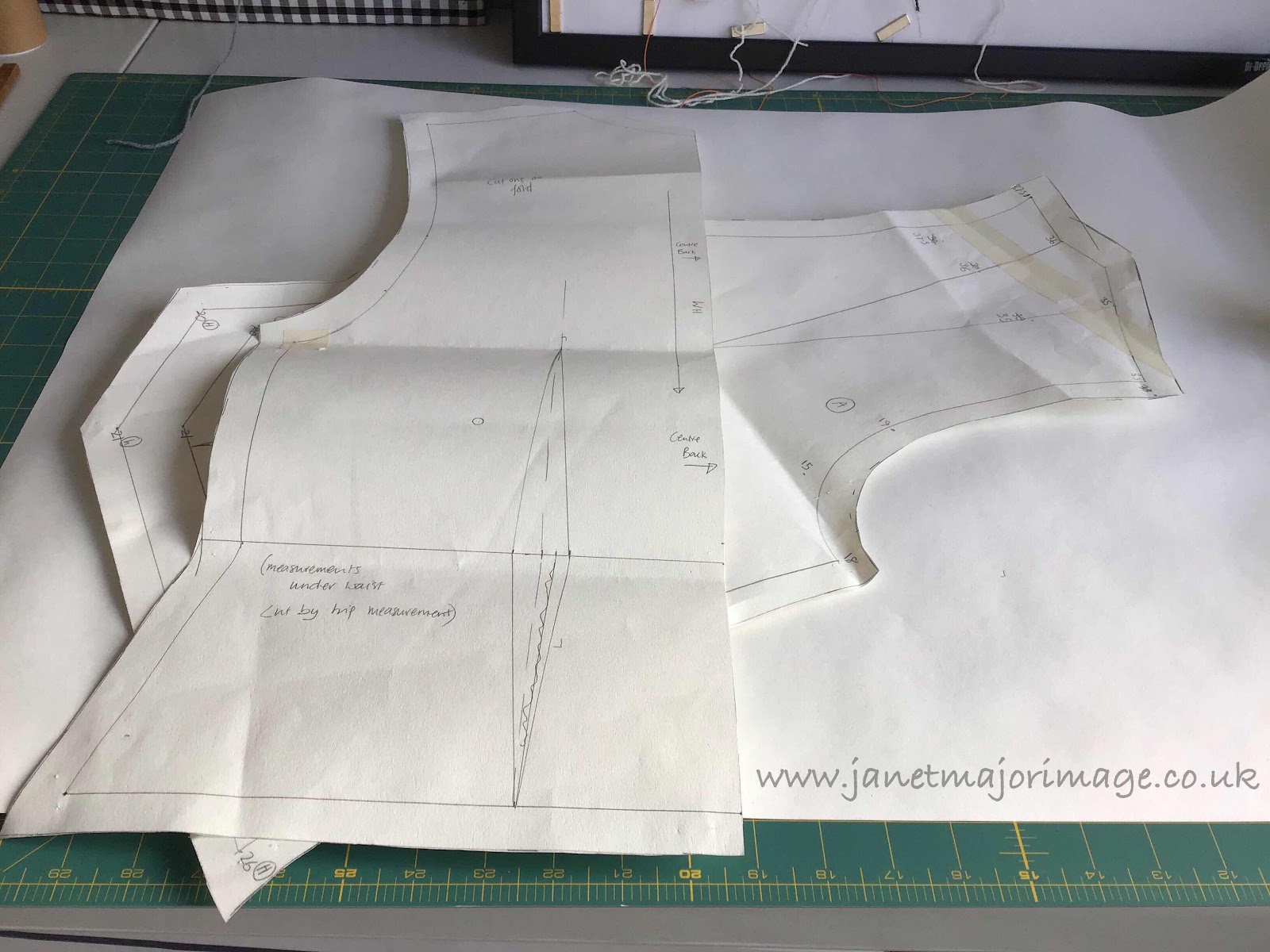
I decided it was time to go back to the drawing board and redraft the back to have a more conventional fit. This would mean new pattern pieces for the back, the fronts, the sleeves, but the shawl collar I hoped would be fine but would need to be longer. I modified the jumper block I used for the merino jumper and made a toile in double knit jersey fabric, the nearest I had to the fabric formed with my intended yarn.
.JPEG)
This nearly worked first time but I decided to raise the back neck slightly as the back seemed to ride up a bit…I have quite a rounded back.
Fortunately I started with a large cone and managed to knit version 2 without pulling any of version 1 apart.
Completed cornflower cardigan
.JPEG)
Back of the neck
.JPEG)
The fit is great and I now regret not going back to first principles and redrafting this before now.
Now to sort through the cones in other colours and knit another. (I have now done the tension square in red, again Uppingham Lambswool NM 2/14)
The second two projects involve the circular sock knitter machine. I have written about this super knitting machine before. (Post of 10 Jan 2017)
Last Christmas I had chosen as my present some Japanese Knitting Books, both by Hitomi Shida- 250 Japanese Knitting Stitches and the Japanese Knitting Stitch Bible of 260 stitches. These being the original bookend the second one. I thought while I was juggling with wool and foot sizing for machine knit socks I would not knit the leg on the machine but use the leg to try out some of the patterns in these books. I did a trial using a pattern I have used before from Kate Davies Blue Stockings book (1). I now find this pattern is actually in the Japanese Knitting Stitch Bible too, pattern 90.
The red socks and the trial to see if this idea would work- it did and was enjoyable knitting.
.JPEG)
Then changing the wool and the tension I knit a blue pair of sock feet. I like the 84 needle original cylinder with this fine wool /acrylic mix as I can use a tight tension and the socks last longer. So I had 84 sts to play with and chose a pattern for above the ankle that would work with 80 stitches, pattern 39 in the second Japanese Book attracted me. All good so far. However to match the machine knit stitch size I need to knit on size 2mm needles. I could go looser but that would sort of miss the point. I think this wonderfully textured knit is harder than any of the fine lace patterns I knit. The first sock was very slow going, especially where the pattern swapped blocks, but the second was quicker and I hope that now having done one of the hundreds of patterns the next I chose will not be so slow.
The completed socks
.JPEG)
Showing the pattern in more detail
.JPEG)
With the sock knitting machine, you in fact knit another heel for a toe! I like then to join this with a Russian Graft.
.JPEG)
I have also knit some real cotton dishcloths as these seem impossible to find in the shops. Even these are not so easy as it might look. Getting the right tension and size is key to their success in terms of function.
Next project(s)?
I have number lined up, the red cardigan knit as this cornflower one is happening. int is a finer wool. Then I am thinking of knitting a simple cornflower jumper to go with the cornflower blue cardigan. The grey cardigan is paired with a matching jumper and they are nice to wear together or separately, again with a lace cowl, either machine knit or hand knit in fine Shetland yarn, that I have naturally dyed in designs from Unst. There will be more socks ahead of the meet up of the sock knitting enthusiasts at Kegworth on the weekend of March 9-10. I have now reminded myself how I strengthen the heels invisibly during the knitting, but not used the ribber for a while!
Notes
1. Kate Davies & Nicole Pohl: Bluestockings. I love this book, it discusses the history of socks and stockings from several contributors, has essays about 'Blue Stocking' women as well as patterns, tips etc. Much more than a book of sock patterns.