Showing posts with label knitting machine. Show all posts

Monday, 6 April 2020

A classic jumper

I like to have some basic, smart, fine wool, knitted jumpers that I can layer more interesting knitwear over. For several years I have had a couple of cream ones, that I machine knitted in Yeoman polo fine merino wool. These have been washed many times and just keep on looking great. 

I decided I needed some grey ones, finding just the right shade of grey was problematic but eventually I found a grey colour that I really liked - it is lambs wool  in 2/ 17 colour Pearl Grey. It comes from Uppingham Yarns as a cone of approx a kilo, mine was 0.970 g. 

I drafted this pattern some time ago. It is very simple and has fitted sleeves. 

However, being plain and very simple there is nowhere to hide. Any slight error sticks out a mile. 

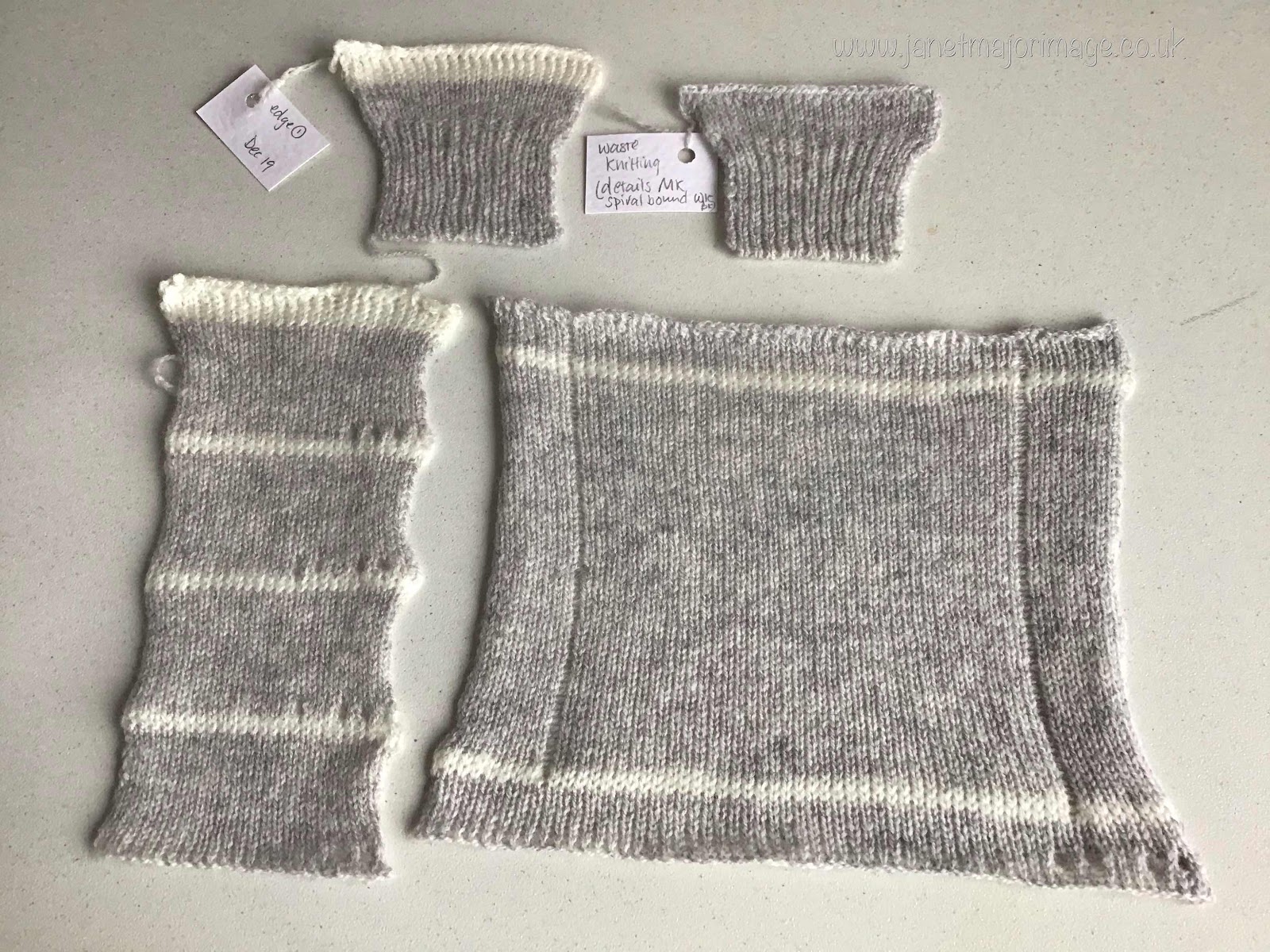
These are the samples I knit before I started. I was looking to get a good edge to the rib and a suitable tension. Hence the strip and then the square to get my measurements for stitches and rows per inch. 


Knitting went to plan. (I have described knitting using my knitting machine elsewhere on my blog)

Blocking the pieces ensures that they must fit me, with no nasty surprises like the sleeves are too long or the jumper is too short. 
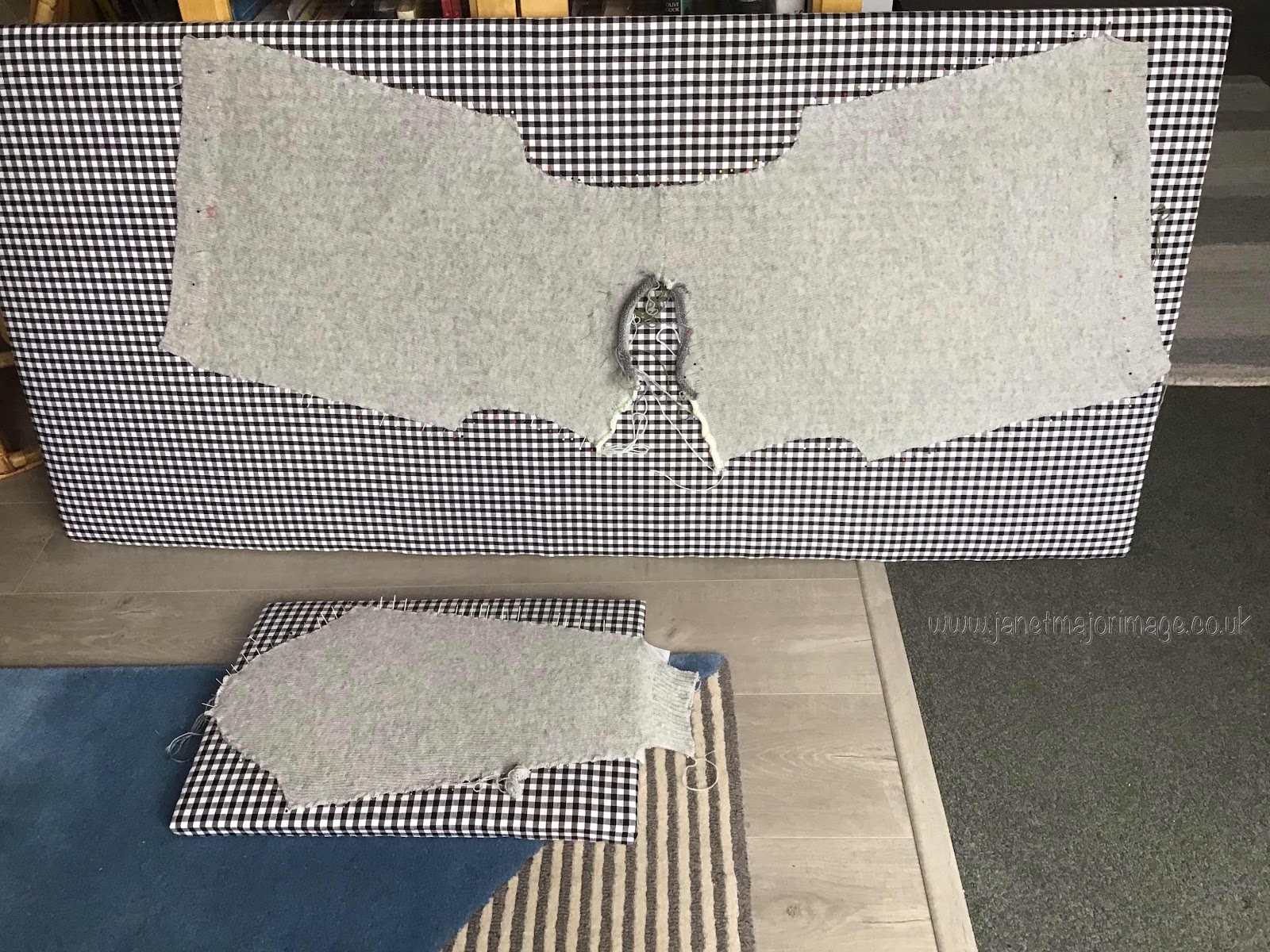


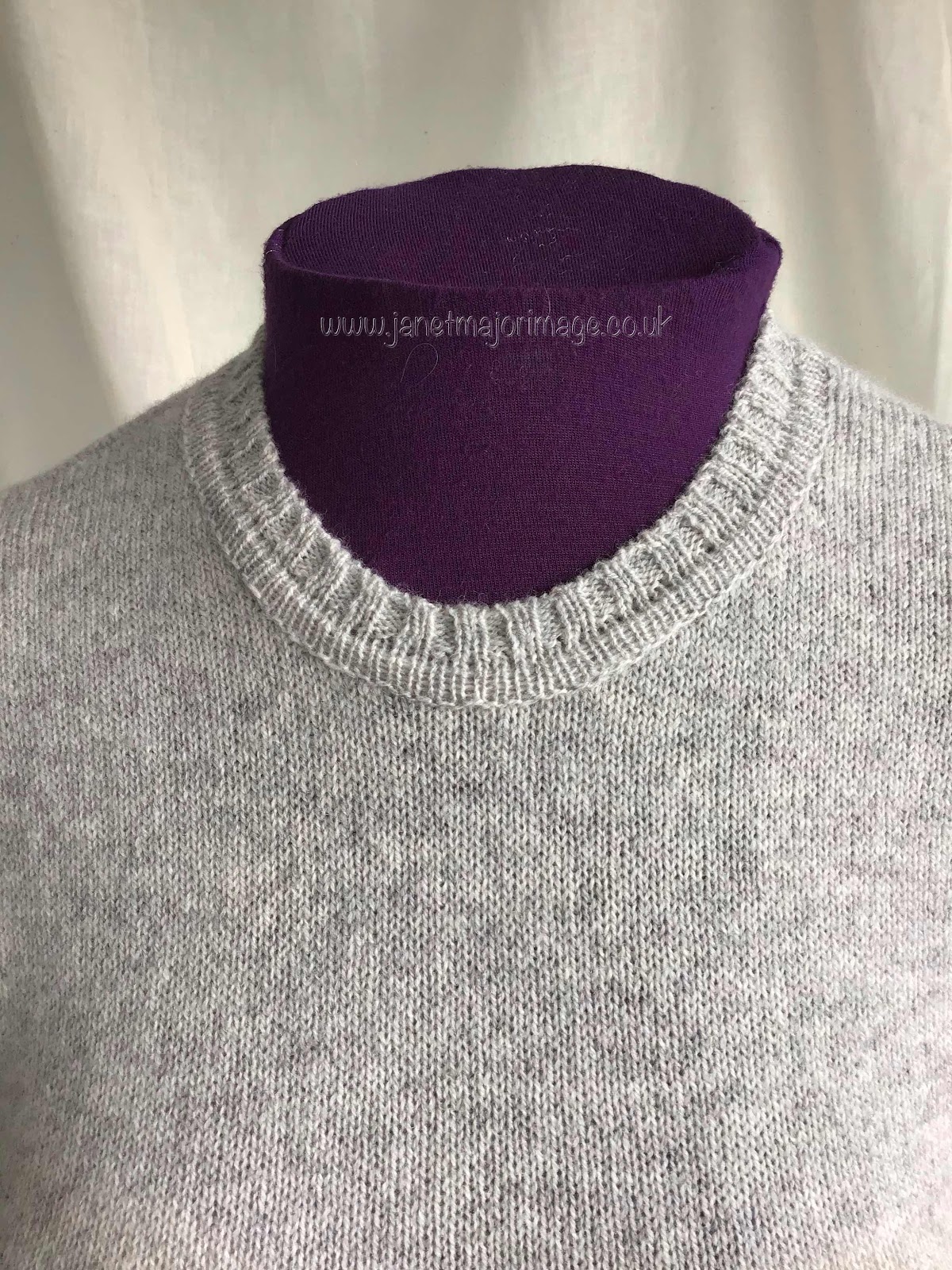
Initially I used a single 1x1 rib for the base of the back, front and sleeves. The neck is done by the ‘cut and sew’ method that I use. 

Cut and sew neck


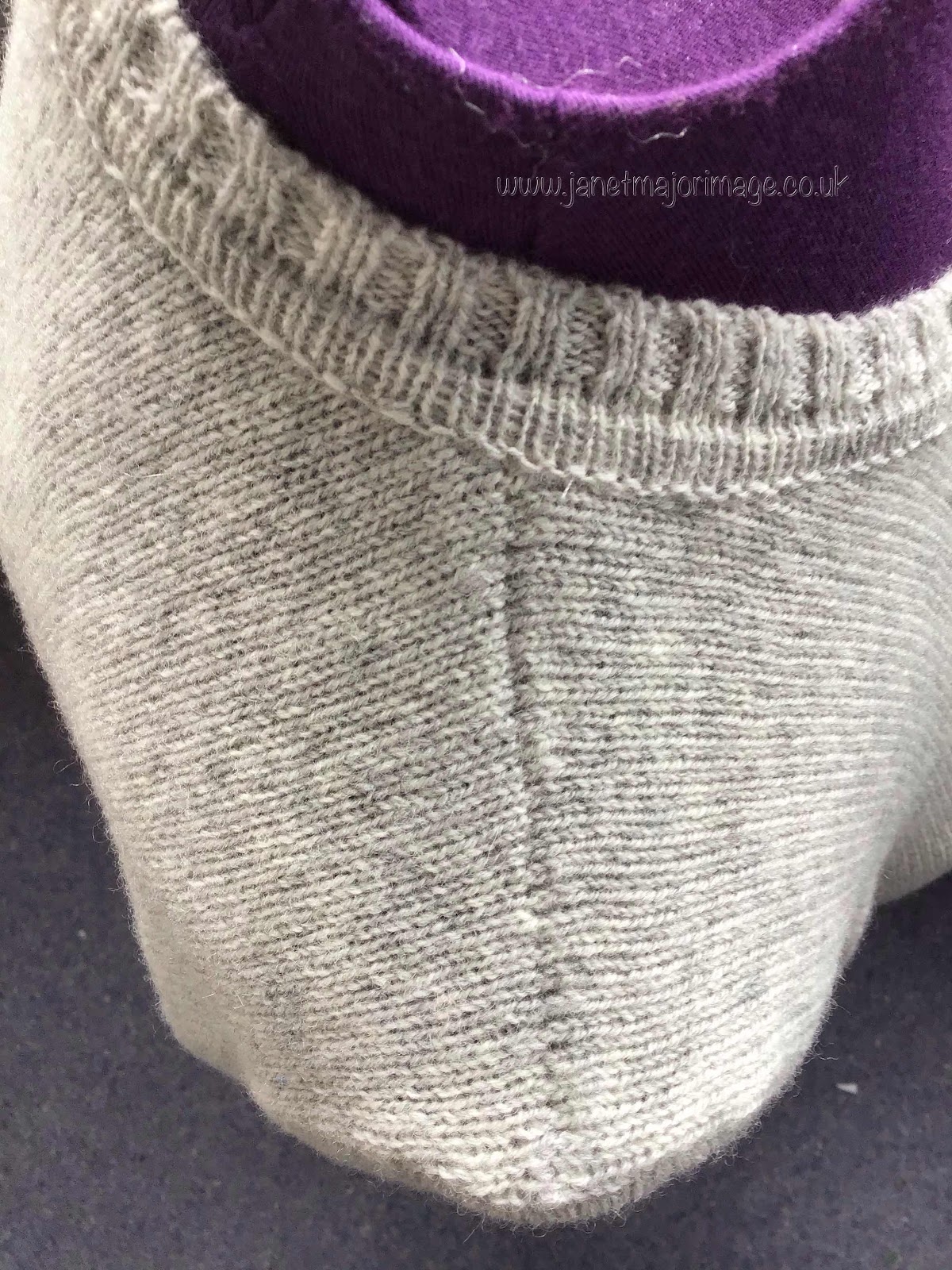
I join the shoulders on the knitting machine 

Shoulder join 


Other  seams  (but not ribs) I sew with my Janome sewing machine. The ribs I stitch together from the outside to get the best match I can with no visible  joins. 


The jumper weighs just 150 g and I finished this first one before Christmas. It has had good wear and is still looking ‘as new’. 


I decided that I couldn’t better this design or colour so I have just knitted another. Version 2 has 2x1 ribbing at the base of the body pieces and sleeve. 


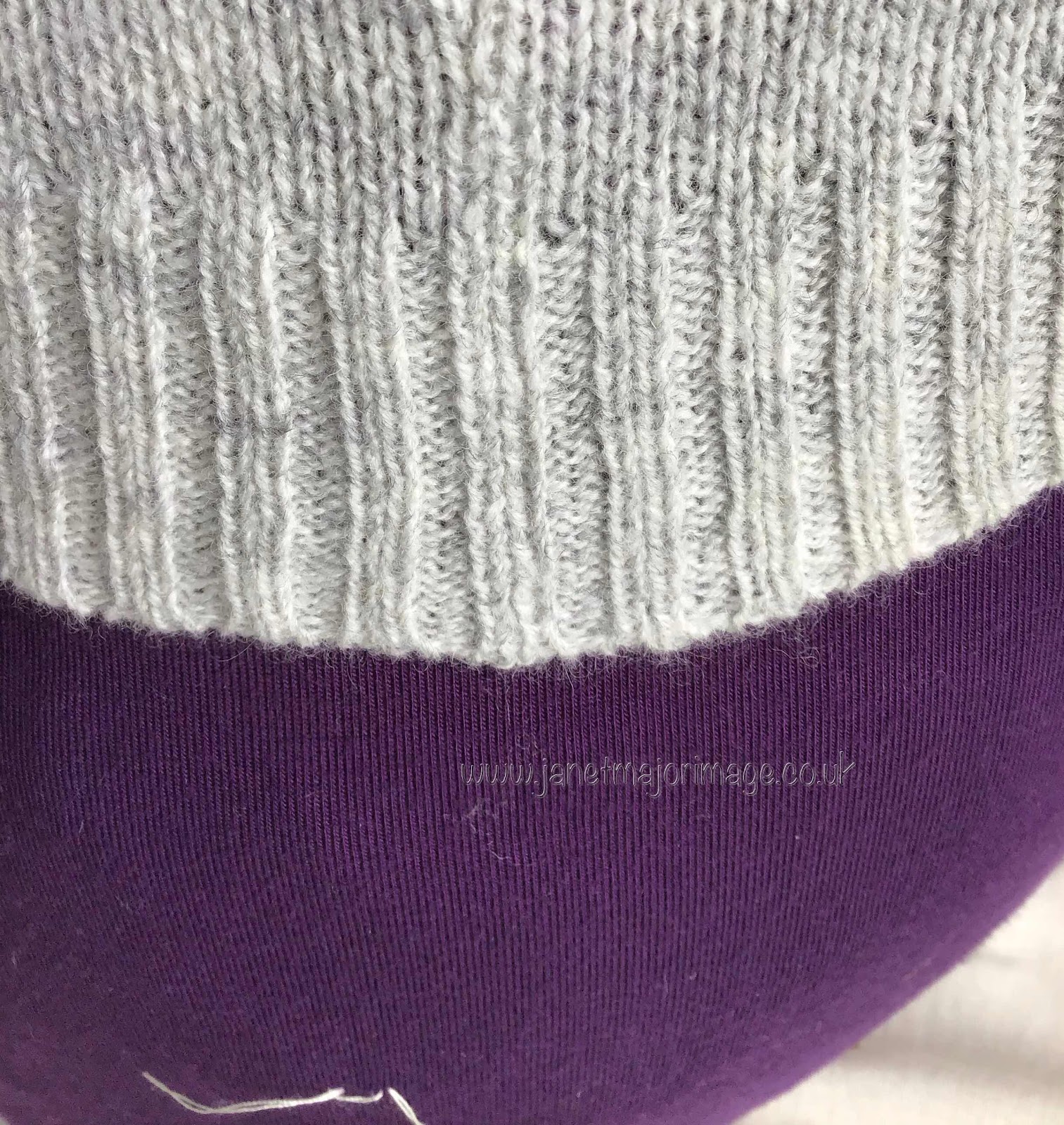
Mattress stitch ribbing 


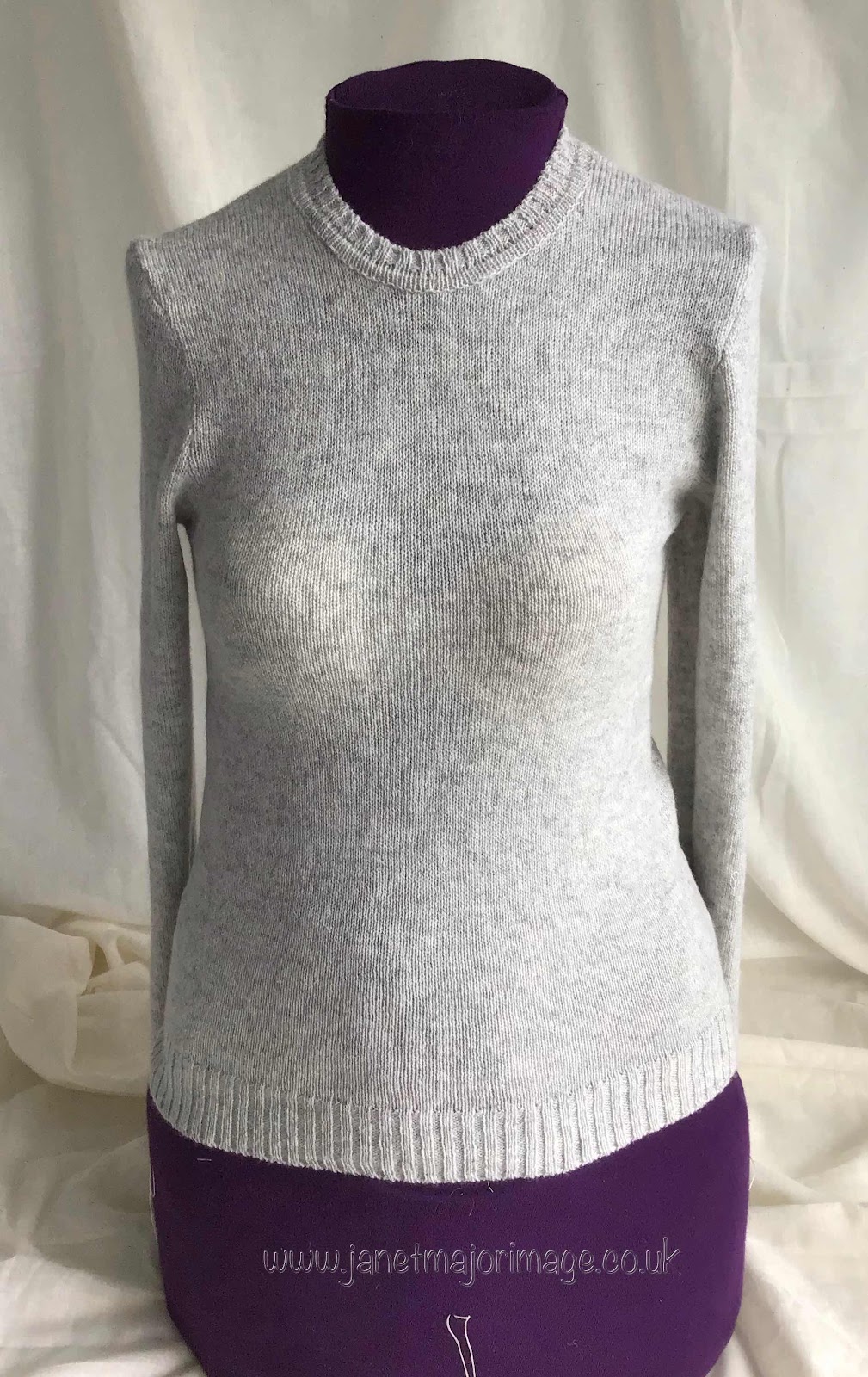
The completed jumper 

I love how the sleeves fit and I love this yarn. 


Jumper v2 complete 


Yet again the 30 year old plus  Brother 830 Knitting Machine delivers. 

So only 300 g of yarn used , 150 g per jumper and 670g left. 


Saturday, 13 May 2017

A machine knit item from the Great Exhibition of 1851


I've already written about a few of the items that really intrigued me in the V and A 'Undressed: A brief History of Underwear'. This is another ( and the last I shall write about). It was a machine knit man's long sleeved machine knitted undershirt. It was made in Britain and as I noted  above was in the Great Exhibition. It was labelled 'The Soltanello' - or perhaps 'sottanello'. I haven't been able to find any more information about it, even though the maker is given - 'Capper and Walters'. What I couldn't really  believe was that it was machine knitted at that time. 

If you know me well, I have a 'weakness' for machine knitting and own a couple of more vintage ones than I knit on myself but 1851 seemed a long time ago to have knitting machines that knitted this fine as well. 

So I set about a little discovery to see what I had missed. I knew the date given must be correct - this is a V and A exhibition after all. So this is a summary what I have found out. 

1589 William Lee invented a stocking frame which depended on the use of a spring and a bearded or barbed needle. The yarn was placed over the needles in a frame. This method was unchanged for the next 200 years.

1657 the Worshipful Company of Frame Knitters was incorporated

1849  latch needle ( much as we use today) patented by Matthew Townsend in the UK and James Herbert in USA

In the 1860's Pastor Isaac Lamb developed the first V bed flat knitting machine

1867 a  Mr Lamb in Northville Chicago developed an 84 needle machine weighing 15 lb and by the 1890's Lamb machines are noted as being used by home knitters throughout the world.

1924 Japan claims Masako Hagiwara invented the first knitting machine aimed at home use. This still required the yarn to be laid across the needles. I am unsure when a carriage took the yarn over the needles as in domestic machines in use now. 
I have been given the following information from ladies in the FB group for vintage knitting machine owners:
1956 Knitting machine had no tension arm
1958 Passap machine had a tension mask and carriage. 
So it looks as if the moveable carriage came in 1957/8 ish! 
Again any further information would help here! 

I have a vintage Lanofix machine that knits in this way, ie the wool is placed over the needles.  It was designed as a portable machine and the advertising with mine shows a gentleman in a wheel chair with the machine sitting on the arms. This would be World War II. It appears my machine may be one of the first models which dates from 1938 but I need to try and cross check this - very exciting. 
This is a poster for it - it seems it have had different names in different countries.


So knitting machines were available in 1851 but I don't have a clear idea of what the one knitting the undershirt might have looked like. I have tried to search the official catalogue of the Great Exhibition and found an entry that would have been good to see - an actual knitting machine! This was made by Eastman New Jersey - I think they were also connected with Photography. But so far I have drawn a blank on a drawing or photo. 

I have tried to cross check the information above. I apologise if any of it is incorrect. Please let me know if you have anything to add to this or if you have an image that I could see of the actual knitting machine that was in the Great Exhibition of 1851. 


Tuesday, 18 August 2015

Day 15 Creativity - Hand Spun yarn and a Chunky Knitting Machine


Some time ago I was given a basic chunky machine. Well, it is not that basic - it will do slip and tuck stitch and weaving and has a ribber. What I really mean is that it does not have a punchcard facility so that means no fair isle.

I replaced the sponge bar when I received the machine but with ill health and moving I never really got round to putting it through its paces. So today I tried a little experiment. I wondered how it would manage with my hand spun wool. I have some (12 wpi) that is thicker than I would use on my standard gauge machine and I wondered how that would work. Well, surprisingly that knitted well at tension 1.

The blue is waste yarn.
So then I thought I would try some of my hand spun brown Jacob yarn which is about Aran thickness (8 wpi). That knitted nicely on tension 6.
 
Notice how the different thickness of yarn and tension makes the swatch have irregular sides! I started the off white on T3, then turned to T1 - the equivalent of changing needles in hand knitting.

So now  I wonder how thick it will knit as the maximum tension is 10.2. More experimenting needed.

Seeing what this machine can cope with, fair isle would seem unecessary. Double thickness (as you get with stranding of fair isle) of these yarns would be too thick in all but the coldest of conditions!!

I like fine (ie thin) yarn knitting but I'm looking forward to trying something a bit different - and of course I have the rib and different textures to experiment with too. This feels just like a new toy.

Wednesday, 3 August 2011

Red Fine Knit Cardigan

What do you do when you would like /’need’ a cardigan in a preferred style and colour ? Well in my case it's not to walk round the shops in hope. Online shopping definitely has it’s advantages for some things but not when you want to ensure a good fit; for clothes it is important to feel for the quality too.
This is where being a ‘textile maker’ is so useful. The design I’m going to use is one that I have used before and I have made make a cream and then grey one previously.
Some of their plus points:
Both are easy to wear & weigh little.
They wash well and once rolled on a towel are nearly ready to wear again.
Each gets lots of positive comments when worn.

Each time I have tweaked my master pattern and plan to do the same with the red one by narrowing the horizontal width at the bottom to make the cardigan less flowing. This will give a less casual and more tailored look.

Materials : Hobby yarn from Metropolitan in Cheshire.
Technique: Machine Knit