Showing posts with label design. Show all posts

Thursday, 12 October 2023

‘Sweet pea’ fingerless gloves 2023


I first designed a pattern for these, many years ago. It was prior to 2014 which when we moved back to Norfolk, so possibly 2006! Then they were called the Alchemilla fingerless gloves as they were to match a handbag that I knitted. Sadly I no longer have the handbag, it is one of the few bags I have sold. I still have the design work and the gloves though! 


Alchemilla gloves


They are excellent when I am doing photography in cooler or even very cold conditions! 


I made the next pair (left in image below) sometime in 2016 when I spun the yarn, from Shetland fleece and naturally dyed it to knit the first wool week hat, the Swook hat by Hazel Tindall. I called it my Skaw hat as I matched the colours to seaweed in a photo I took at Skaw beach on an earlier visit to the most Northerly beach in Unst, or in fact  the UK. I wear these a lot and it a usual day of somebody, usually a stranger,  doesn’t have a conversation with me about them. It’s nice that they spark a knitting/ spinning/ dyeing conversation and I have introduced several to Shetland Wool Week through these gloves. 


I had so much dyed Shetland wool left the year I knitted the meadowsweet jumper and the hat and the notebook cover that I knitted another pair in those colours! 


….and now in 2023 I have knitted another pair using the colours in the yoke of my Shetland Wool Week jumper yoke. There is one slight variation from the yoke - I used a stronger coloured pink in the centre of the yoked jumper motifs but thought there was enough pink showing in these fingerless gloves to use the wool that I dyed and did not use in the yoke. Also this year it is the first time I have used all the colours in sequence and arranged them so that the colours run in sequence across my left hand, outer to thumb side, then across my right hand thumb to little finger with palms down.

The clips show where the stitching for the thumb slot will go 


There is an invisible graft in the picture. (I hope it is invisible) 


I have learnt the graph I used from studying videos and articles from Joni Coniglio who does, in my mind, ann excelled 2 sided lace knitting graft. It took me time and many trials to ‘get’ this but more than worth it. I have described this I detail I previous posts, such as http://imagejem.blogspot.com/2021/11/grafting-2-sided-lace.html


This shows the trial of the graft


Preparing  for the graft 

Showing the foundation rows in waste yarn 


 Graft complete


Removing the waste yarn from the left 


Each time I have knit them, since the first there has been a modification, or improvement in my mind. Perhaps now the pattern is static and perhaps I might publish it! 


My aim at first, and remains, was to run the stripes down the hand. This lengthens rather than widens my (to me) broad hands. 


You can read about the jumper and the natural dyeing using cochineal and indigo in the post of 8 Oct 2023


Sunday, 16 January 2022

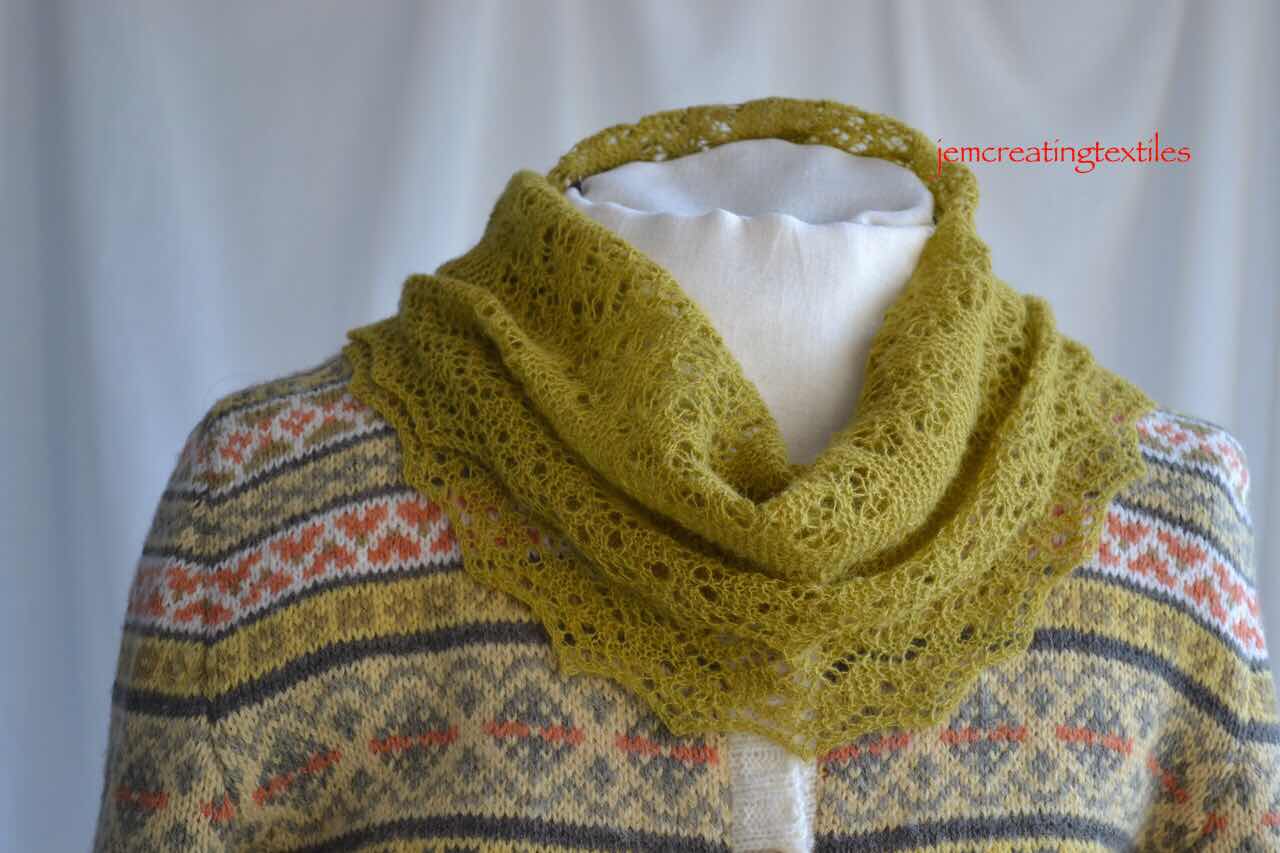
Fine Lace Cowl


I finished this in the autumn and even wore it in November and yet it has got to the middle of January before I have managed to turn the draft of the text into the post! I’ve been distracted by more knitting, the first natural dyeing of the year, warping the loom and life….more of these things later. 


I have several fine lace cowls that I wear. I wear them most of the year and I guess they are a signature piece of clothing for me. 


I am often asked if I knit them. The answer is yes, I then add that I used the knitting machine and the response then varies. I did design the pattern and knitting something so fine on a knitting machine needs skill! But, and I have to agree myself, the skill of knitting one in a fine lace design by hand is different. Different skills and many more hours. 


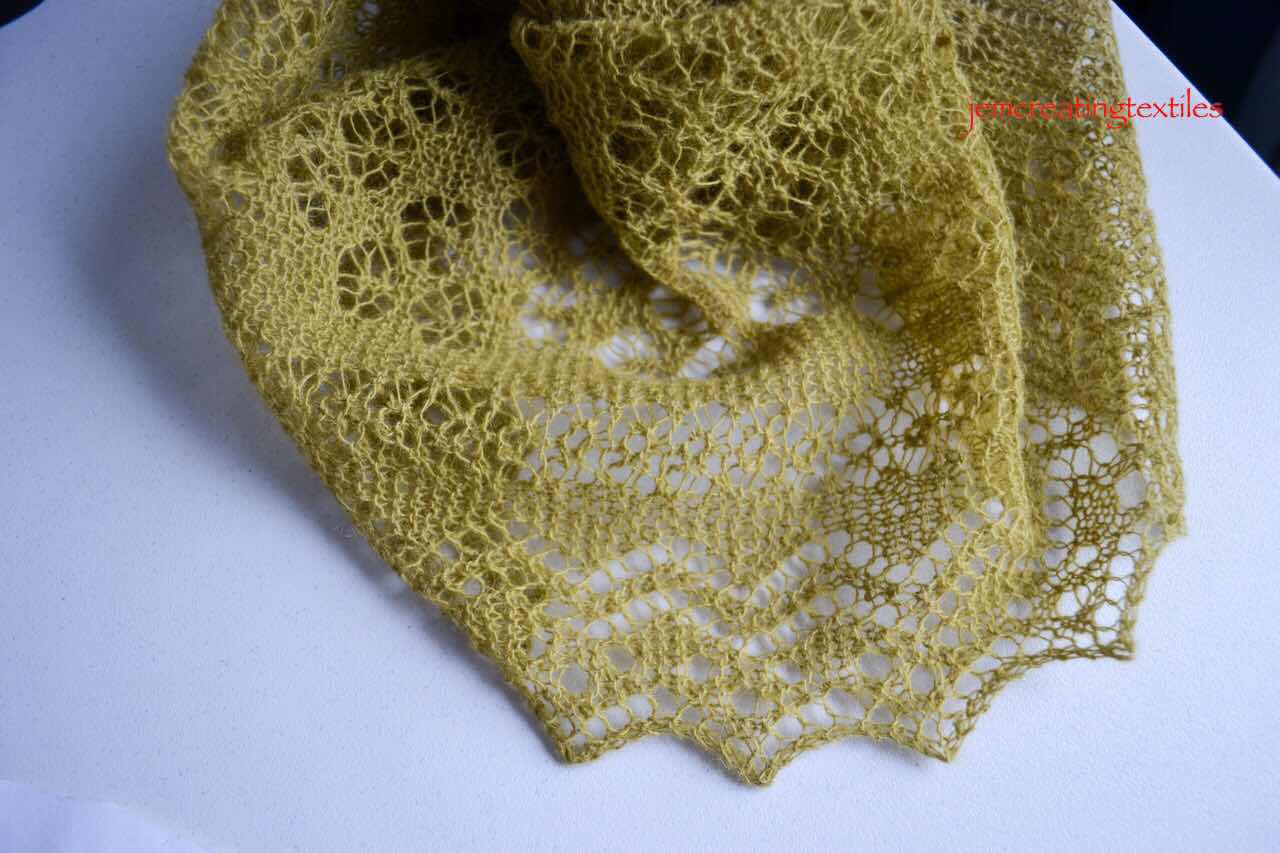
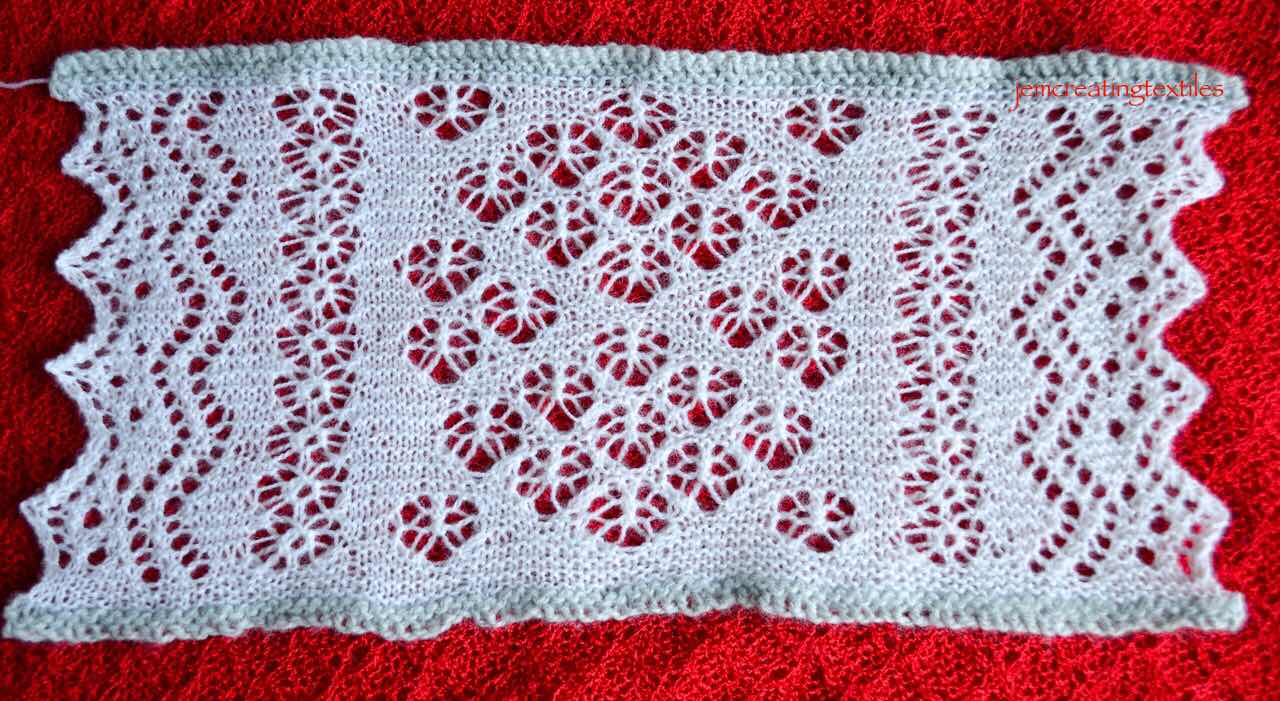
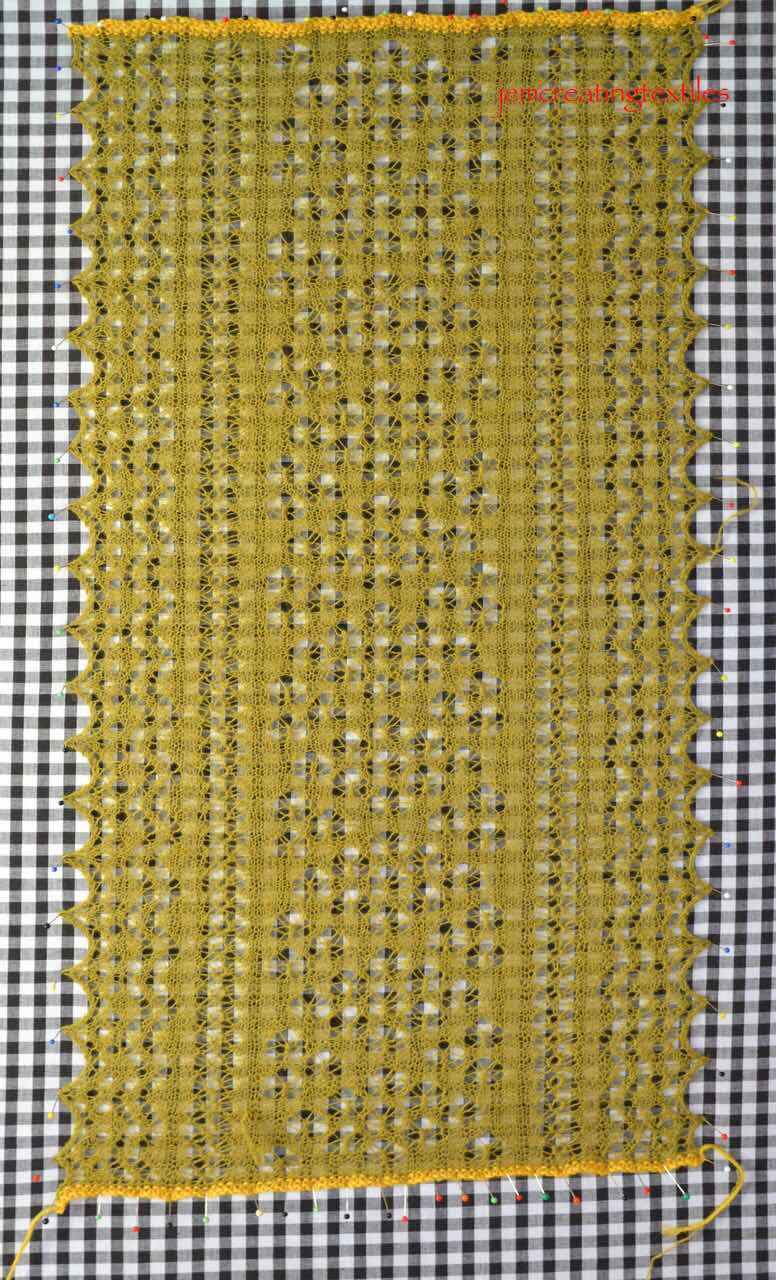
I have spent a long time thinking about and designing this one. I have used traditional Shetland motifs and chosen ones that have particular meaning to me. The yarn is Jamieson and Smith optic white which I have naturally dyed with golden rod with a copper additive to get this particular green. 


In the design I was aware that the lace edgings would be particularly noticeable and added an inset  inside these and then a central panel. I was aware that the design would be observed mostly ‘sideways on’ and to me it was important that all the motifs looked good sideways. (I feel this is not always the case with some lace designs which look far better hanging vertical). For a cowl that goes round my neck close to my face I wanted it to be a design that worked well for that purpose. 


Loving Shetland and in particular Unst I chose motifs reminding me of my time there: 

Lace Edging: Norwick Waves - by Hazel Laurenson (1) 

Insertion: It is just called ‘the insertion’ in the Unst Lace Stole - by Sharon Miller (2) 

Central Design : Drummie Bees - also by Hazel Laurenson

(there is another Shetland link but I will discuss that later in this article)


I designed the Central Portion to include clusters of Drummie Bees so it was not quite an all over design but there would be plenty of interest however the folds of the cowl went around my neck. I used Stitch Mastery for the first time and learnt a lot about motif  placement. 


The three sections all had different row repeats so this needed a bit of maths to get the piece to work as a whole piece. 


 Checking the motifs will work with one another


During  the knitting I marked off each row as completed. All in all the knitting took 31 hours making it a virtually priceless piece. 

Dressing


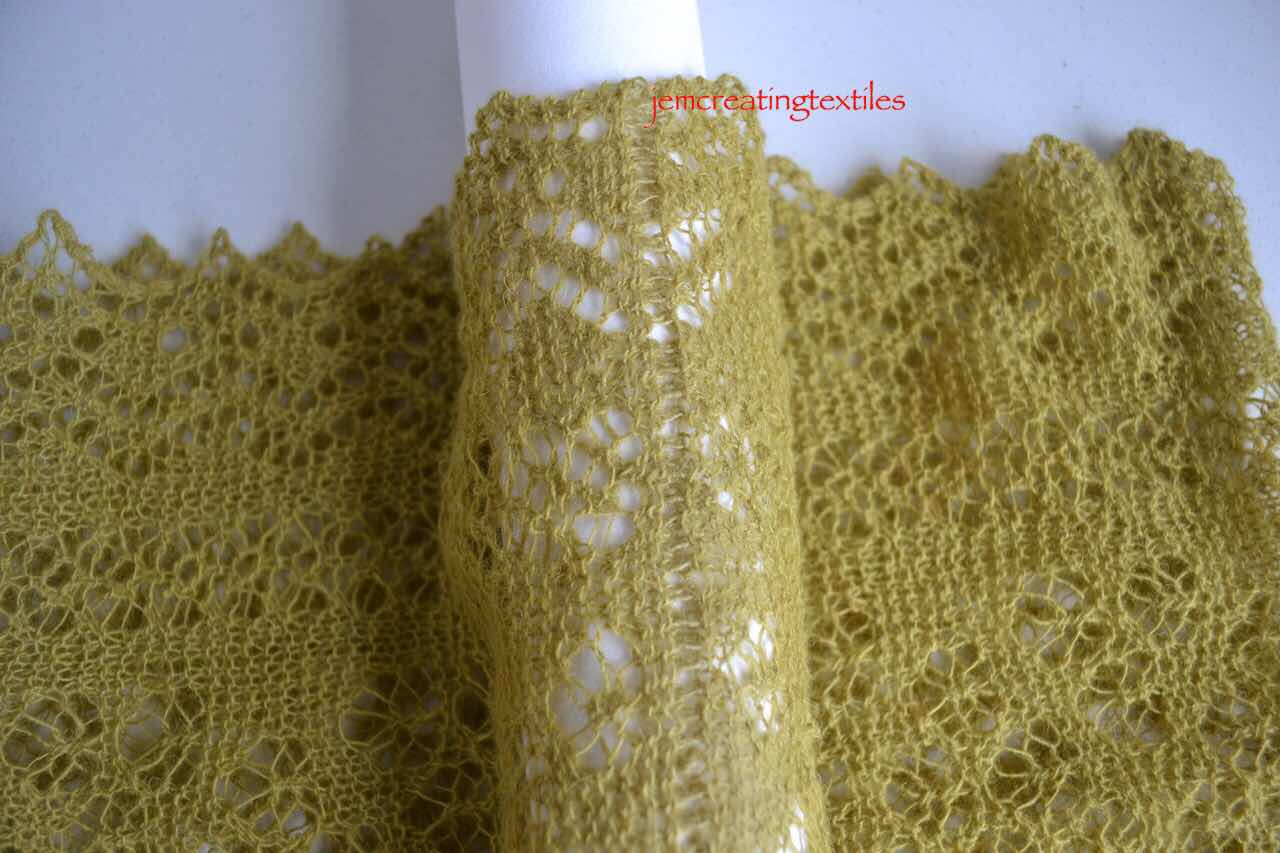
Once I had dressed the finished piece I did a ‘Betsy’ join to form the back of the cowl. (3) Betsy referring to the masterful Shetland Fine Lace Knitter (and spinner) Betsy Williamson. 


Summary of some facts: 

Yarn: Jamieson and Smith Optic White Cobweb ( 1400 m per 100 g, given as NM 1/14.5) (5)

Mass of yarn used: 22g

Colour: Moss Green - dyed with golden rod with copper additive 

Needles used: 2.5 dpns with a knitting belt 

Hours of Knitting : 31

It will be worn particularly with my ‘greeny’ Harris Tweed Skirt


Now to design another with a different construction method! 


Notes 

 Hazel Laurenson designs and knits fine lace scarves and is one of the knitters from Unst Heritage Centre. She has translated many pieces of  ‘found ‘lace from Unst into patterns which are sold at the Heritage Centre

2 Both these patterns are available in the booklet Recreating Vintage Shetland Lace  obtainable from Unst Heritage Centre

3 Stitch Mastery at Stitchmastery.com enables me to create knitting charts for both lace and fair isle, although I always start with graph paper!

4 Hazel Tindall demonstrates the Betsy join and discusses one way of using this with Elizabeth Johnston in the superb  DVD 50 Tips from Shetland Knitters

5 This should then be 1450m!


Friday, 30 April 2021

The Norwich Red Jacket (part two)


So it was finally time to start knitting the garment. The shape was drawn on my knitleader (shaping device) where I use my tension square to convert the stitch and row count for the actual shape of the piece. For this garment I will knit 2 fronts, the back and 2 sleeves with the different punchcard pattern. The front edgings and neck edging would be knitted later. In all the knitting with the finishing took 18.5 hours. This compared favourably with my 4 hour knitting of the ‘kit’ jacket start.

Once the fronts and back were knitted, I washed these and blocked them to the exact shape of the pattern (see blog 30 July 15 to see how I do this). Then I joined the fronts and back together using the knitting machine. At this stage I  tacked round the shape of the front and back neck where I needed to remove knitted fabric. I ‘cut’ out the shapes using the overlocker on a stretch stitch setting. 

Next up was the front edgings, I was using the technique taught by Tony Bennett an Australian designer who I have been fortunate to attend several workshops with. These are the hardest part to ‘get’ right in the whole of the garment.

This is the sample I did.


Each front edging took an hour, but this was well worth the time spent.

Now the front edgings were on I could do the next facing. I picked up stitches from the folded over cut edge. I did the equivalent to knitting the rows on smaller and smaller hand knitting needles and then increased the size again ending with waste yarn for about 6 rows, this gave a well fitting shape. The final stage of this is to backstitch the .live stitches down to over the cut edge on the public side to give a very neat edge to the front and back. Special care is needed at the outer edge of the edging  to get a smooth continuation with the front facings. 

The sleeves were set in and I stitched these in with my ‘normal’ sewing machine using a slight zigzag. Underarms seams were done in the same way. 

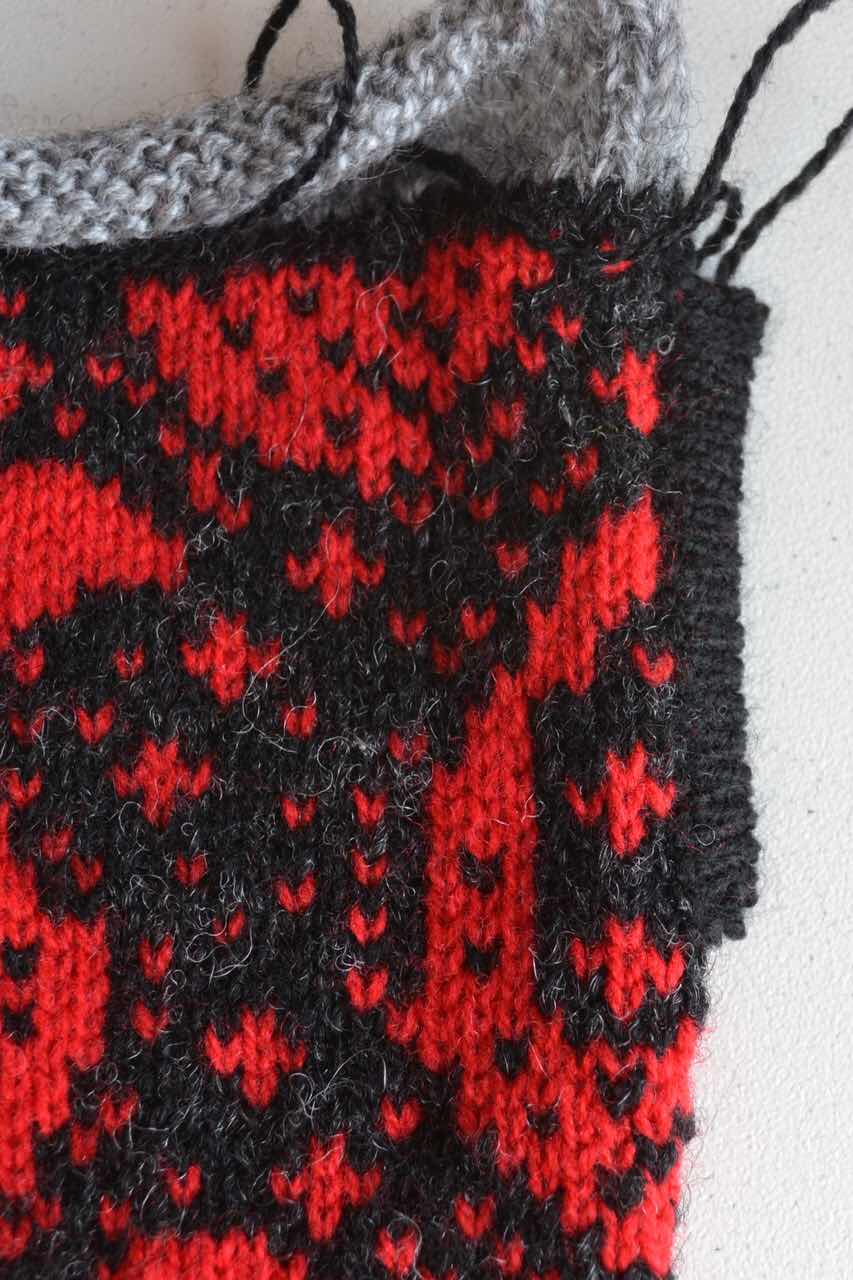
This just left me with joining the underarm seams and I had done a lot of planning to enable me to have an invisible  seam there, so now the stitching was crucial. I used both black and red and worked from the outside and was pleased with the overall effect. 

Final threads to weave in


The underarm seam


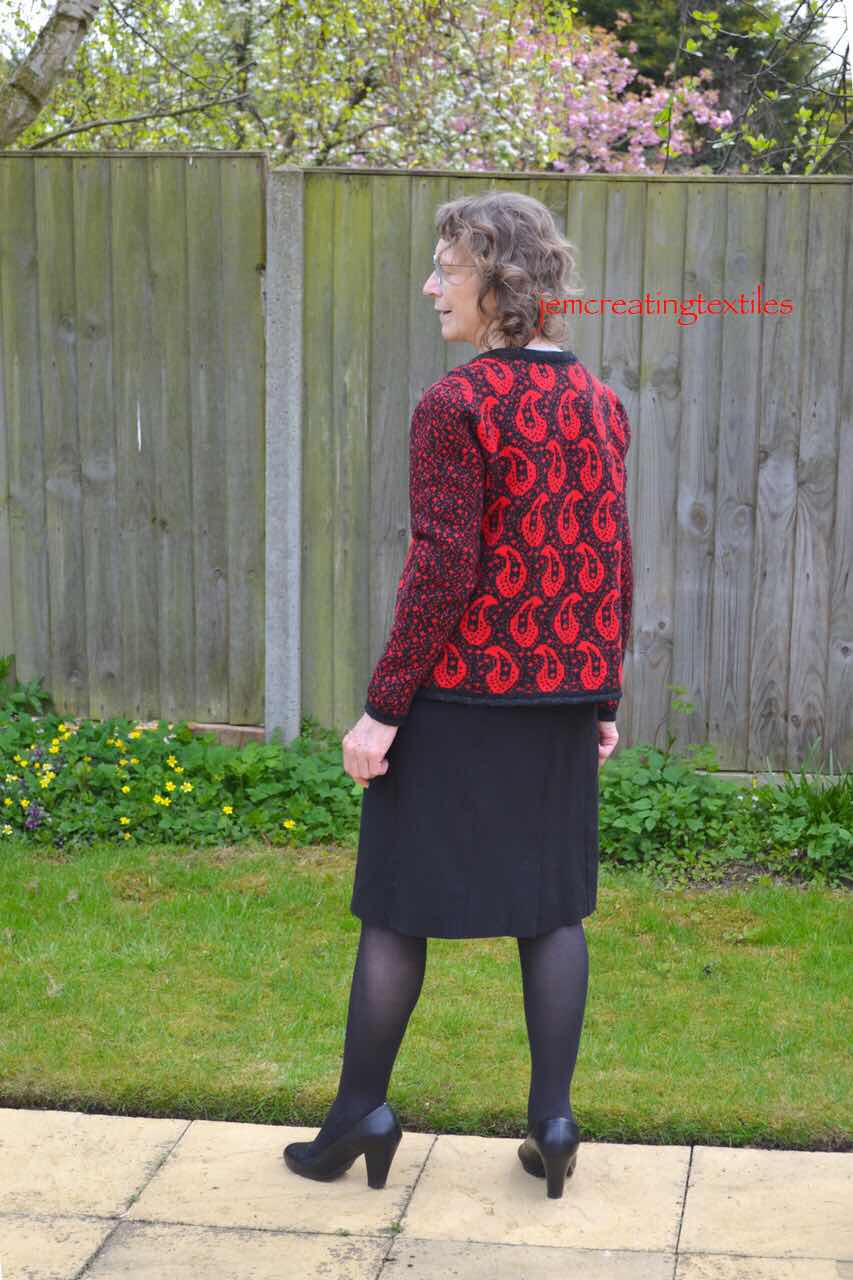
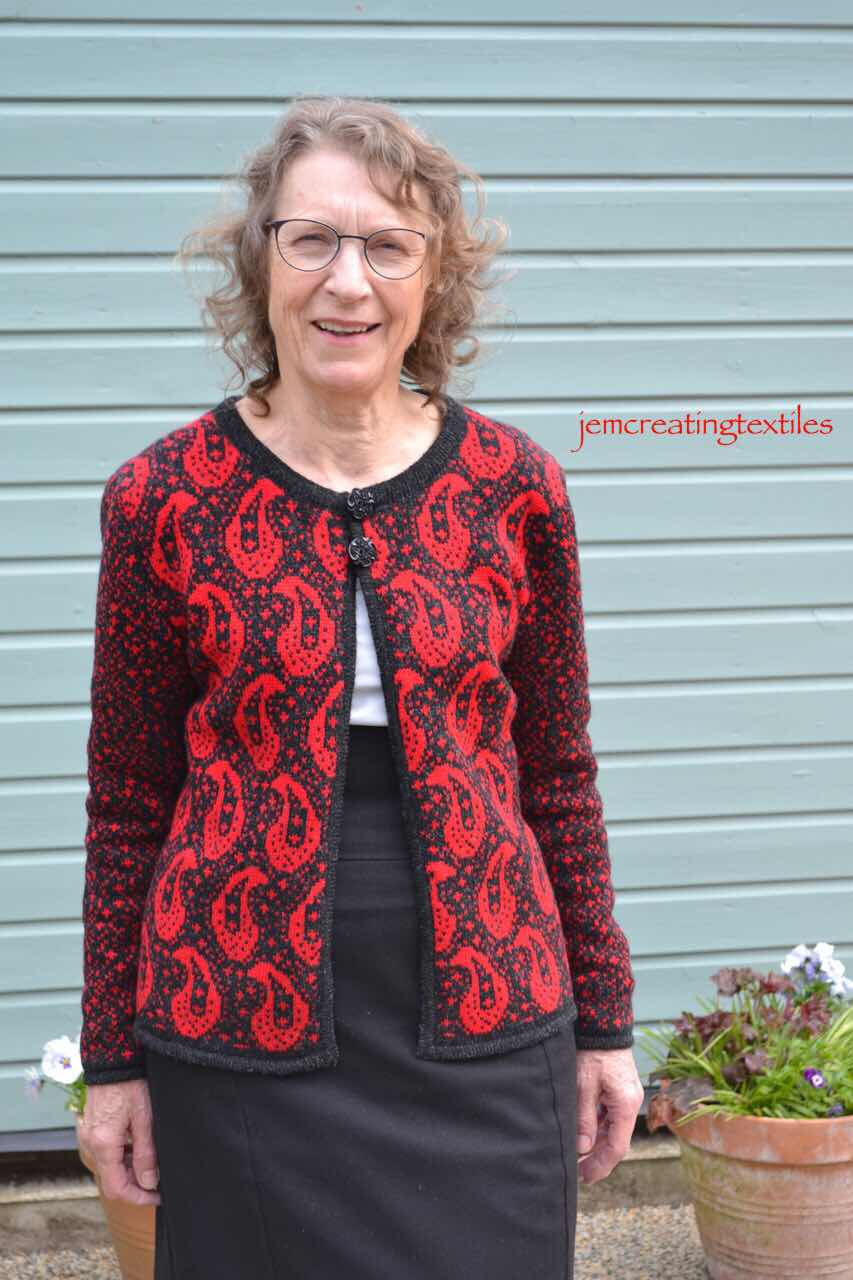
A final press was needed and then to get some photos with me wearing it that I was more or less happy with. Thanks to Michael for being so patient  taking these. 


Overall I am very pleased with this. Now hopefully as we come out of lockdown and get used to a new normal I will get a chance to wear it out. 


The Norwich Red Jacket (part one)

The Norwich Red  Jacket (part one) 


Those of you who read my blog posts  will know I am very interested in Norwich (1) shawls and in particular the Boteh design. (Boteh is Hindi for ‘flower’ it is also called pine cone and today is often known as paisley. ) 


In 2018 I knitted my Art School Jacket using mainly the technique of slip stitch. For yarn I used mercerised cotton and Jamieson jumper weight wool in charcoal. I liked the shape and thought something similar would be good and would suit  the proposed boteh patten. (Post about this cardigan is 15July19). 


I have been doing research into Norwich shawls, particularly their construction.  (This has still to be written up.) Part of the research involved natural dyeing and from this in 2019 I used  madder to dye some 3ply/thin 4ply yarn to be used in Knitting the planned jacket. However, I never got round to designing the motifs to be used as the pattern in the jacket. I was too interested in my controlled dyeing experiments! So the jacket idea got shelved. 

Fast forward to 2020 and Covid-19 and for some reason although I had all the time in the world I did virtually no dyeing. Somehow fine lace spinning and knitting were all absorbing and much better at occupying my mind and keeping it off too much worry about things covid 19 related that were happening in this country and the world. 

I saw and very much liked a knitting kit I saw by Sidsel Høivik. I had never bought a kit previously but I loved the greens. The kit came quickly from Norway and was beautifully packed. After much preparation, described in a previous blog post (9March21) I started the hand knitting.


The start of the hand knitting. I used the cool pink as the waste yarn and when completed I would pick up stitches from the red garter st row and knit an inner facing. The jacket felt very thick to me, but something was needed to pull in the garter stitches. I wondered about knitting a facing inn dinner yarn….but as it turned out I abandoned the project before needing to take that decision. 


This start took me two nights worth of knitting ( about 2 hours per night). I was not happy with it and also I found I could not knit this wool with these needles as it hurt my hands and the following morning my hands had seized up and needed forcing open. (This had happened to me once many years ago and surprisingly I have recently read about other examples of people having similar problems with their knitting (note NOT this kit) too. That was it, I was not going to knit the kit, I had spent a long time organising it to work for me in terms of colour, size and pattern placement and I did beat myself up a bit! However, I resolved to do what I should have done in 2019 and that was design my own jacket. I had the shape, I knew which yarns worked well and ‘all’ I had to do was work out motifs to knit! 


When I thought deeper about the problem with my hands I realised recently I had been using the knitting machine for knitting fair isle  and everything else except fine Shetland lace which I continue to knit by hand. This of course, is much lighter and a shawl can take only 25-50g in total. 


I now had some firmer ideas about what I wanted in terms of pattern and what I did not want. The motif placement vertically was important and because I would knit this on my vintage (or virtually so, date 1974ish) punchcard knitting machine I would be limited to a horizontal repeat of 24 stitches. For me the pattern would also need to match as invisibly as I could make it at the underarm sleeves.


Fortunately I had some charcoal wool left over from the Art School jacket, I decided I would use some finer red yarn that I had and that I could use this double. Unfortunatley the madder dyed yarn was too thin to use with the charcoal for this project.  This decision was based entirely on the hue of the red! 


So the actual design. I had 2 punch cards in my collection vaguely being ‘Boteh. I had knitted one  many years ago using black wool and Jade chenille as the contrast. Then I also had a much larger design in a group of cards that I bought as a job lot! I had some black acrylic and another red that I could use for playing with designs. 


These are how the punch card patterns  knitted up.

The one I had knitted previously hardly looked like a boteh design to me now. 


I liked the other design but it would be too overpowering for me. 


(I pinned these vertically on my samples block board and looked at them for a few days to come to this decision.) It was at this stage  that like I decided on the idea of trying a different pattern for the sleeves. The sleeves would be fitted and not drop sleeves, as this gives a better fit on me.


I was concerned about the length of the floats and at this stage tried out the slip stitch technique. In machine knitting 2 rows of the same colour are knitted, say the background and then the same two rows knitting the foreground (motif detail). I got the design working but decided not to pursue it as this design needs flowing curves which would not be smooth working on the 2 rows main colour, 2 rows background that worked so well in the geometrical design of the Art School jacket. 

Motif being trialled with slip stitch, I got a much better shape with fair isle due to the nature of how the slip stitch technique ‘works’.
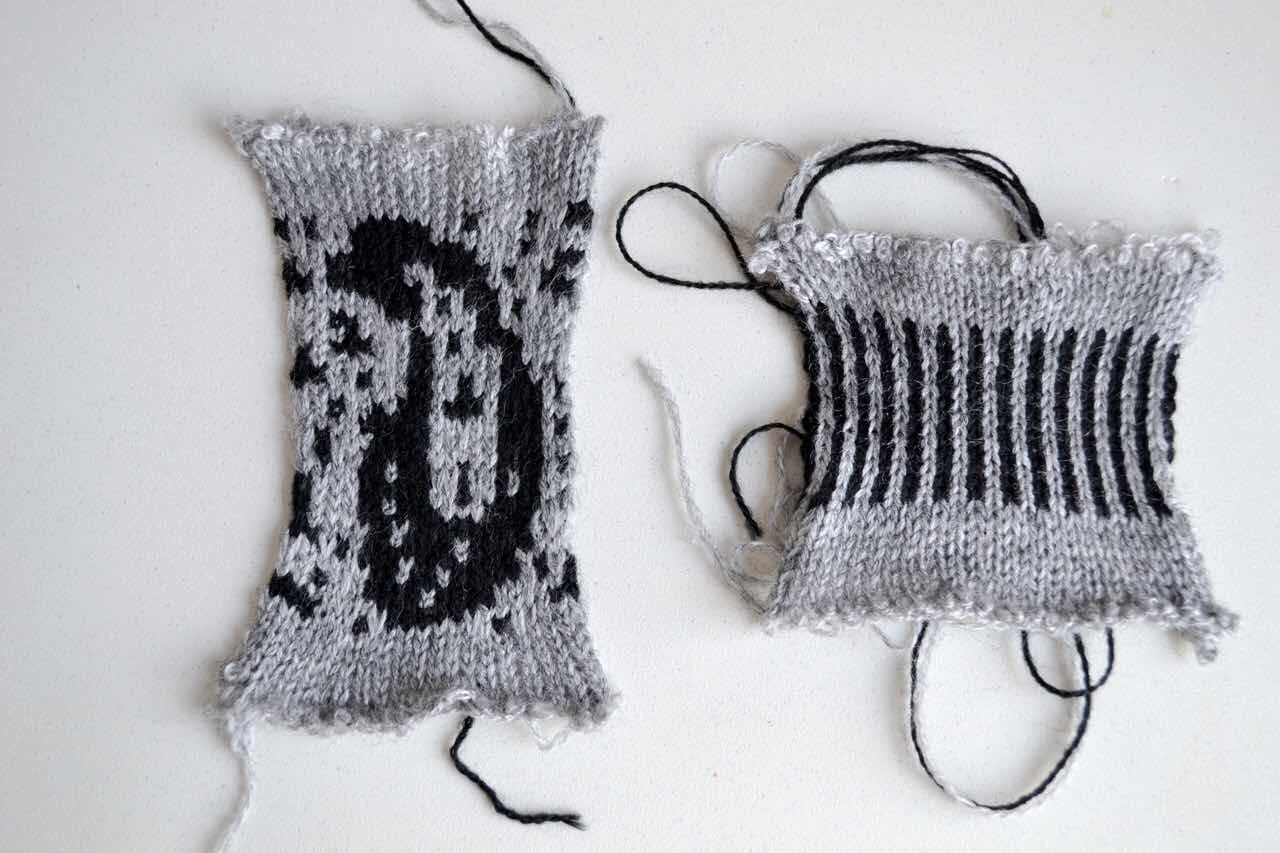


So I then set about drawing my own motifs but being mindful of float length. I knew that Shetland wool would cling to itself and not be too much of a problem with floats if I did not make excessive demands  of it.

These photos show my modifications  in the design process: 

This picture shows changing the punchcard to improve the shape of the boteh on the left hand side and knitting a small section to check.


These show sleeve samples, the one above is the one I used as it had much shorter floats


This picture shows knitting samples to check the vertical placement and horizontal match ( side seams and front) of the motifs


Continued as part two.


  1. We are fortunate to live about half an hour by car from Norwich and more can be seen about the shawls on my website( link top right from blog)  by looking at Weaving  and then choosing the Heritage Weaving section. 


Saturday, 24 October 2020

More about Norfolk 2 : Sea Palling


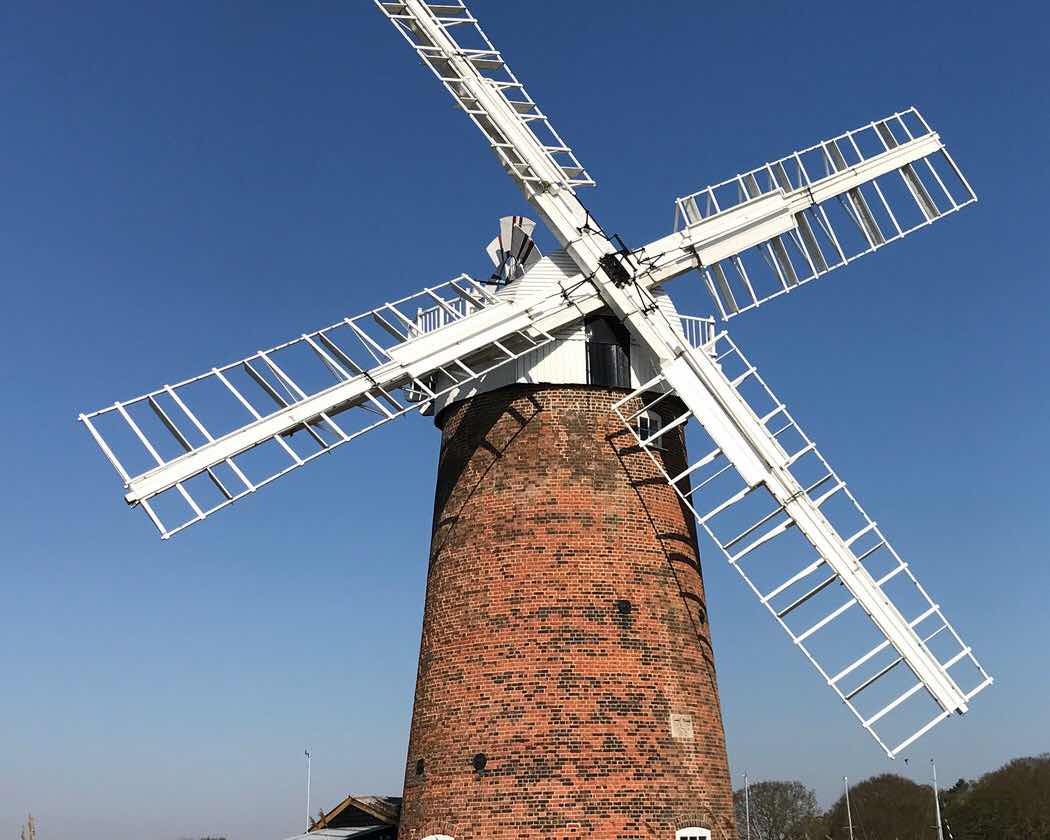
Last Thursday looked like a good day to go to the sea, but we began to doubt this as we drove round Norwich. There was a cloudburst but fortunately traffic is usually fairly light and we kept our nerve and continued to the East Coast. By then it was bright. First stop was at Horsey Windmill where we had coffee and cake.


We had cake and coffee with us,  but it was good to see the National Trust little coffee shop was open. This great windmill is worthy of a post of its own later. 


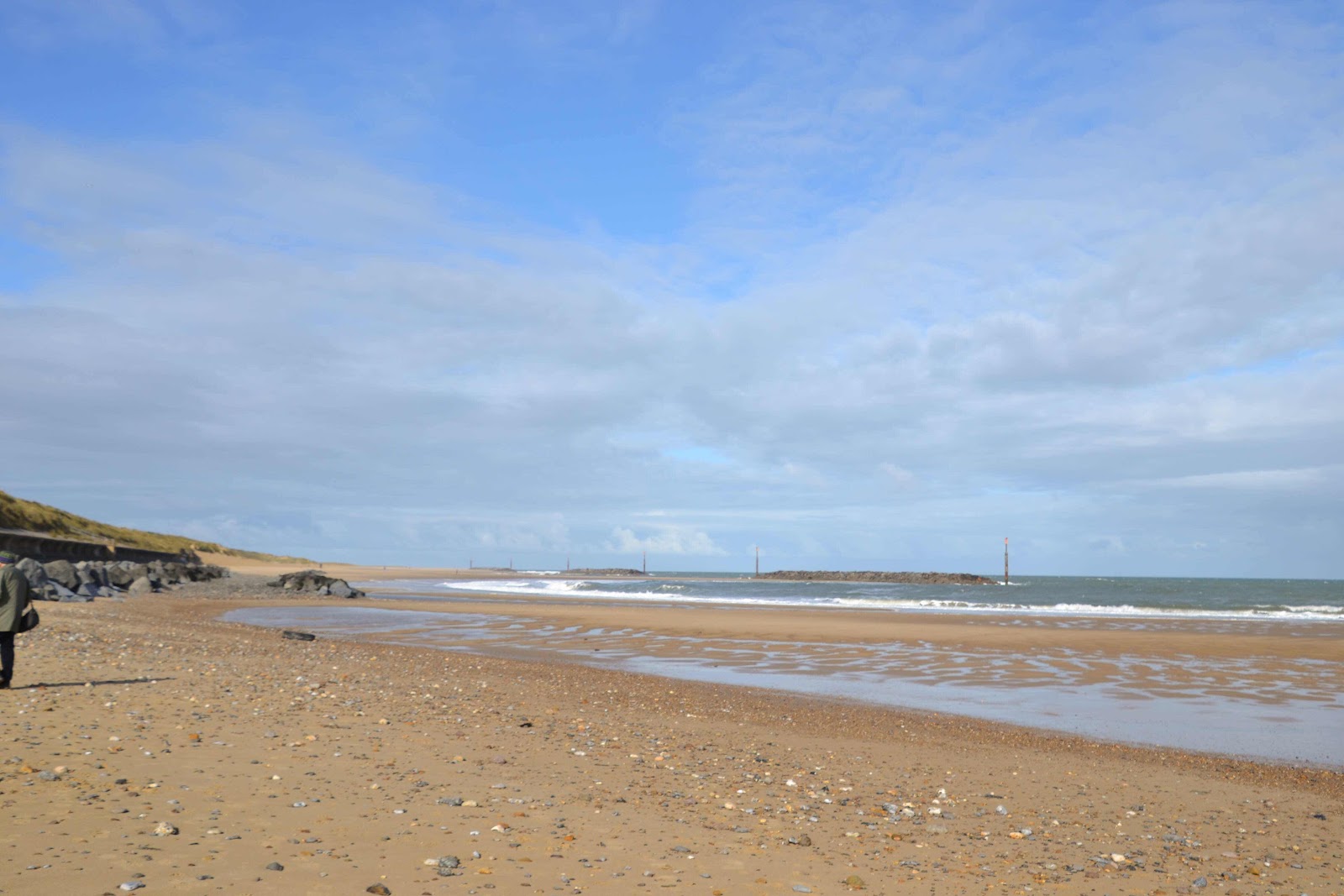
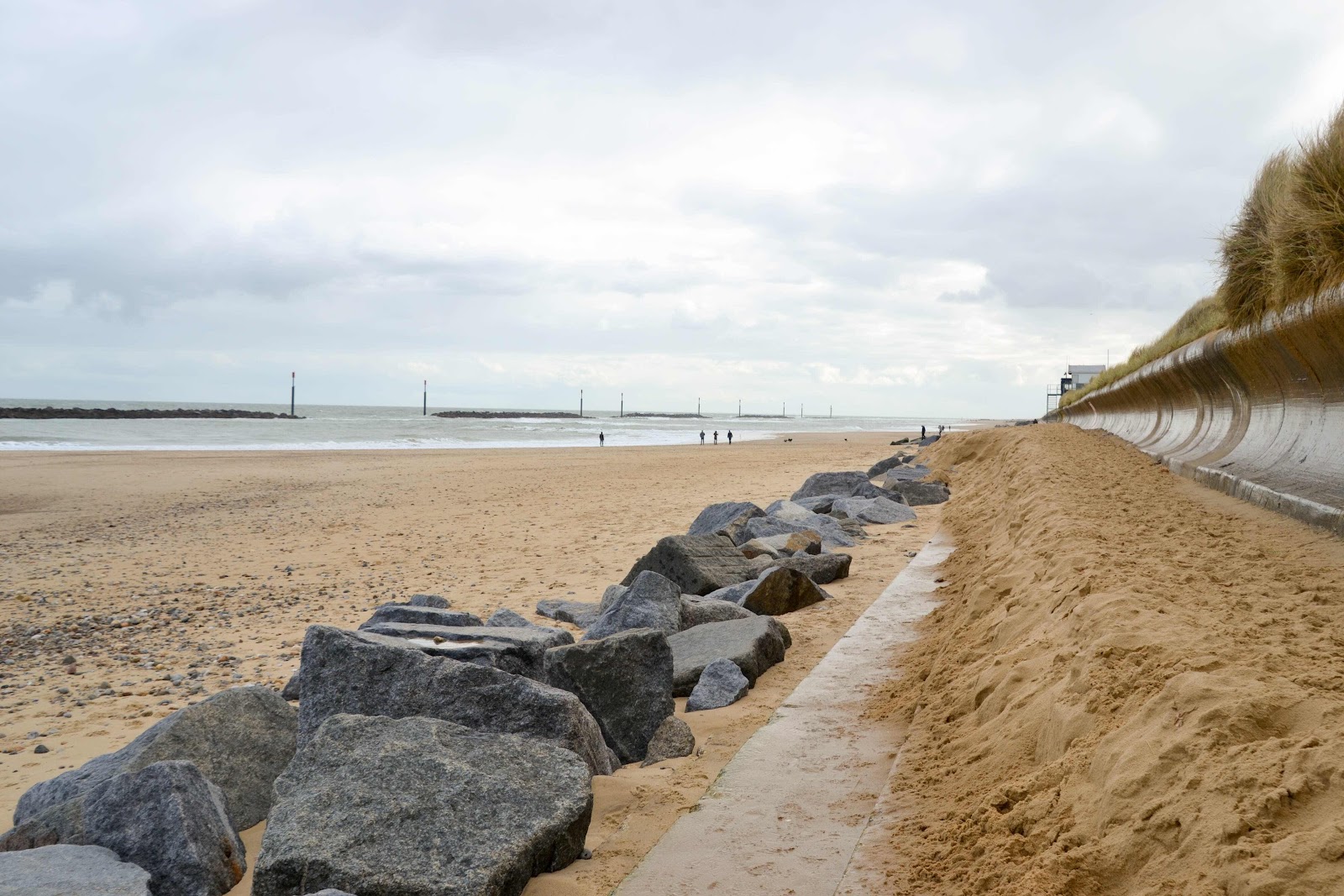
We drove on and aimed for Sea Palling (1)  not a beach we go to often. It is another of Norfolk’s  ‘big skies, big sandy beaches’ and just the place for a brisk walk to blow away the cobwebs and recharge the batteries. I remember stories of my father cycling there (approximately 40 miles each way)  after the 1953 North Sea Floods. Sadly 7 villagers from the area were drowned. 


The beach is characteristic as it has 9 giant reefs made of very large rocks to try and halt the erosion of the beach  and protect this small seaside community. 


Michael walked on ahead, trying to keep a good pace but as I had the camera with me I could not but stop and take photos! 


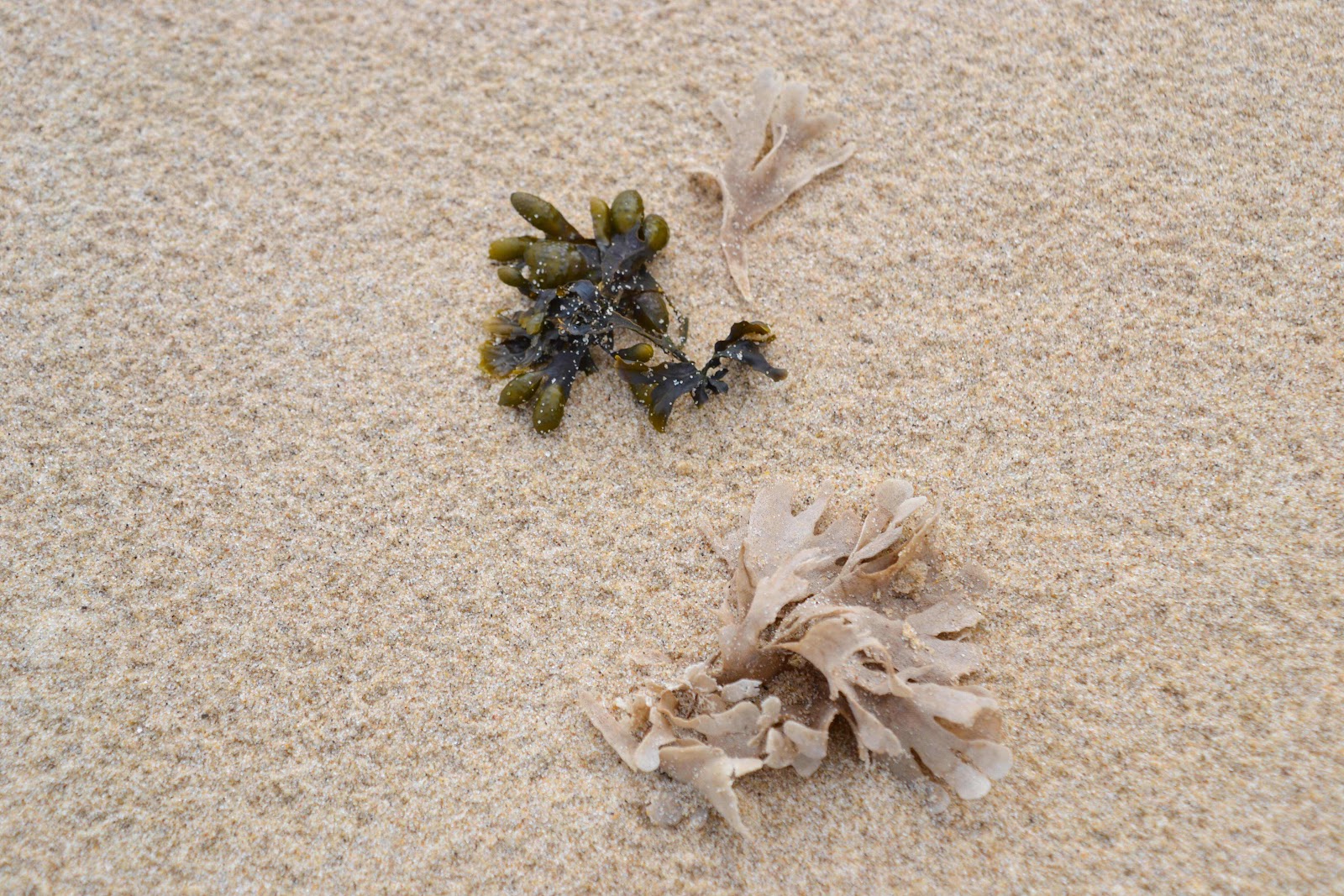
Composed by the tides, this shows a bit,of seaweed and actually a couple of colonies of animals! The lighter one of the three is Hornwrack, actually a group of Bryozoans, rather like hydra, each in their own little space. Not sure I was taught that until University! Hornwrack can be mistaken for seaweed, and strangely enough I saw that error on iG  only a few days ago. 


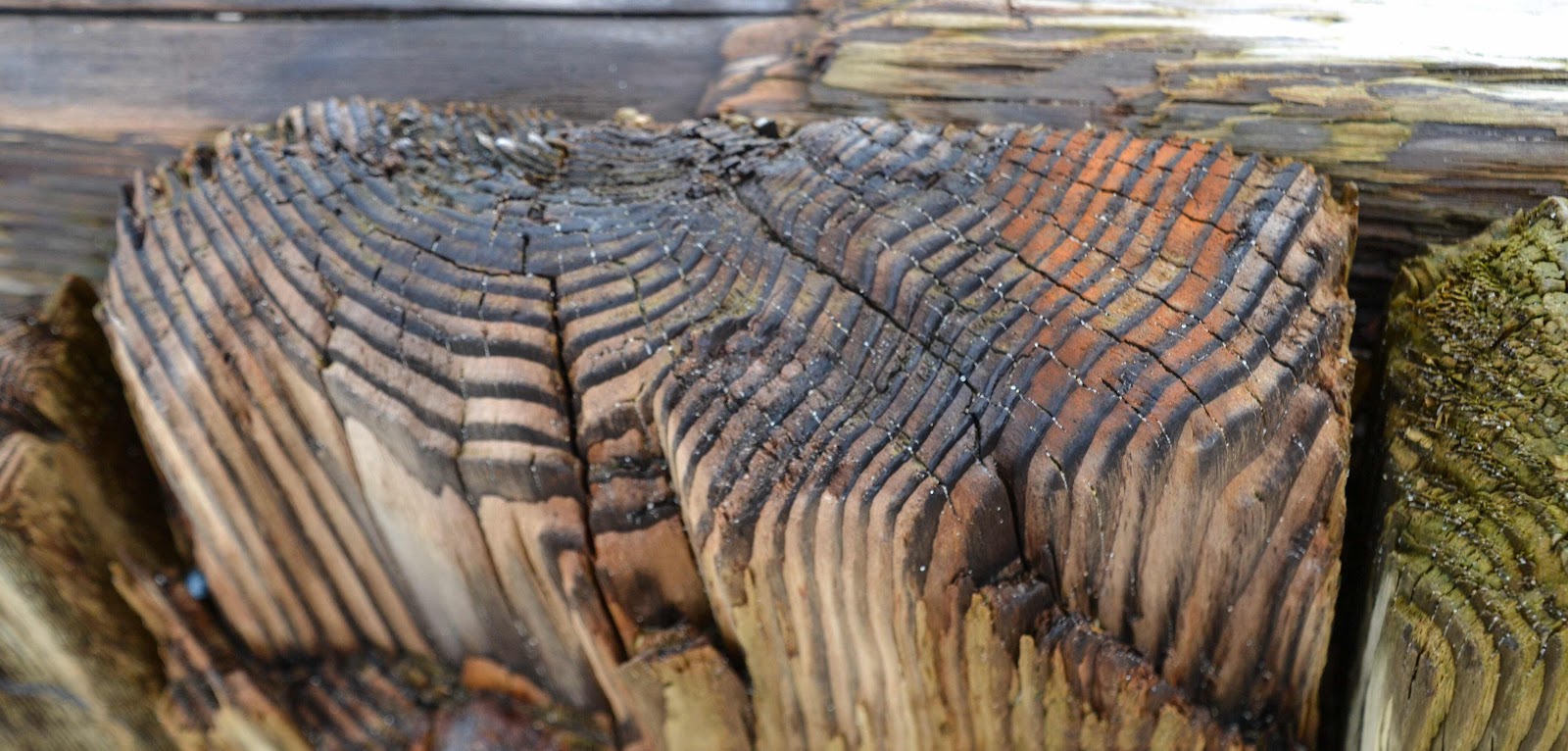
I’m always on the look out for textile inspiration as these two seemed to fit the bill today. 


Unfortunately I was behind one of the piles of large stones on the beach and suddenly noticed the tide coming  in much closer, I could not climb out easily on the land side, and had to put on a spurt to catch Michael up. All that watching of the tremendous  work done by the RNLI in ‘Saving Lives at Sea’ should have made me more cautious. 


Sea Palling like many of the Norfolk coastal towns and villages has a lifeboat station. This one however Is now run by volunteers and unusually funded by local people. It was set up in 1840  by private funds and the RNLI funded it until 1931 when it was closed down. It was revived, again by private finance in 1974. 

So what began as a day out to take sea air has led to far more, research into the heritage of the area, respect for those that live by it as well as textile inspiration. 


Notes

  1. The history of the village dates back to the Domesday book when it was called Pallinga. Notice no reference to ‘Sea Palling’ as it was not by the sea then! To me, the entry there is particularly interesting as it notes 71 sheep which is quite a lot. The area of the village was 3c. I understand ‘c’ to be a carucate- the area of land a plough team of 8 oxen could till in a single annual season. Further investigation looks like this area equated to about 120 acres. Ref Phillimore edition of the Domesday Book. Norfolk was lucky it belongs to the Little Domesday Book series and hence has more detail than the earlier counties surveyed and we have a copy of the 2 volumes, fortunately the original Latin and the English Translation
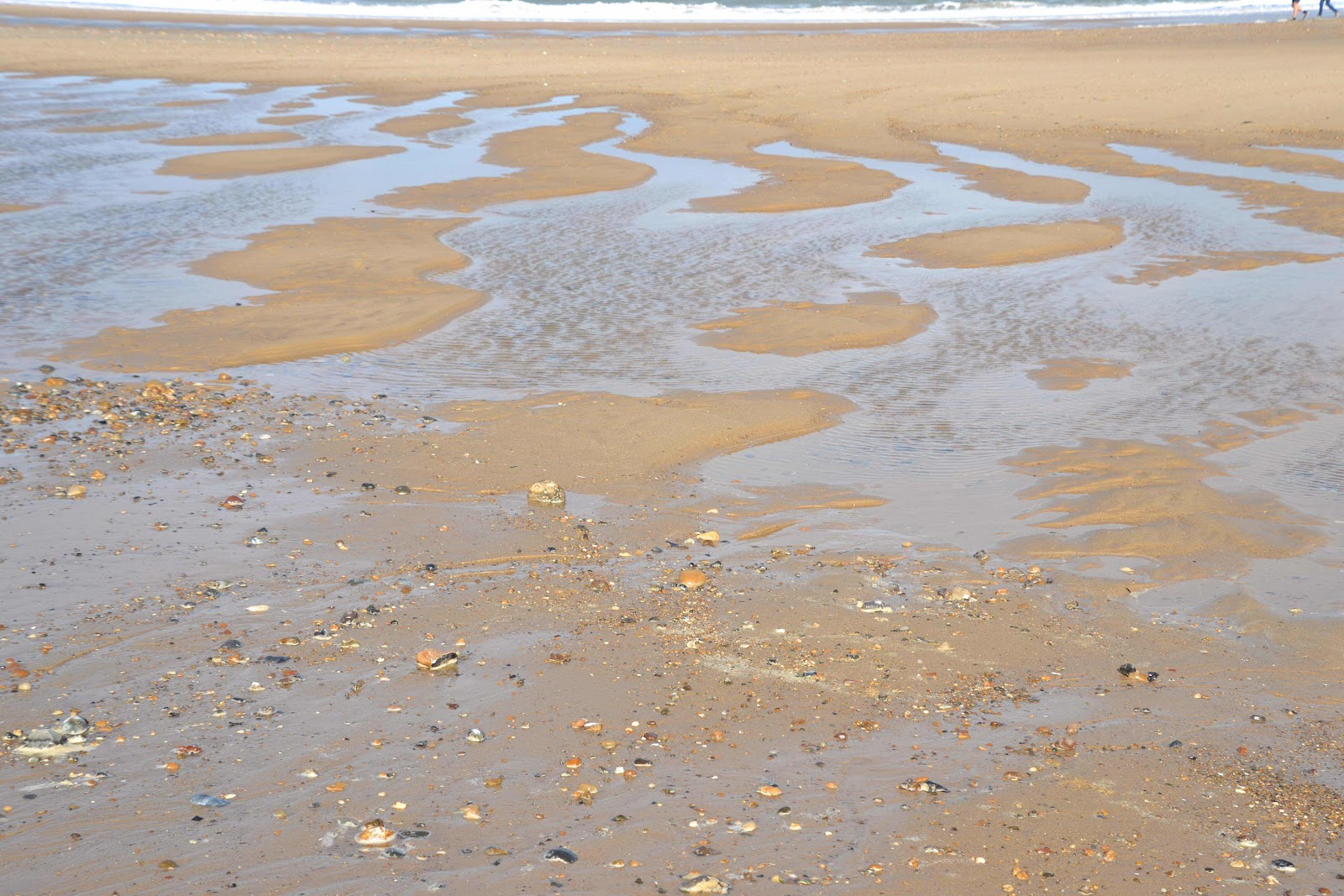
  2. This shows how the barriers affect the beach shape due to diffraction as the sea hits the barriers. You might need to move the photo along a bit to get the full effect. It is a bit more impressive than looking at waves in a ripple tank in school physics https://www.bing.com/maps/?v=2&cp=52.788763840321245~1.6073888540267944&lvl=16&sty=h&eo=0

Monday, 6 April 2020

A classic jumper

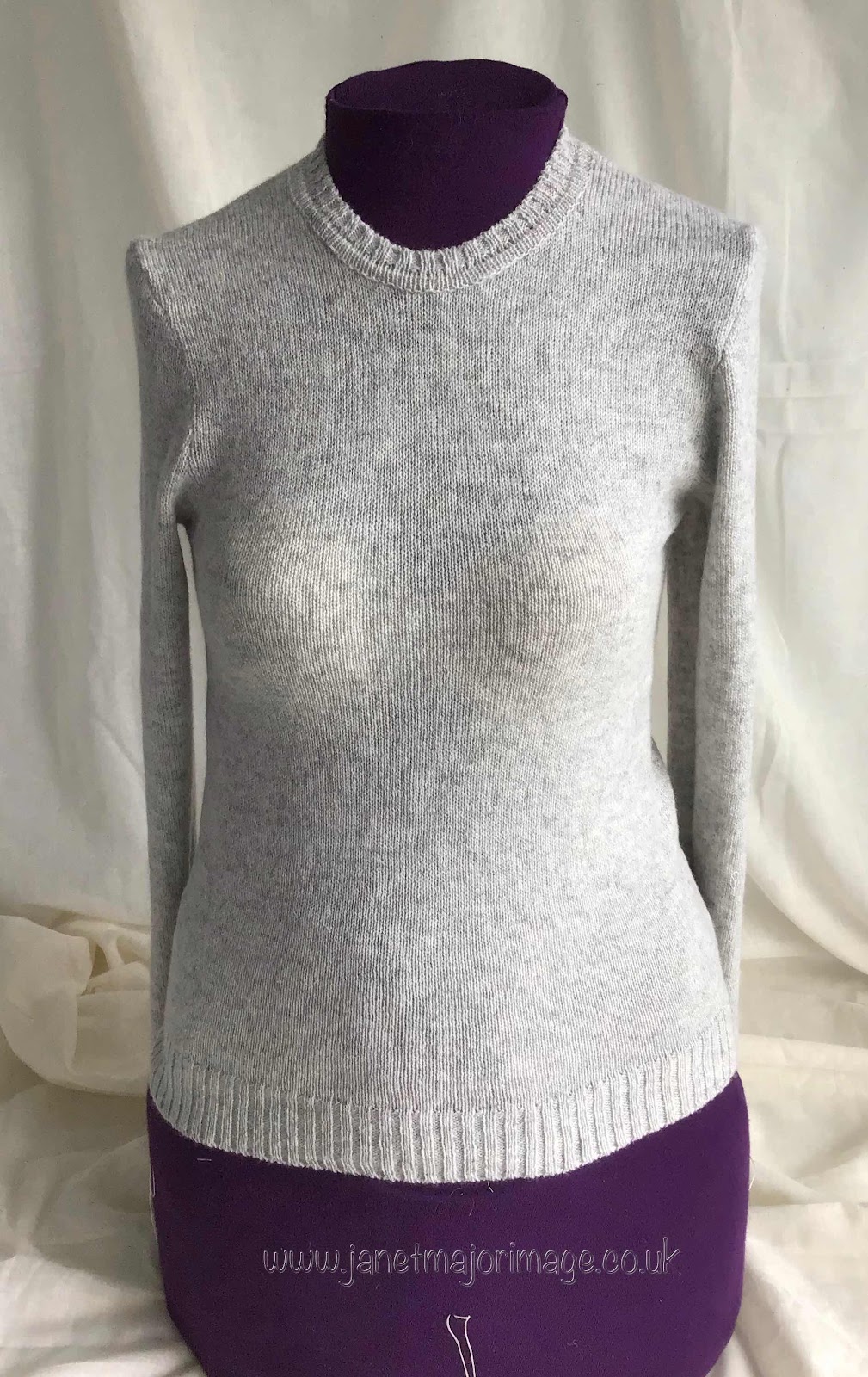
I like to have some basic, smart, fine wool, knitted jumpers that I can layer more interesting knitwear over. For several years I have had a couple of cream ones, that I machine knitted in Yeoman polo fine merino wool. These have been washed many times and just keep on looking great. 

I decided I needed some grey ones, finding just the right shade of grey was problematic but eventually I found a grey colour that I really liked - it is lambs wool  in 2/ 17 colour Pearl Grey. It comes from Uppingham Yarns as a cone of approx a kilo, mine was 0.970 g. 

I drafted this pattern some time ago. It is very simple and has fitted sleeves. 

However, being plain and very simple there is nowhere to hide. Any slight error sticks out a mile. 

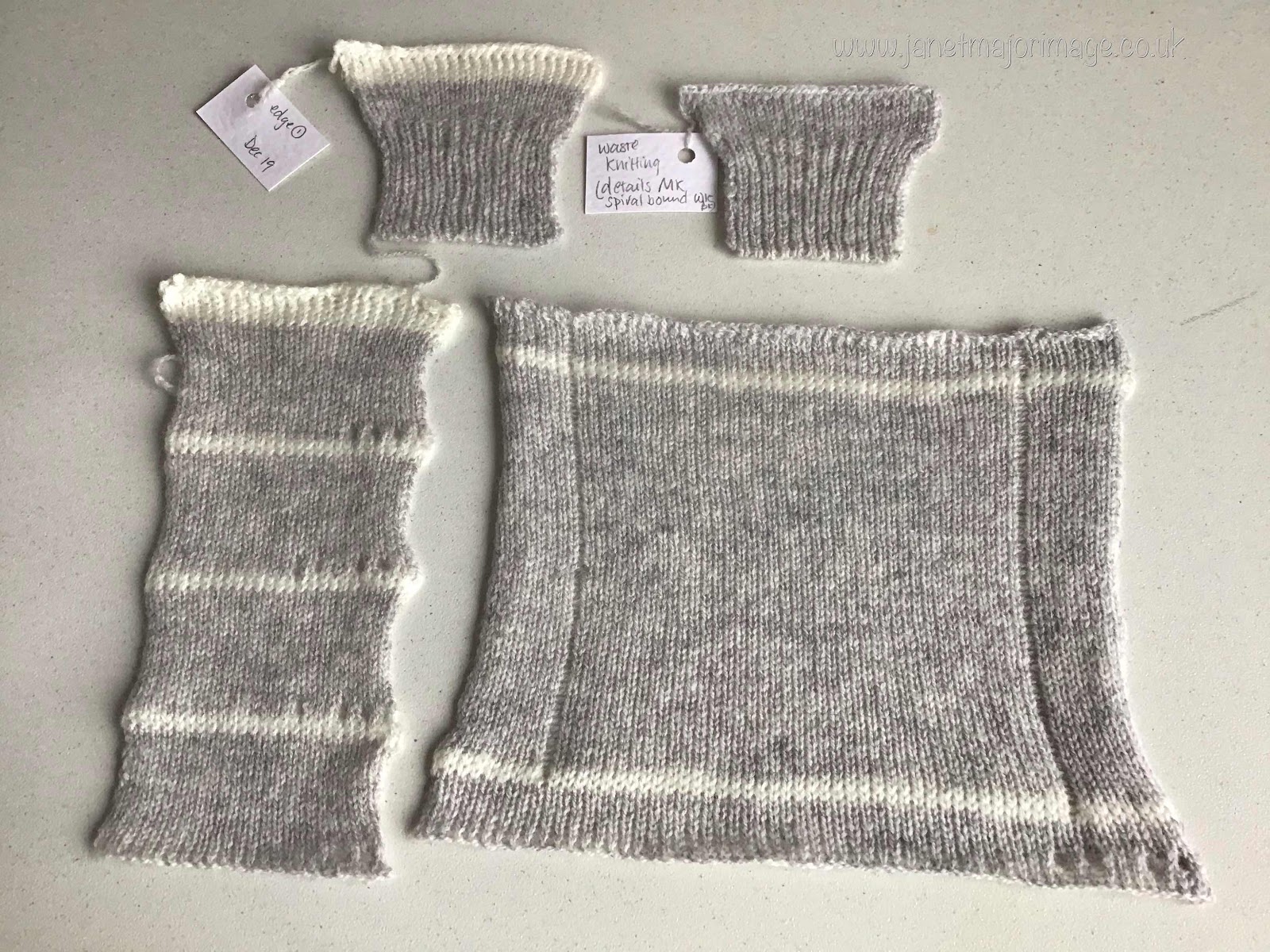
These are the samples I knit before I started. I was looking to get a good edge to the rib and a suitable tension. Hence the strip and then the square to get my measurements for stitches and rows per inch. 


Knitting went to plan. (I have described knitting using my knitting machine elsewhere on my blog)

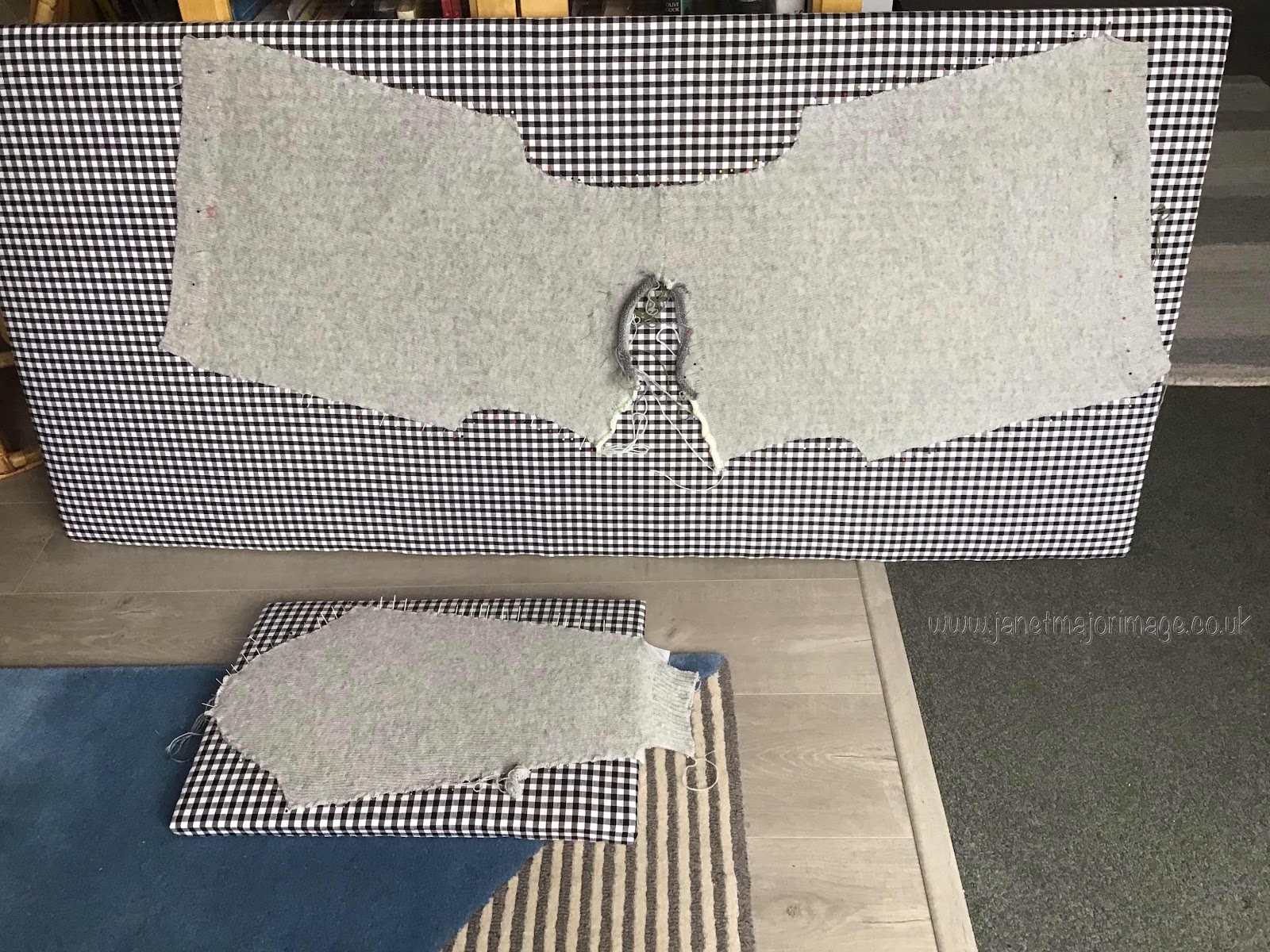
Blocking the pieces ensures that they must fit me, with no nasty surprises like the sleeves are too long or the jumper is too short. 


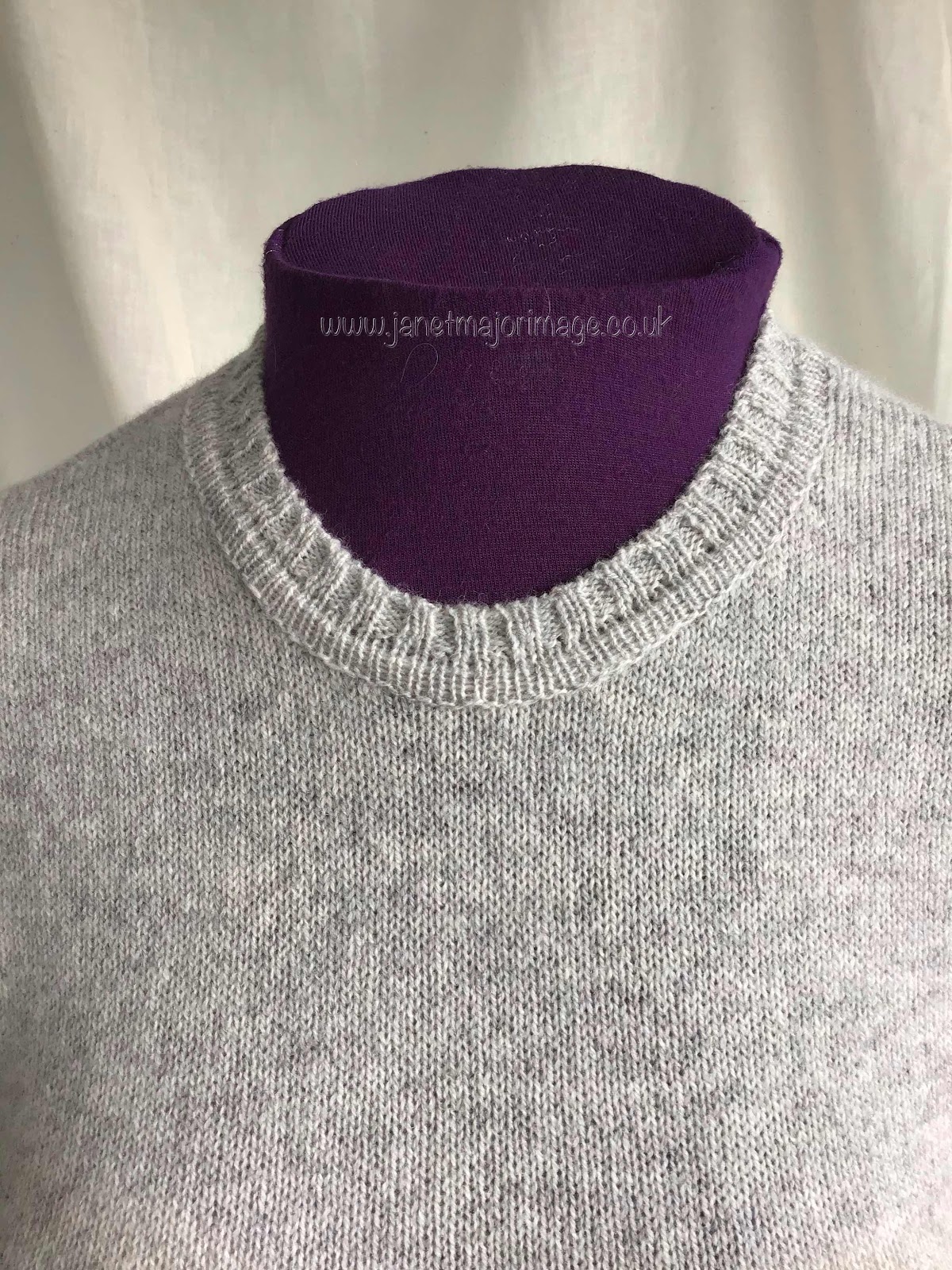
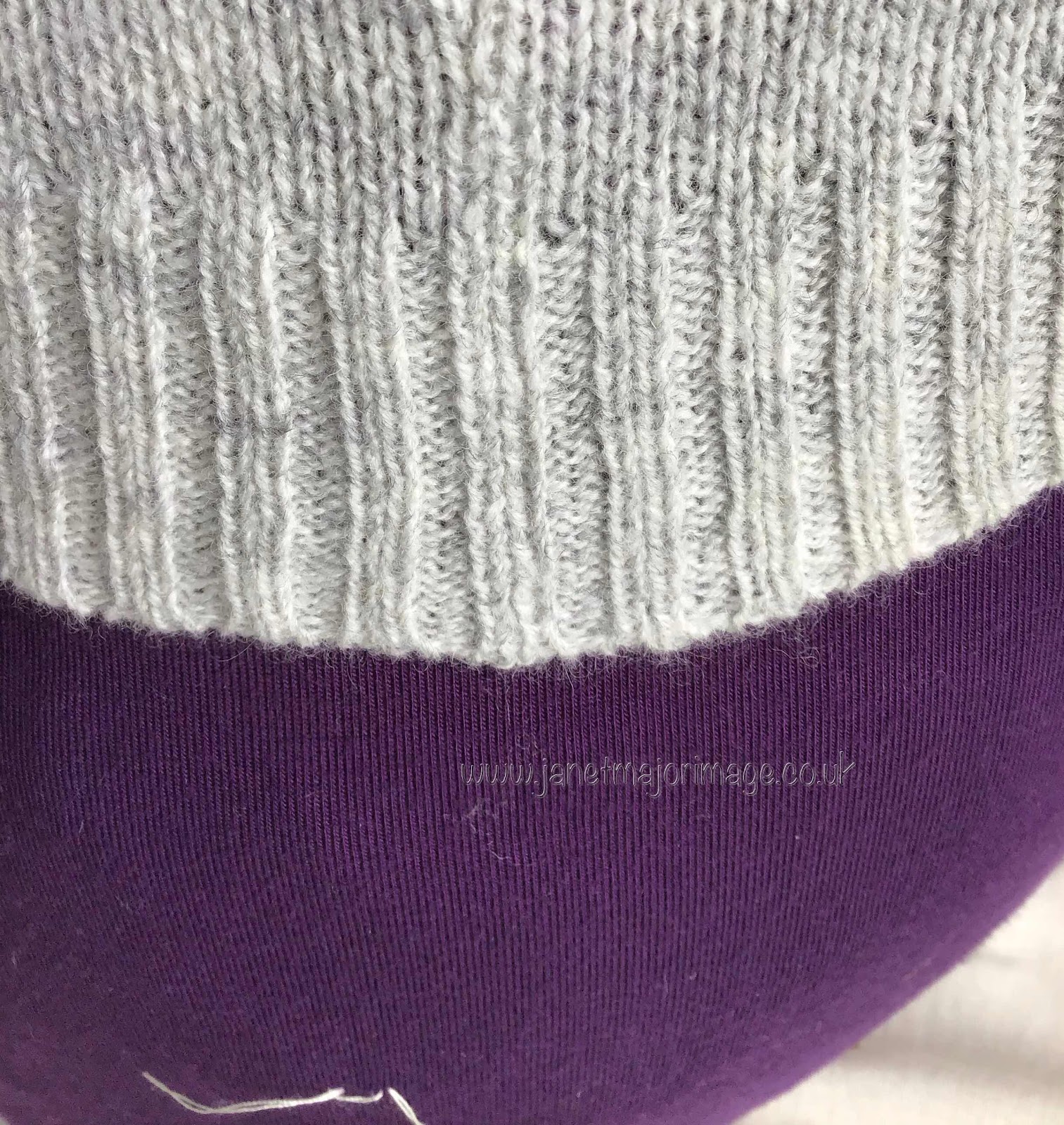
Initially I used a single 1x1 rib for the base of the back, front and sleeves. The neck is done by the ‘cut and sew’ method that I use. 

Cut and sew neck


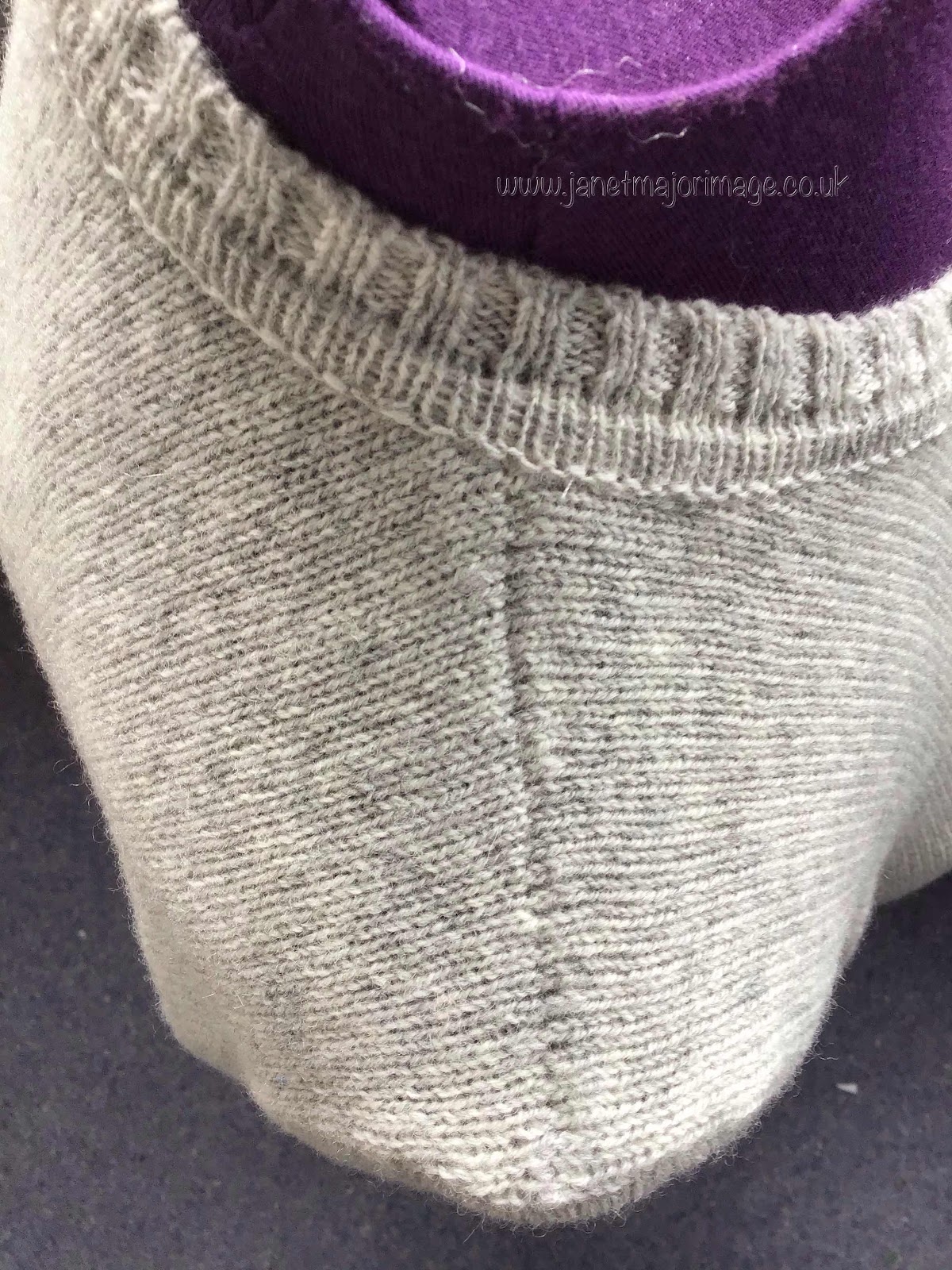
I join the shoulders on the knitting machine 

Shoulder join 


Other  seams  (but not ribs) I sew with my Janome sewing machine. The ribs I stitch together from the outside to get the best match I can with no visible  joins. 


The jumper weighs just 150 g and I finished this first one before Christmas. It has had good wear and is still looking ‘as new’. 


I decided that I couldn’t better this design or colour so I have just knitted another. Version 2 has 2x1 ribbing at the base of the body pieces and sleeve. 


Mattress stitch ribbing 


The completed jumper 

I love how the sleeves fit and I love this yarn. 


Jumper v2 complete 


Yet again the 30 year old plus  Brother 830 Knitting Machine delivers. 

So only 300 g of yarn used , 150 g per jumper and 670g left. 


Tuesday, 17 March 2020

Pink Lace Cardigan


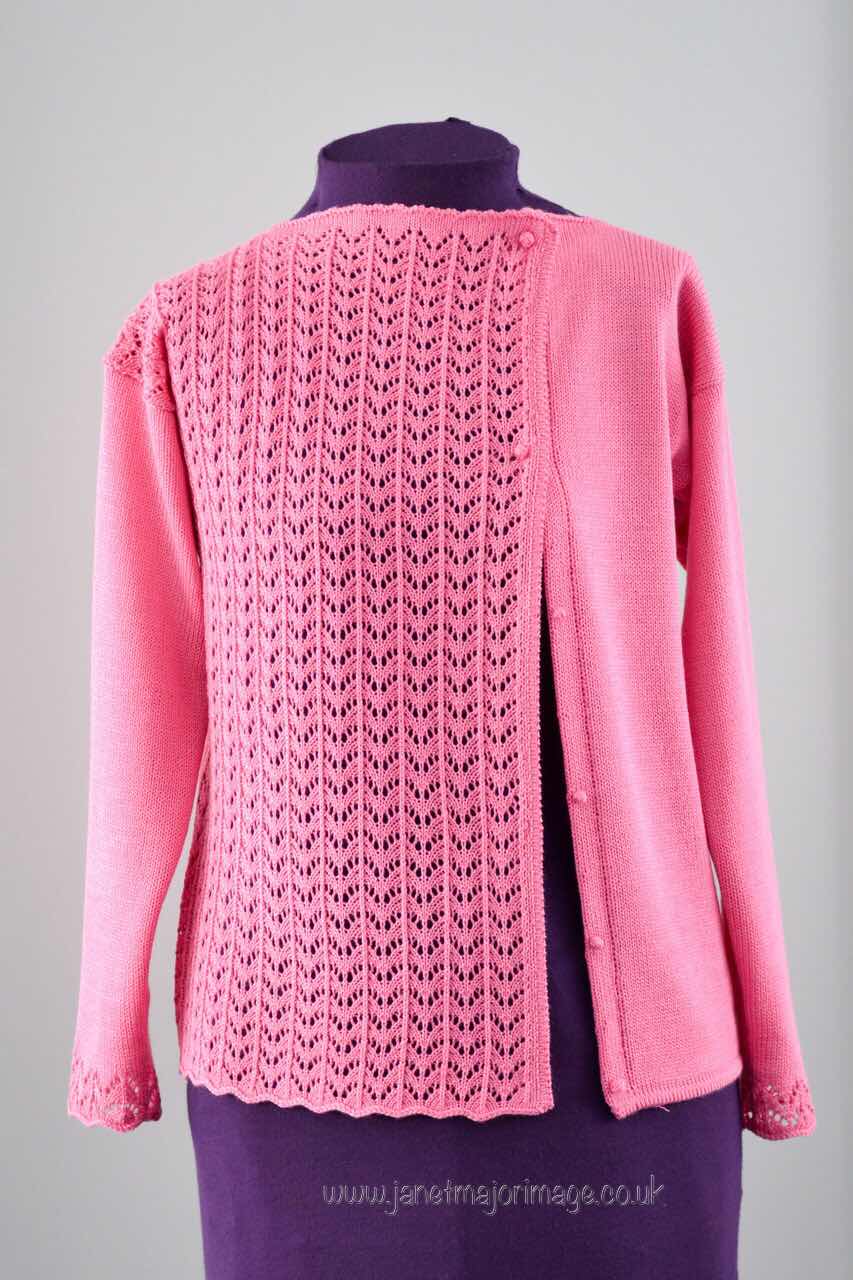
In 2016 I took a course at Metropolitan Machine Knitting, Cheshire (now sadly closed due to ill health). This course was with a superb visiting Designer from Perth, Australia called Tony Bennett who runs Domani Knits (1).


As the week progressed we were encouraged to take one of his Designs and work it our way, aiming to complete the garment during the week. I chose to make a cardigan with a lace front and some lace at the base of the sleeves. To me, Tony is into detail, his garments have great finesse.

I loved how professional looking this cardigan turned out to be and I have received many lovely comments about it and have shown people how to do some of the details.


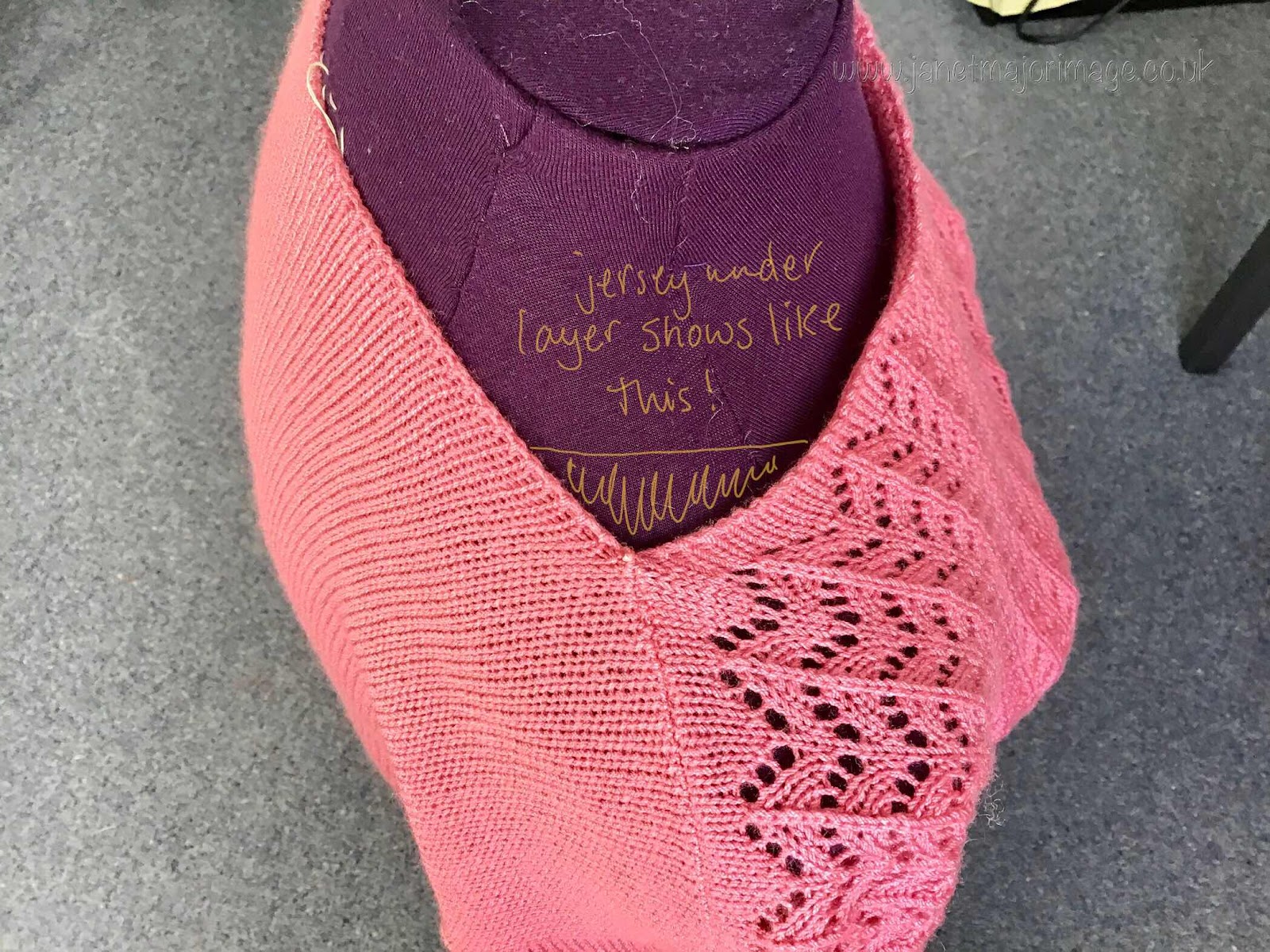
However, the cardigan has always bothered me on the shoulders. The cardigan needs a layer under it, eg a fine jersey top. The jersey top was visible where the back met the front at the inner shoulder. I have worn it with a fine polo neck and that didn’t feel quite right to me either - polo knit and lace over it was not my best look. 

I have spent some time thinking what I could do to improve it. 

This is the before look: 


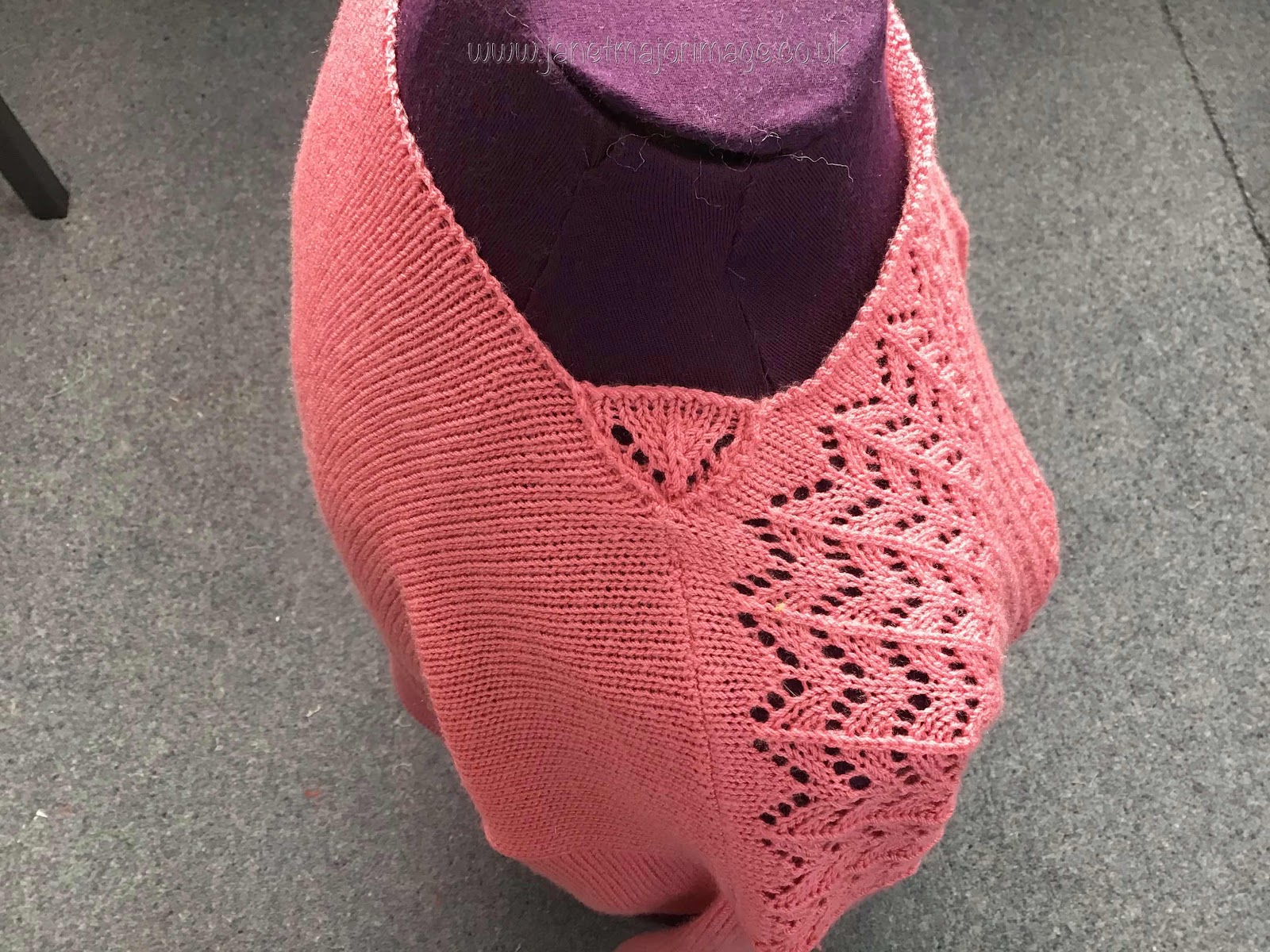
What could I put in the gap? I needed a little triangle. So I mulled this over and decided to knit just that a little triangle. But wouldn’t it be better if it was one of the lace triangles, like at the bottom of the sleeve.


Knitting this was tricky, working out the stitch width, making sure the tension was right and manipulating the stitches when there were so few.

This is the result. 


I am more than pleased with it and now the cardigan has a new lease of life, just ready for the spring weather. 


(Apologies  for the change of colour, the first picture is the best representation!) 


  1. Tony’s web site is https://dormani-yarns.com

Saturday, 25 January 2020

Shetland Wool Week 19: 16 Mood Boards and Machine Knitting

Friday Oct 4:Day 19 

Today I was taking my last class of wool week and like yesterday’s class it was one I had been hoping to take for some years. The American lady I chatted to from the table next to ours last night in The string had taken the class Thursday afternoon. She was very complimentary about it and if anything, over breakfast, I was looking forward to it even more. 

We were up and about early as M was going to drop me in the middle of Lerwick at 9.00 and then drive back and park at Tesco. He could pick up bits and pieces we needed and walk back to the Health Centre to have another INR  test. 

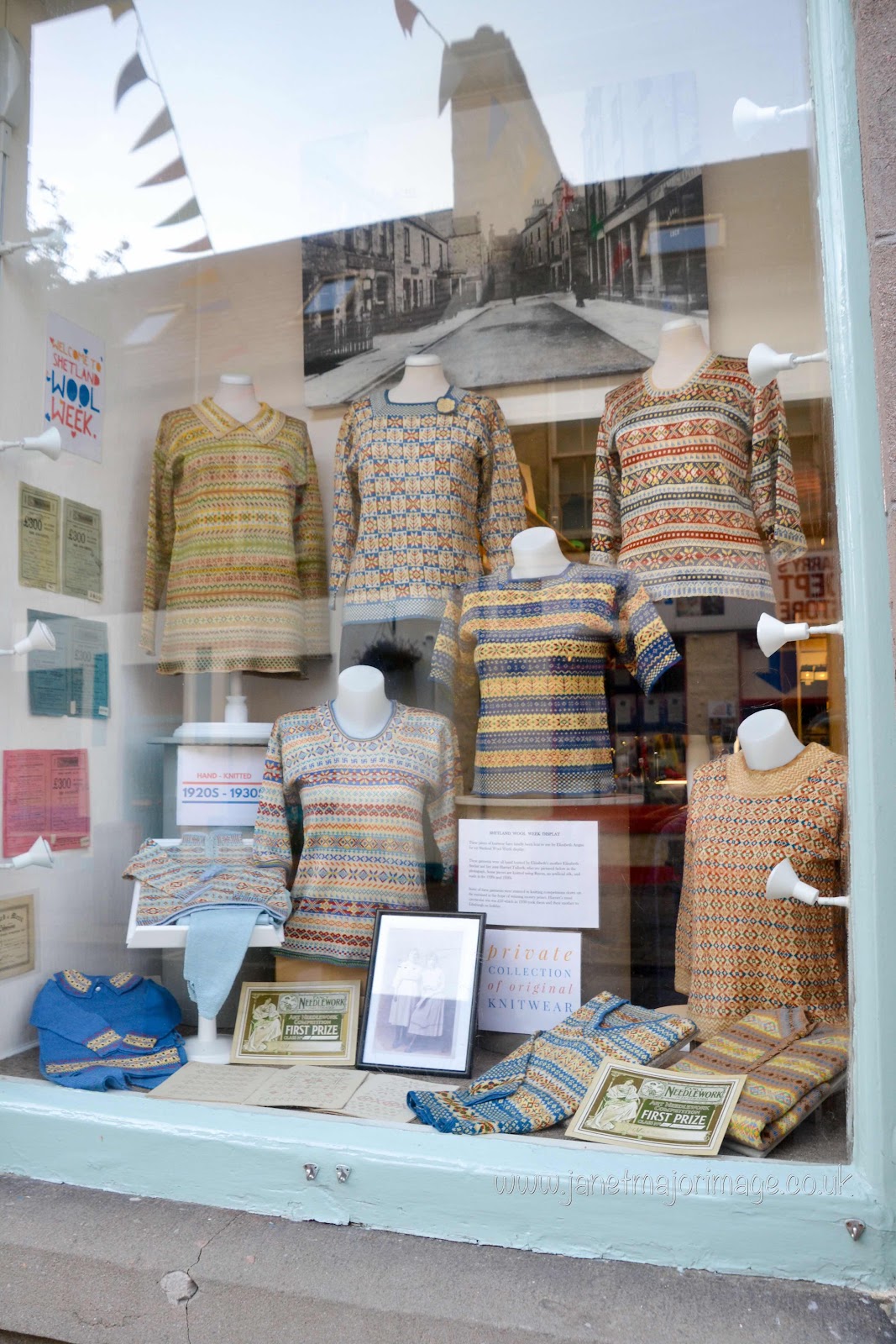
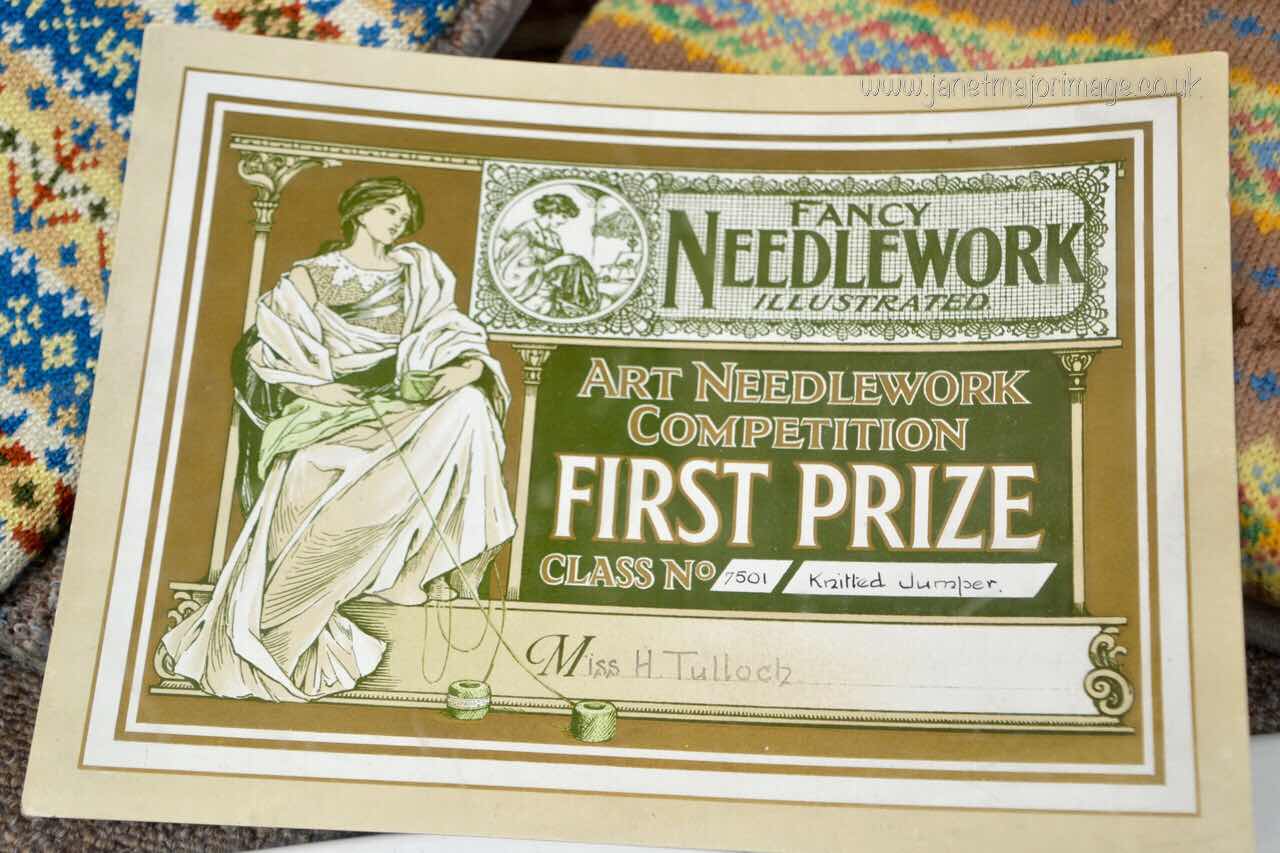
I took the opportunity to walk up the town (North) and spent some time looking in Tullock’s window. This was like looking in a Museum as on display were a selection of jumpers that had been knitted around the 1920s and 1930s and had been lent by Elizabeth Angus.They were very interesting as many were knitted in fine rayon, many had fantastic finishing details and many had won knitwear prizes and they were in great condition. (1)


The window, apologies for the reflection! 


One of the prize certificates. 


It is so lovely to see shop keepers getting into the spirit of wool week and pulling out all the stops. Again looking at these was free and something any visitor to wool week could do. 

My class was in Ninian in Joanna’s  upstairs workshop. This is quite small  and 4 of us sat round a table with Joanna standing. It was very much a workroom and it felt good being in there.(2) She is very enthusiastic about what she does and still had bags of energy left on Friday. 

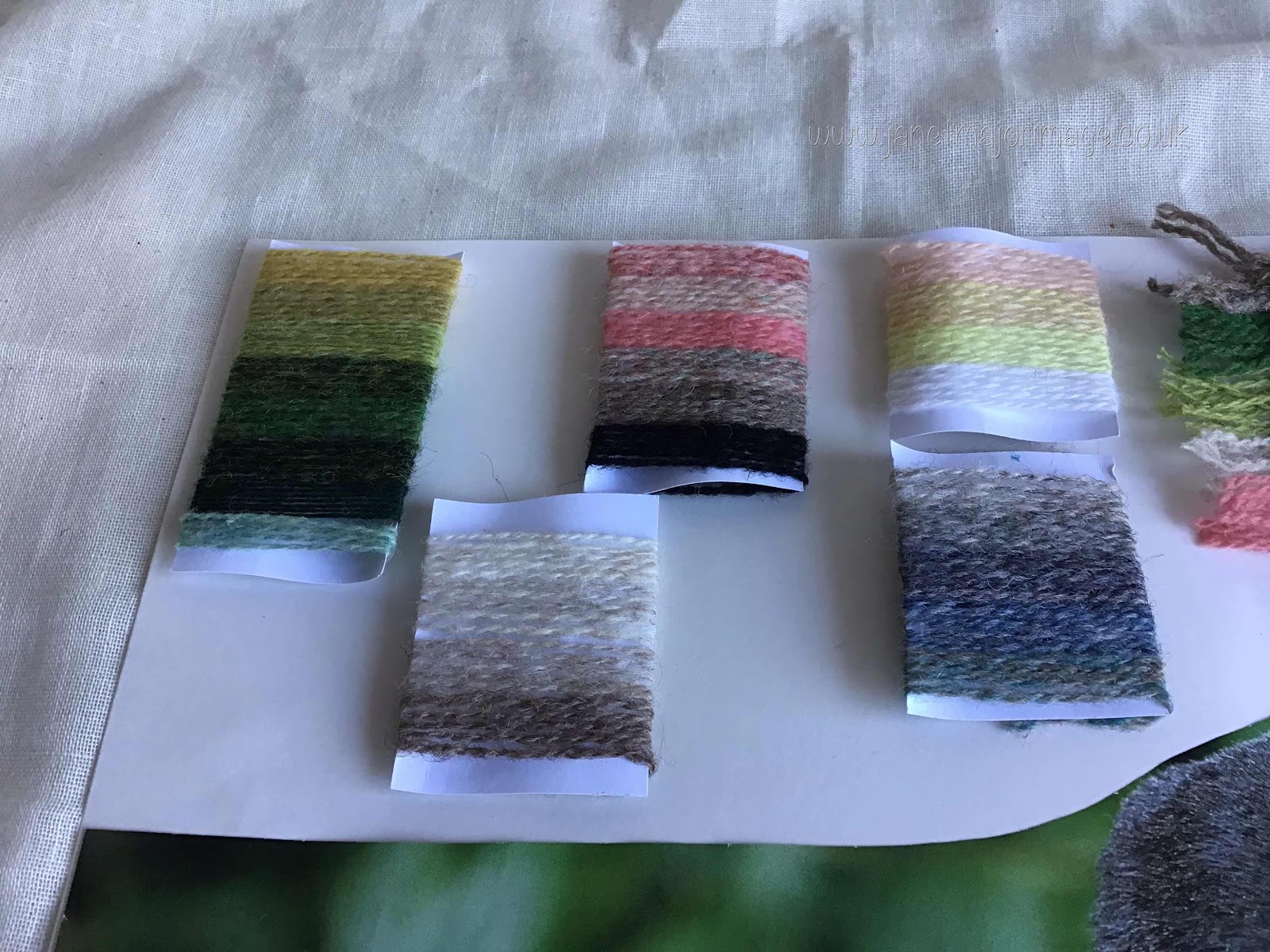
What was great was that she had the whole set of Jamieson’s yarns for us to select from. These were in the Spindrift range- that is a lot of yarns and they weren’t just samples they had started as whole balls of yarn. (This is important, I have the shade card but having more of the sample colour makes such a difference.) Joanne wanted us to work outside our comfort range of colours- I found this the most difficult part of the class. 


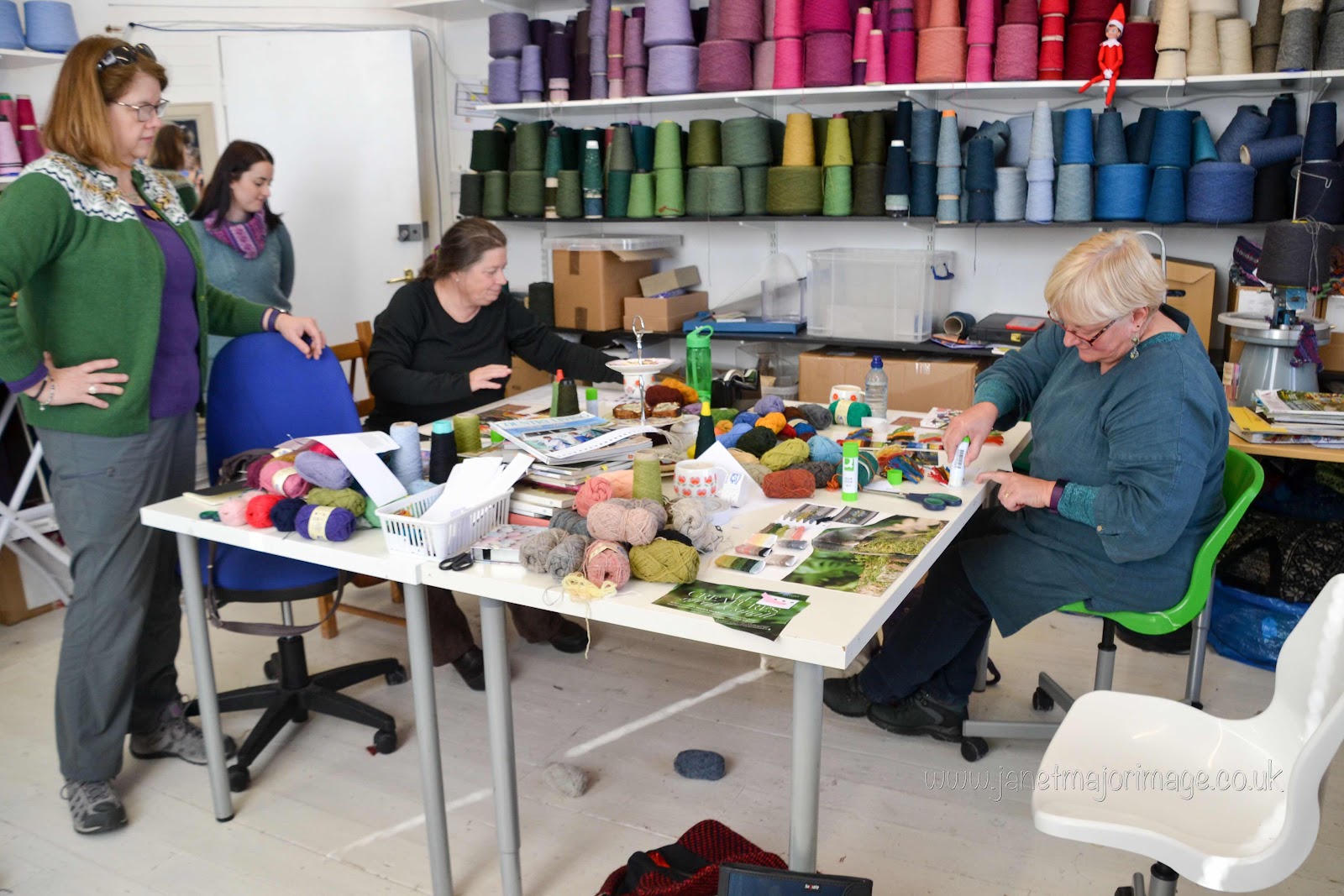
She began by talking about her background in designing going right through to making the finished machine knitted product. She talked about  where this had taken her geographically and also gave real gems of tips. Then it was our turn! We started with a blank sheet of A3 paper and guidance as well as one to one encouragement and motivation to stretch our capabilities. Then there was the selection of a working palette. 


The final treat was to see these mocked up into a working design, using DesignaKnit which I had heard of, it is used by some machine knitters. I thought (wrongly) that it was just about designing shapes but was more interested in it when I saw how it could put colours together and then switch individual colours at the press of a button (or two). Seeing our colour choices  added into a charted pattern was great. The class ran over. The cake and drink were superb and the time went too quickly. It was a great class to end the week on for me. 


I met M who was anxious as I was so late. (I need to eat regularly and often to avoid migraine) so we drove down to Mackenzies, our usual second breakfast venue. Although  it was busy we managed to find a space to eat, along with other woolly minded people. The bonus was M got chatting to a birdwatcher and got details of  another place or two to add to his list to visit. My plan had been to go down to Bigton for lunch but we felt it would be too much of a rush. Another item for next year’s list....assuming they will continue to be part of Wool Week in the future. 

After lunch we decided to shop at Wilma’s as we hadn’t seen her or Irene all week.(3) It was good to have a chance to have a proper chat and M found a couple of jumpers he really liked, this is one of them and Irene and I talked about some of Wilma’s new designs for this year based an Mike Finnie’s artwork.(4)

Wearing the new jumper 


I think the other jumper  is very clever, it is in finer wool and has stripes and both the body  and each sleeve are knit in the round. As a machine knitter is it good to see different designs from those in my usual repertoire. 

Another great day finished off by sharing notes with Kate, who had been on the Whitling a Shawl Pin workshop and visiting St Ninians - one of the very special places of Shetland. 


  1. They were all knitted by her mother or aunt. They best prize had been of £50.00 and had paid for a holiday in Edinburgh for their sisters and their mother in Edinburgh. 
  2. As Joanna could only have 4 at a time she ran this class 8 times during wool week. I was there on the Friday and she showed no sign of it being her 7th time that week! 
  3. Wilma Malcolmson is TerriLaura’s grandmother, we had seen them briefly at the Terri’s Creative Crew evening on Saturday. Wilma trades as Shetland Designer and M very much likes her jumpers. He likes to get a new one each year. 
  4. Mike’s artwork can be found at https://www.redhouss.co.uk/

Sunday, 12 January 2020

Shetland Wool Week 19: 13 Ollaberry plus

Tues Oct 1: Day 16 

This was a day without any classes.  I had planned to go to Isleburgh Knitters and Spinners again this year in the evening, but realised that if I did I would be so knocked up I wouldn’t cope with my classes on Wednesday and Thursday. 


We started off in Mackenzies as we usually do in wool week for our second breakfast. Then it was a quick trip along to Isleburgh. I had arranged with Bunchy that I would pick up my Natural Dye Colours from Shetland book before her class. I knew how frantic preparing for the class might be so I had the money ready in a sealed envelope and all I had to do was swap it for the book. I had followed  the progress of the book on IG and I believe I was the first person to put my name down when Bunchy said she was producing this book. (1) I had seen the book in Unst as Helen got her copy when she was on Mainland and brought it along to our dye workshop  on the Wednesday evening. Taking as little time as possible I got my hands on the book. 

We then parked the van at the museum and went in for a coffee. 

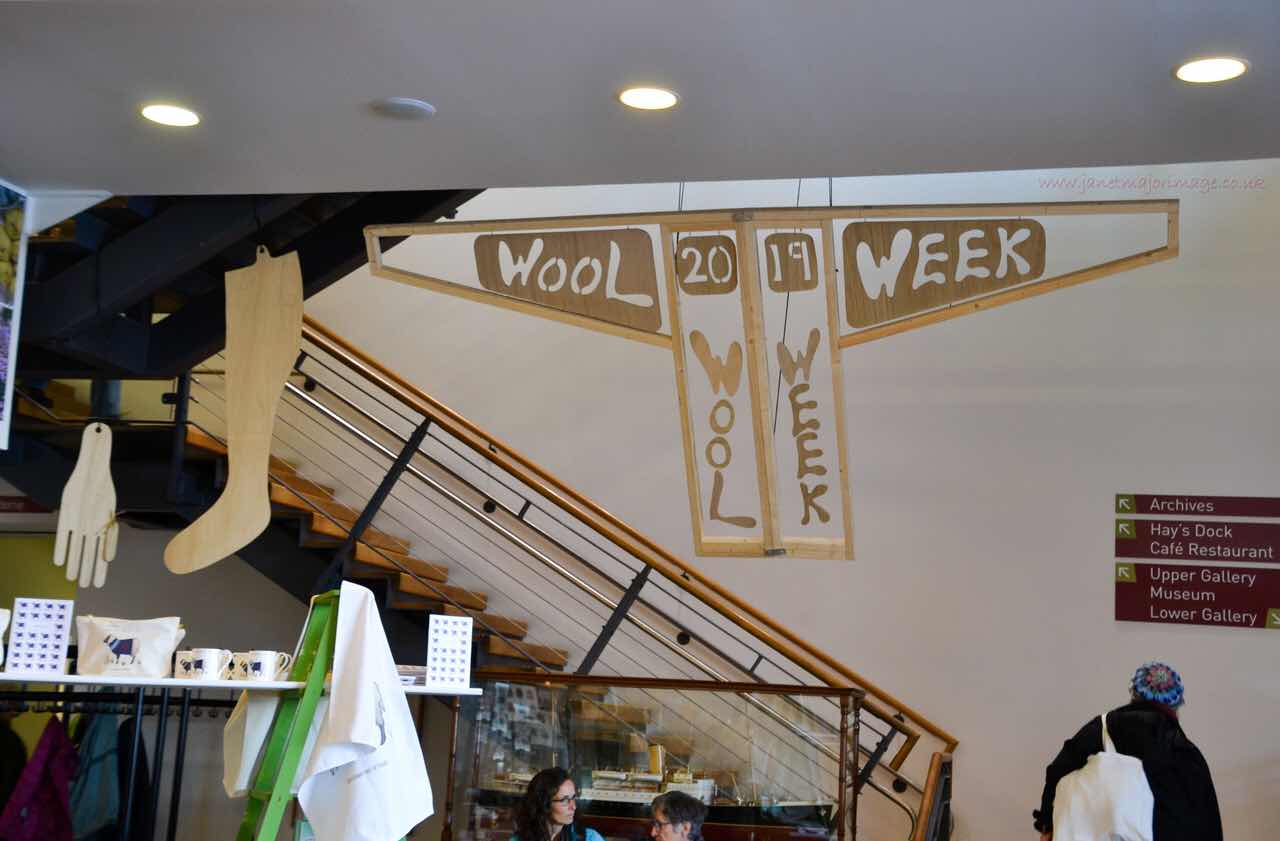
Entrance Hall Of the Museum


This was my opportunity to have a closer look at the items belonging to the patterns in the SWW annual and also to look round the knitwear section of the Museum. It doesn’t matter how many times I look round I always ‘see’ more things. I was particularly interested in grafting in shawls this year. 

So first of all the Hub where the Annual Knitwear display was - it was good to see how Elizabeth (Johnston) had mitred the corners on her shawl pattern in the annual. 

What a mitre! 


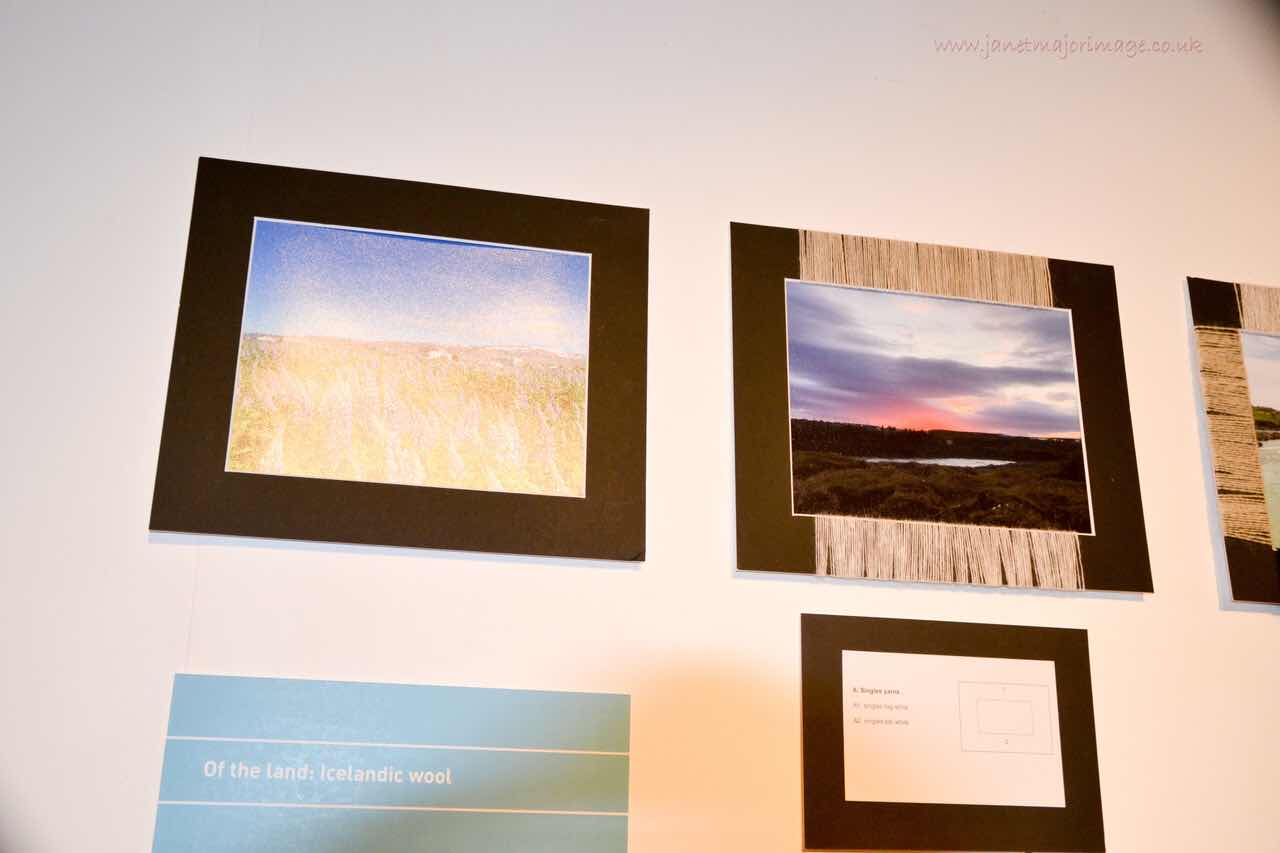
The museum hosts other exhibitions of interest during wool week. One such was from Deborah Gray:  ‘Of the land: Icelandic Wool’ from her time as an artist in residence there. The frames are bound with hand spun wool, naturally dyed. During her time there she explored the differences between the two different wool fibres in the fleece  and the effect of natural dyeing on these. 


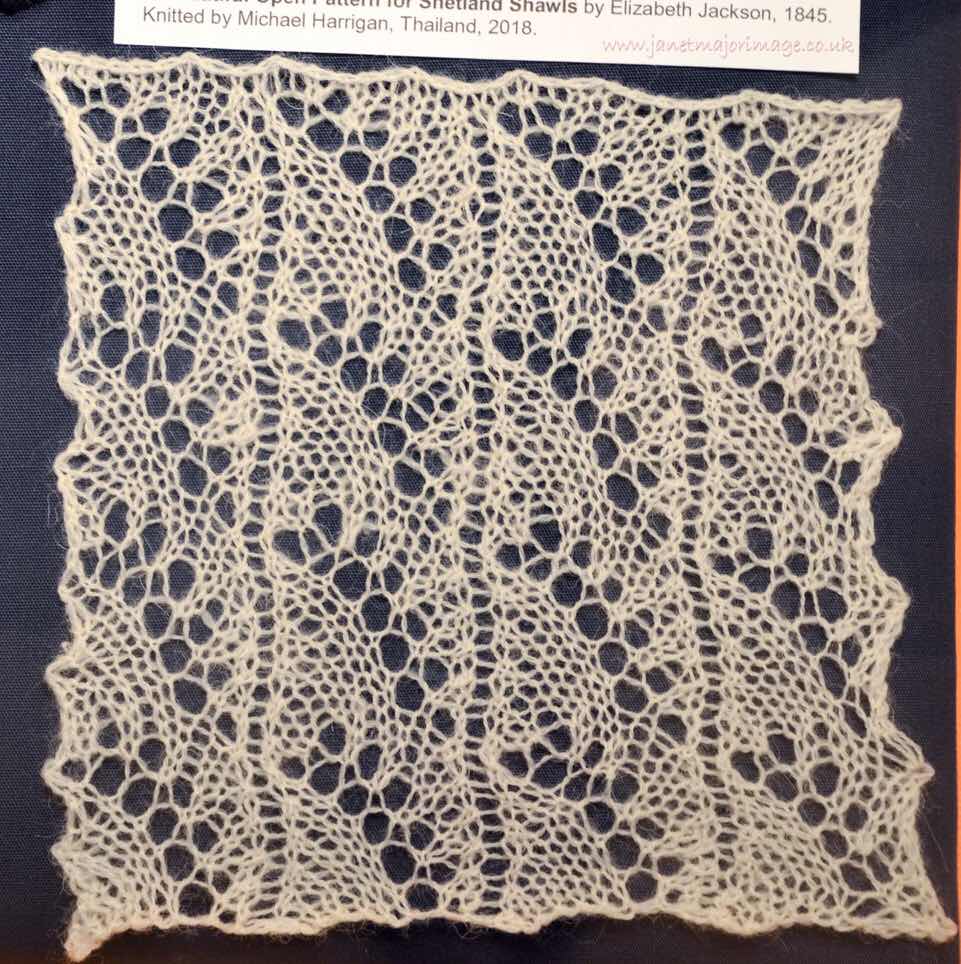
While looking around the knitting section my eye caught a glimpse of a name I was familiar with from a fb lace knitting group. I duly messaged the owner, in Thailand,  who was really pleased that I had noticed this. He had answered the call some time ago to take part in the Nottingham-Shetland Lace Research Project and had sent in his samples in 2018. He did not know they  were exhibited in Shetland Museum and was very pleased to be able to see photos I sent him. Another example of the wonders of fb! (2)


Then I had to return to look at the exquisite examples of the ‘so fine’ lace and tell myself to be patient. I am spinning fine, I just need to do metres and metres more and then design my own shawls just like these truly amazing women did. 

We left at lunch  time and were going to drive up to Ollaberry. The day was warm and bright, what a super journey we were in for. 

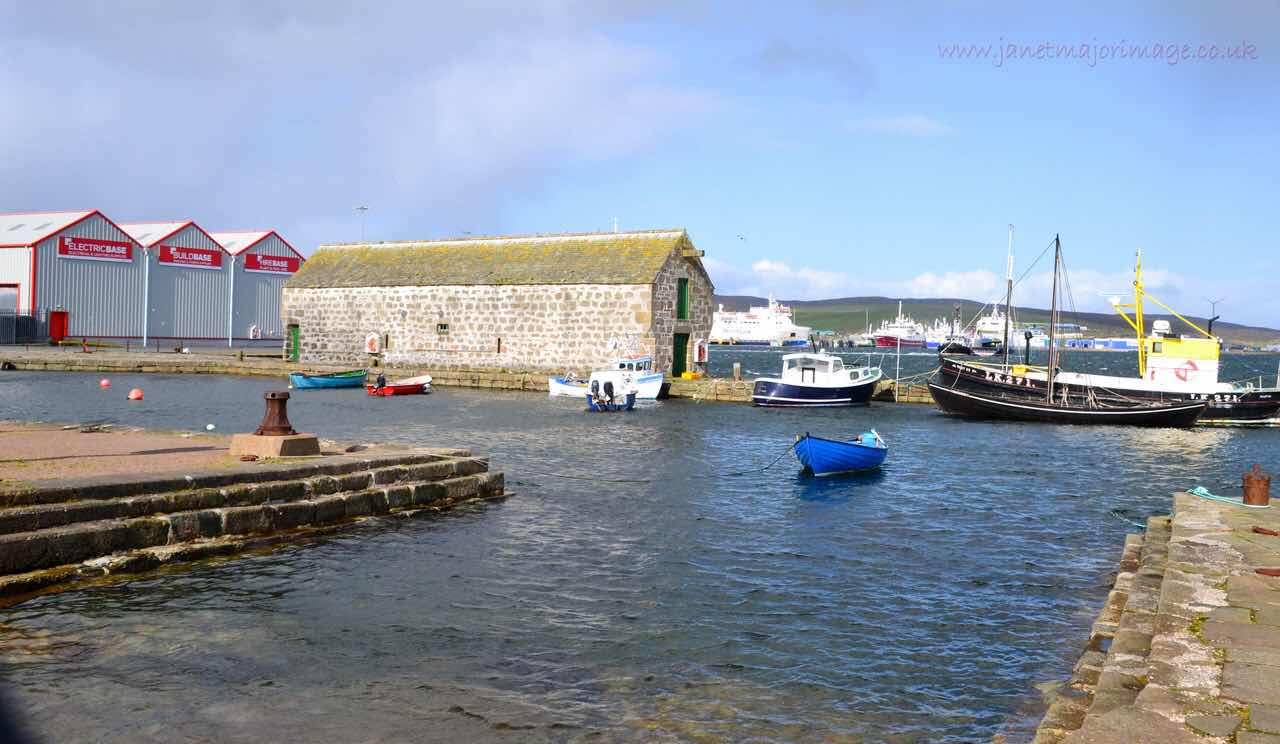
 Hays Dock by the Museum, it was October! 


Ollaberry is special, it is associated in my mind with much marvellous lace, the ability to talk to lace knitters with real expertise and great food. We decided that we would have our plate of food when we got there and call it lunch! 

We were too polite to be the first for the spread, but were encouraged by the ladies serving that this would be good. As we sat down they told us they were expecting a coach tour, this was  one  of the tours put on for wool week and it must have been full considering the number who came in for lunch. As always it was a wonderful spread and after the coach had left more food was added and one would not have known 50 or so people had just been in for lunch. 


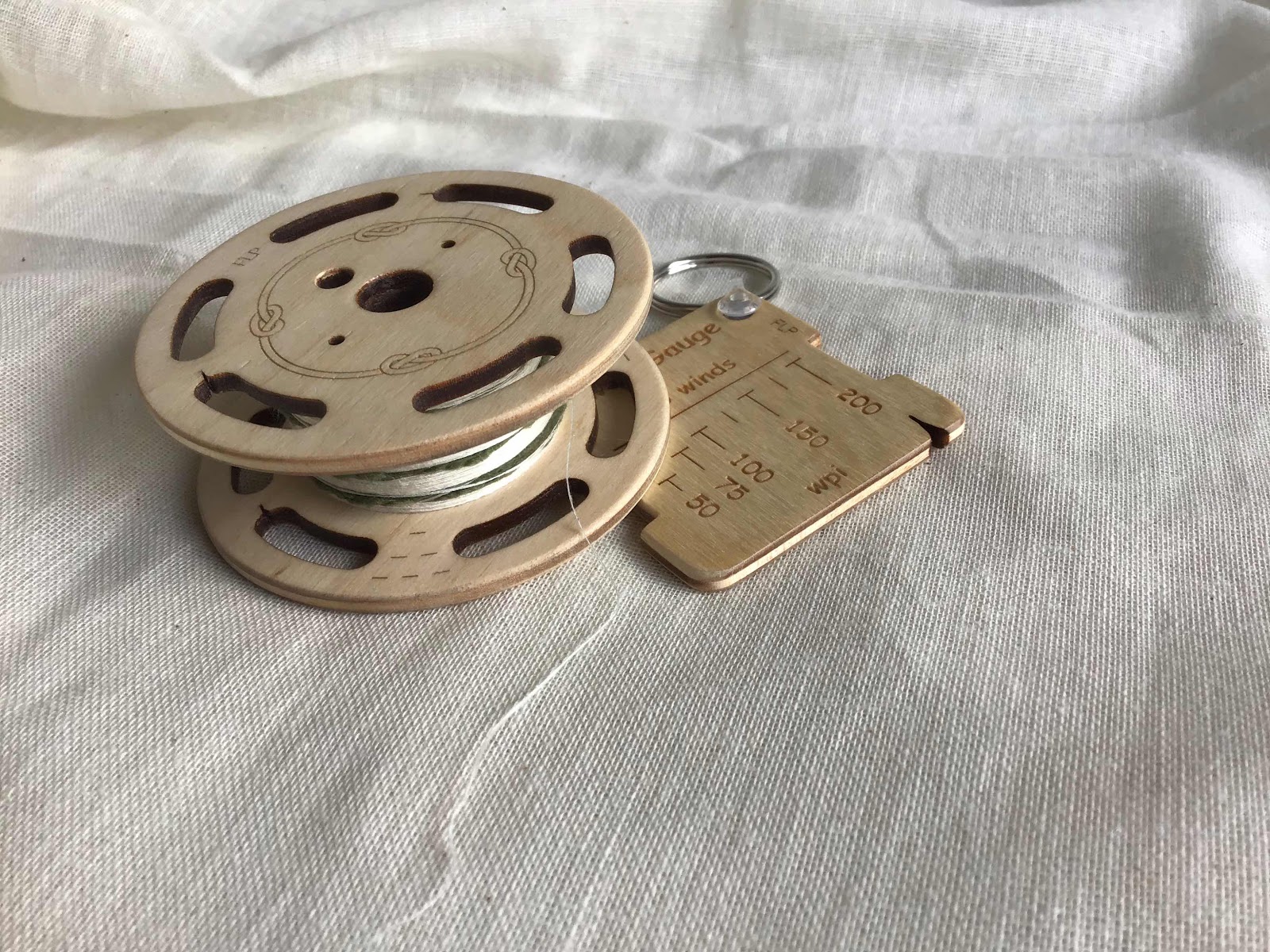
We had come to Ollaberry this day in particular as I was going to meet Gordon (Fleece loved products) and his wife Gill. I had been in touch with him before we left home and I was hoping I could buy  one his fine lace bobbins and the brake system that he had customised for my wheel. Kate had told me how great they were and so I was very excited by this prospect. We met and I used the said system on my wheel and was delighted with it. It was great to be involved with these expert fine spinners such as Betsy Williamson who the bobbin, named the Ollaberry bobbin, had been expertly designed for. This was one of the major highlights of my week. I decided to have enough bobbins to spin and ply the yarn this way and also purchased an Ollaberry Lace Weight Gauge (and one for another Shetland Spinner and knitter) who had seen Gordon on Saturday and not acquired one. As a bonus I was able to try Gill’s Ashford electric spinner. I didn’t expect to like it, but I absolutely loved it. DH came back from his bird watching walk as I was using it and I believe I heard him say I ought to have one for Christmas! It was a delight to meet this couple and to feel that spinning as finely as I do in not ‘freakish’. (3) It was lovely to be made so welcome by the local ladies spinning at Ollaberry and to be able to talk to them again this year. 

Fine lace gauge and a bobbin


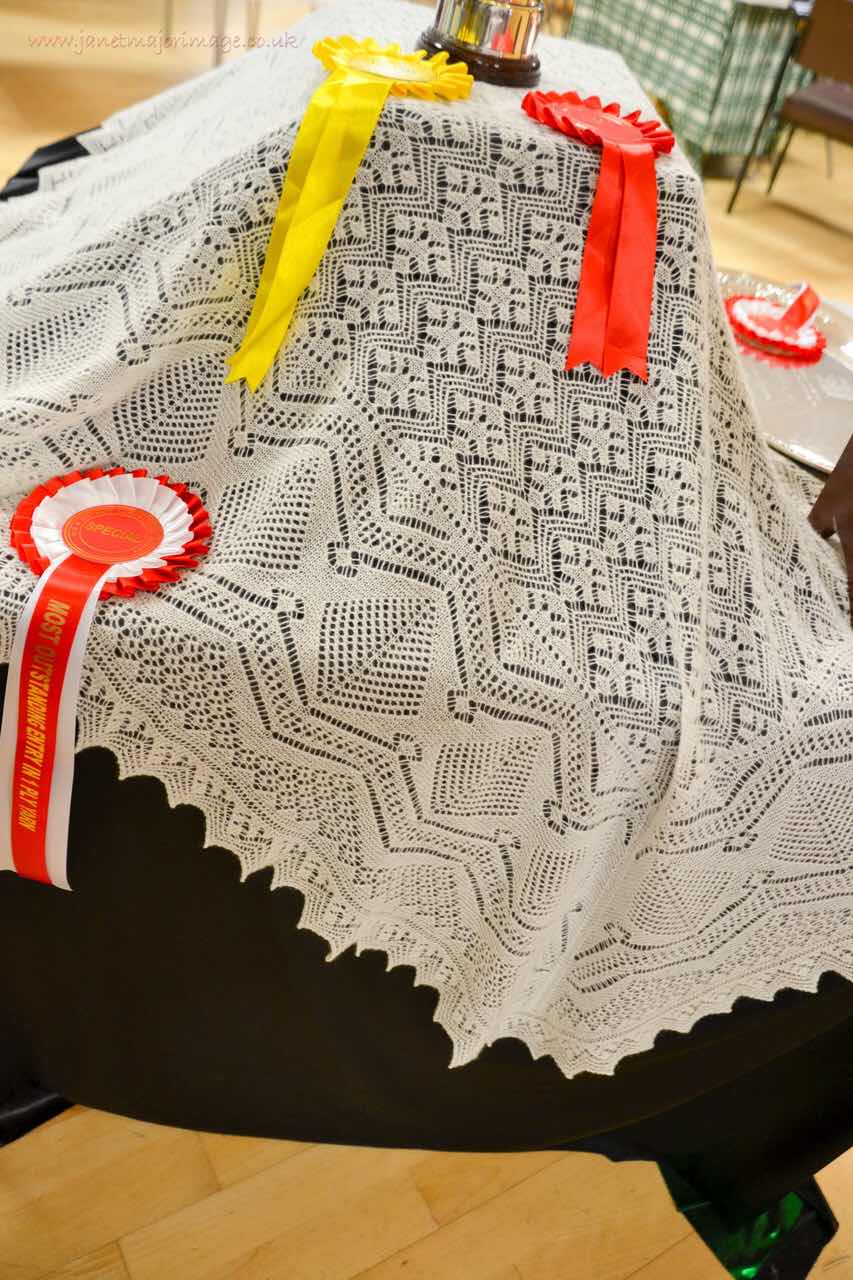
On show close to where we were sitting was displayed the most gorgeous and perfect shawl. This  had been knitted by a young knitter and won lots of prizes. Her name was Lauren Anderson and I heard from one of the ladies (her grandmother) that she had ‘knitting genes’ from both of her parents.(4)

Lauren’s Shawl


What an afternoon this had been, on top of a wonderful morning. It only needed to be finished off by stopping off at Frankie’s Fish and Chip shop in Brae for a very tasty dinner. 


People coming to wool week get upset when they can’t get the classes they feel they ‘need’ when booking. I hope this day will go some way to showing that there is so much wonderful stuff to see and marvellous ‘wool’ people to meet and talk to, that having a day with no classes is nothing to worry about. There is so much to see and do. Everything I did today was free, except for the purchases I made and yet it will be one of my best days in Shetland. Keep your mind and eyes open, talk to people and you will learn so much! 


  1. Again a very good example of social media, Bunchy posts as Spindrift Crafts both on iG and fb and it has been good to follow this publishing journey with her.
  2. Carol  Christiansen mentioned this project on her talk on Thursday. I will be writing more about it then. 
  3. Gordon has amazing skills. An engineer by training he is making a number of laser cut birch products of quality for knitters, spinners, weavers and crochet lovers. It is the ‘cleverness’ of the design which is particularly striking eg on the Ollaberry Gauge just 20 winds of the yarn can give you the wpi down to 200. A very useful tool when actually spinning. If you search for ‘fleece loved products’ you will find Jelly Bean yarns on Etsy and Beaker Button (also both on fb) as some of the stockists or contact directly at fleecelovedproducts@gmail.com 
  4. This is the second shawl of Lauren’s. She was just 16 when she knitted the first shawl and won the children’s section and the judges were so impressed that the shawl was put in the adult section where she won that prize too. She was just 20 when she knitted the shawl in the picture and it won all the prizes possible at the Voe Show. This shawl is just perfect. Lauren was interviewed for the  Fruity Knitting podcast no 87 and  she can be found on iG as laurenclaireart