Showing posts with label Suffolk. Show all posts

Monday, 22 August 2022

East Anglian Churches


Norfolk, and East Anglia, has the most amazing collection of Churches, mainly medieval and mainly built on the wealth of wool. History tells us the merchants felt that giving money to the churches, the merchant would be prayed for and have a better after life. 

I live in a small village mentioned in the Doomsday Book and in 2011 having a population of 785. The village church is grade one listed! Going back Carleton Rode had two Churches, although no one knows exactly where the other one was, it was timber I understand. Today the village also has a Baptist Church which is beautifully ornate on the outside. 

There are over 650 Churches in Norfolk - this is the greatest concentration of churches in the world.  Whatever your beliefs visiting  the churches is a great way to glimpse the best of everyday art and hence life in the past. Many East Anglian Churches that are redundant or at risk structurally are cared for by the Churches Conservation Trust who aim to find novel ways of using the churches so as many people can appreciate them as possible. These churches are often open to the public. (1) 


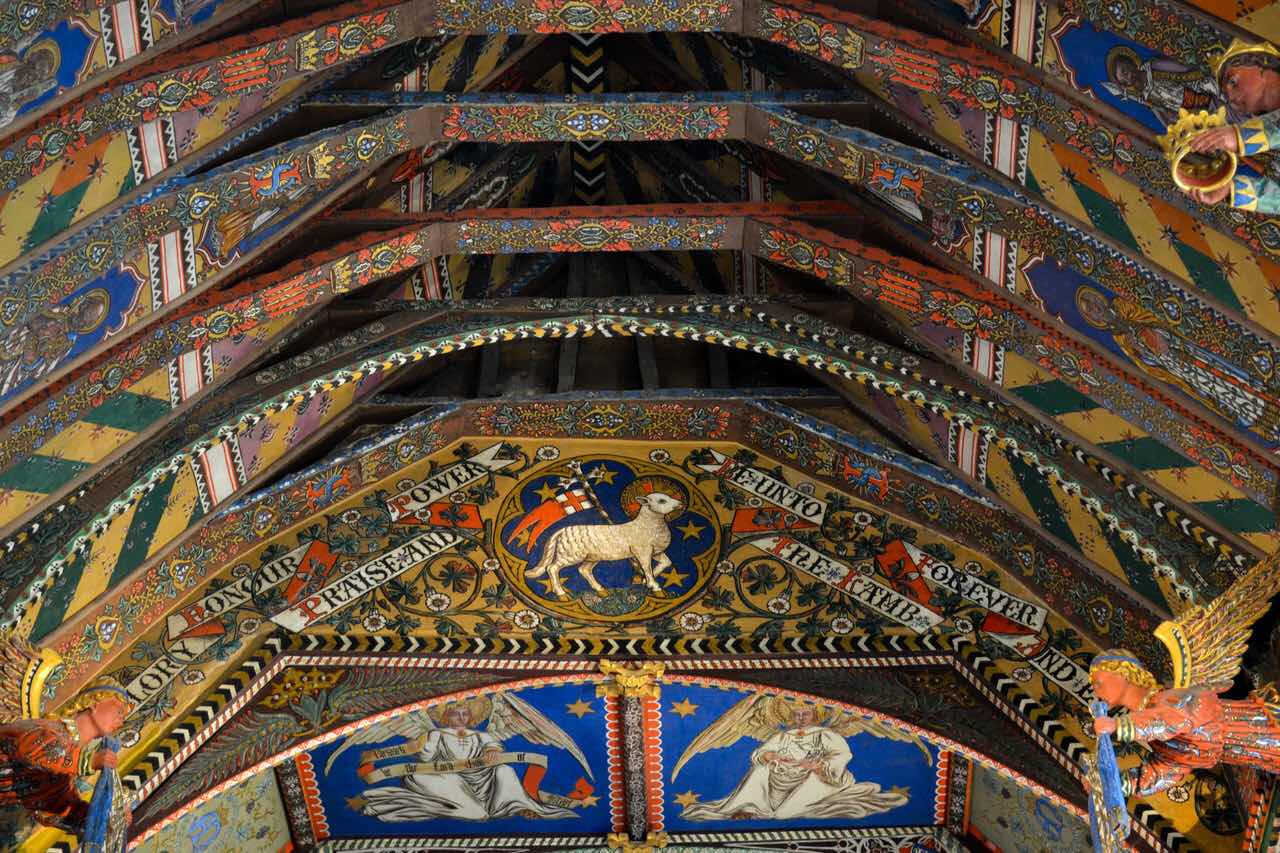
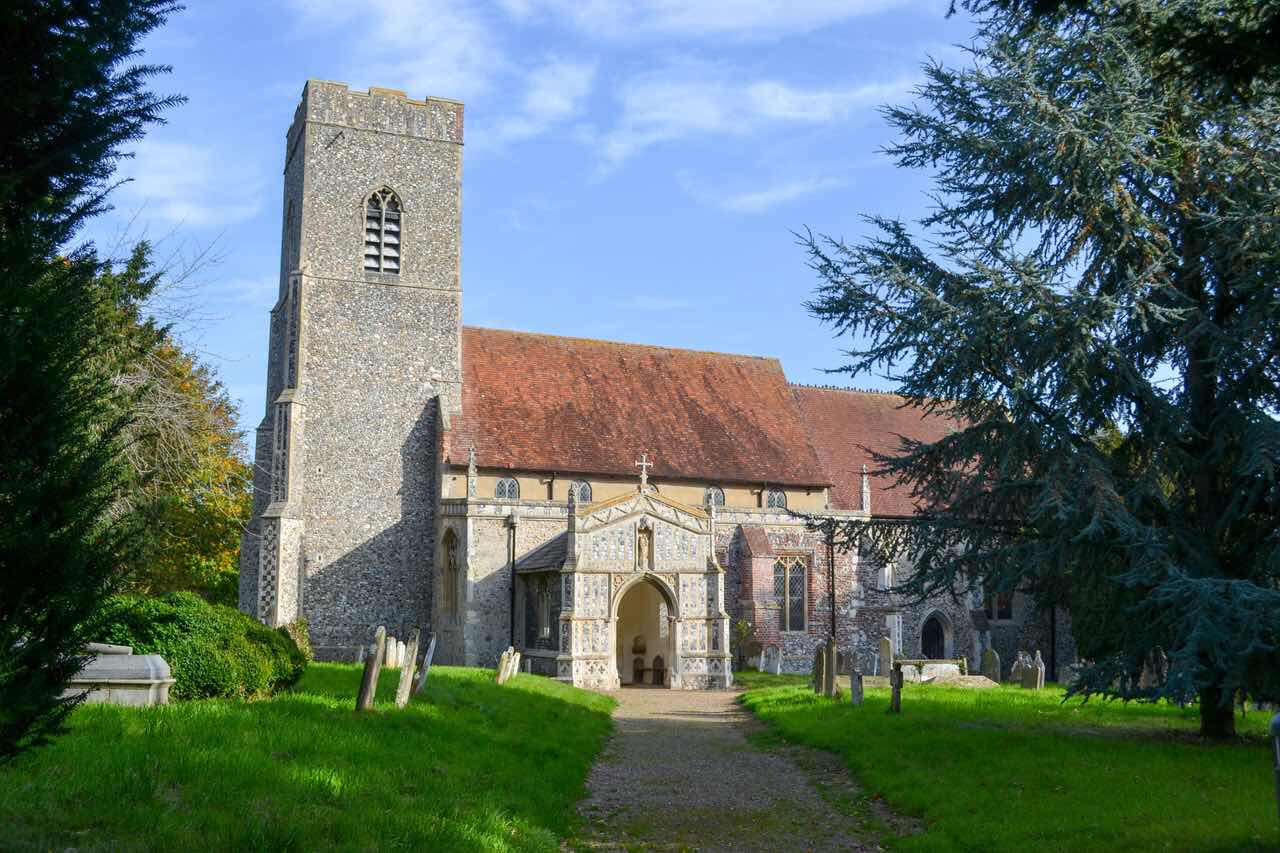
Following the interest  in Sandringham Church I though I would write about Huntingfield  Church which is in Suffolk. (2) 


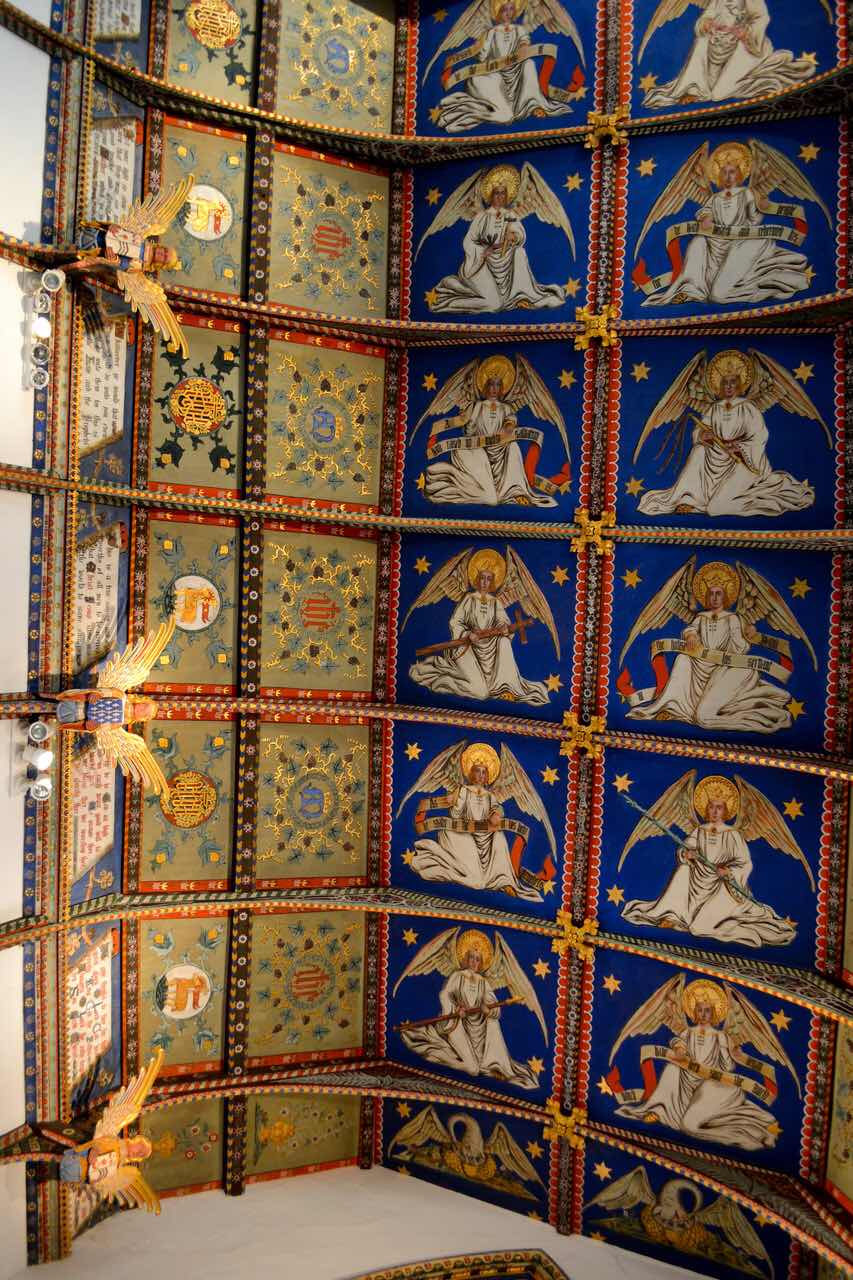
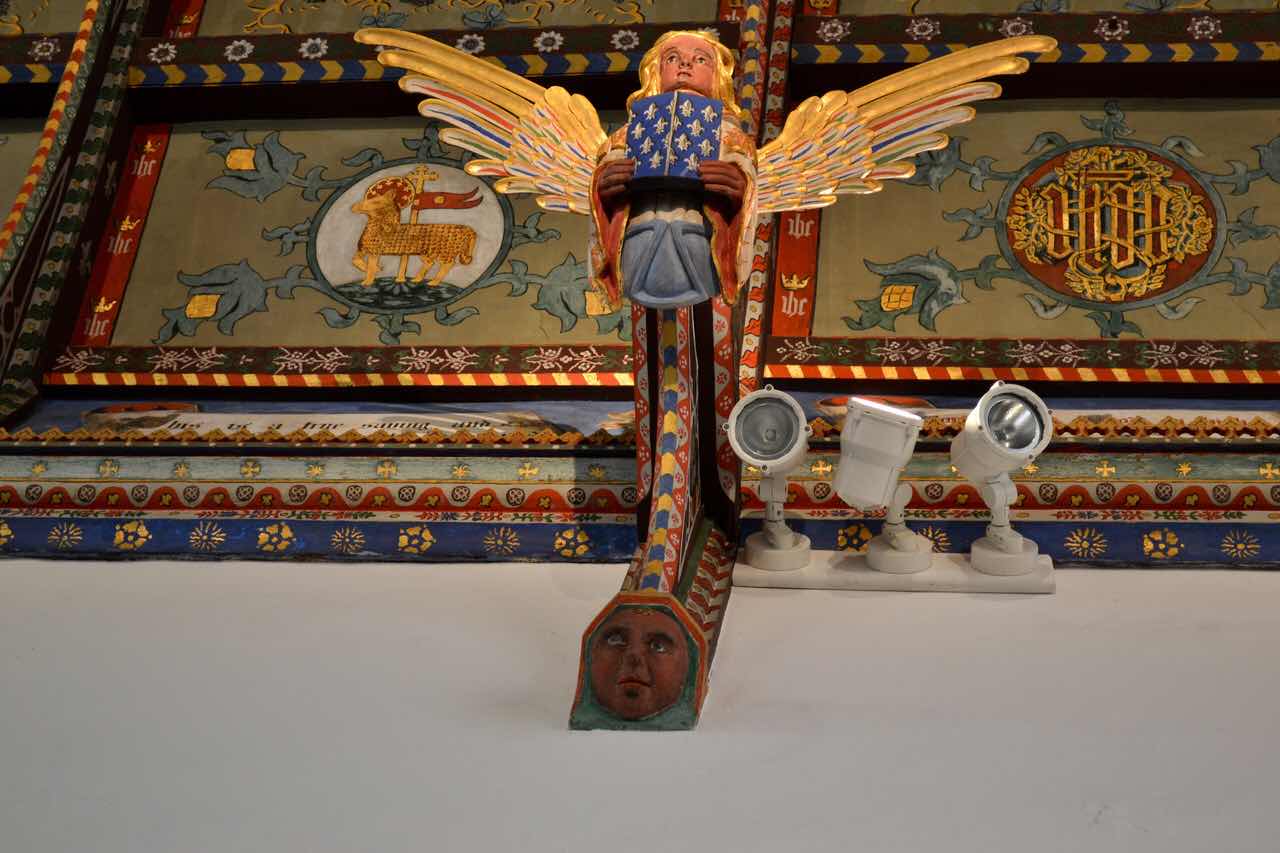
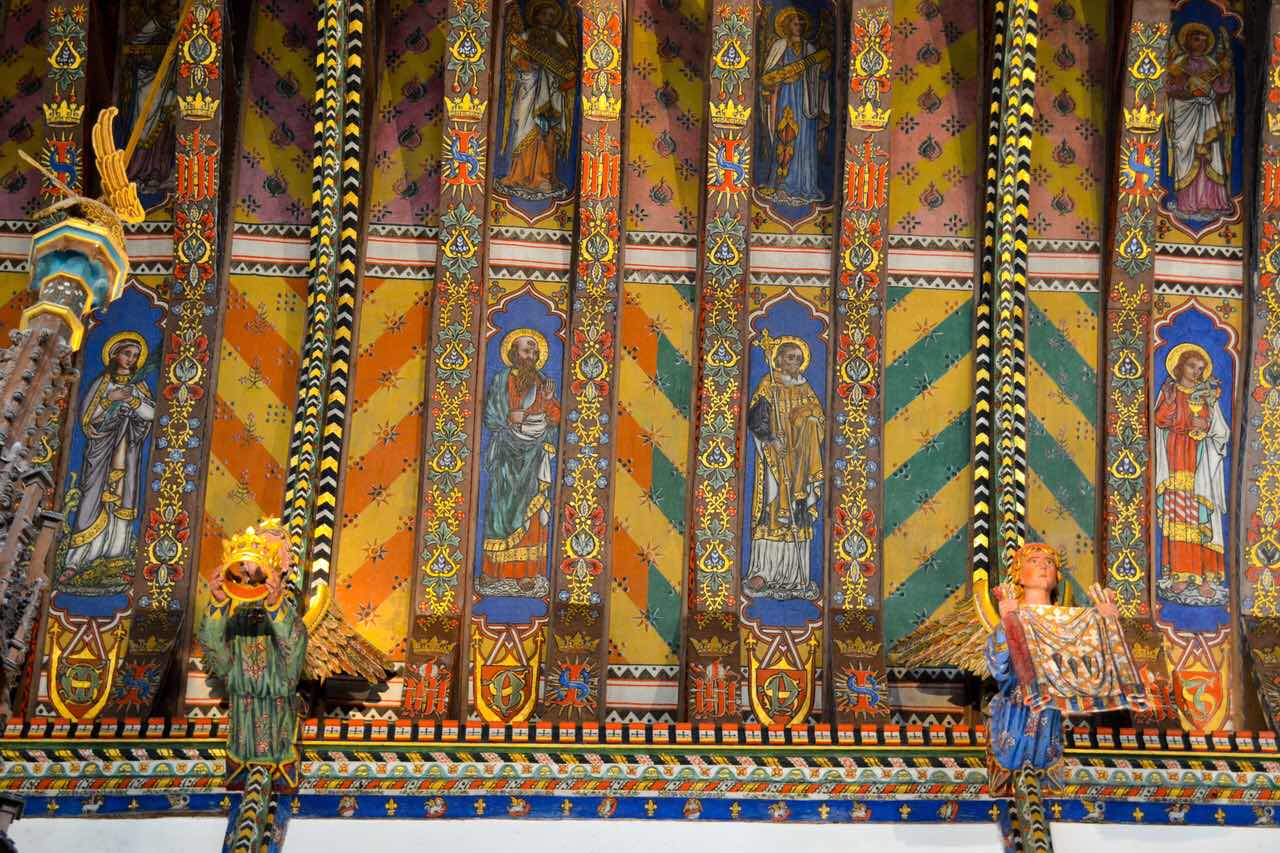
This is also in a small village and parking is not great but manageable. It has a remarkable ceiling and I thought I had written a post about it but have looked back through this blog and Facebook to no avail. We visited with friends in October 2017. We were just back from Shetland Wool Week and I would have been trying to write my journal from that, then I guess things like making the Christmas Cake got in the way! 


This ceiling is even more spectacular than the one at Sandringham, but then Sandringham does have the silver pulpit, altar etc and ceremonial cross! 

What is even more remarkable is that the ceiling in Beddingfield was painted by the vicar’s wife laying on her back, between September 1859 - April 1860, yes, just 8 months! Apparently after another three years she painted the nave ceiling. There is no record of her having help with the painting! 


I hope you will agree that this is an amazing ceiling and wel worth finding. The church is open 10-4.30 daily (do try and check before visiting) and a toilet has been sympathetically added at the back of the church. 


Notes 

  1. The Churches Conservation Trust  has a good website showing which churches they care for. Many have a walk in the local area too. Zoom sessions started on Thursday lunchtimes during lockdown with lectures from experts in their field. These are now available on YouTube. https://www.visitchurches.org.uk/
  2. Huntingfield Church can be found at IP19 0PR


Sunday, 26 September 2021

A visit to West Stow


This is another post about a place local to me in East Anglia. This one does have definite textile interest. On it’s web site (1) West Stow is referred to as one of England’s great archeological sites, I thought that was quite a boast  but after visiting I think it is well justified. 

The reconstructed village 


But first a bit  of background. West Stow is in Suffolk, about 30 miles from us and one of those places that you think you will go to ‘some time’ and this week was that time. It is just north of Bury St Edmund’s and in an area called Breckland or ‘The Brecks’ (2). My first zoom experience in lockdown was joining a lecture about Anglo Saxons in East Anglia and the lecture contained quite a bit about West Stow. Whilst the 125 acre country park it sits in was open during lockdown the museum section and ‘village’ was not. We decided we would wait to go until the children had gone back to school. Michael had taken the grandchildren before lockdown but I think I last went nearly 40 years ago and it has been much improved since then. 

We were lucky the weather was glorious for September. My main interest in going was to see the warp weighted looms there in a ‘weaving hut’ in the village. I had spent a day learning to weave with a warp weighted loom with Elizabeth Johnston in Shetland. (3)

West Stow Anglo Saxon Village is a recreation on the site of the original village. The settlers are thought to have arrived via the River Lark and to have built the village up a slight hill from the river. Evidence of other settlements occur in the area. By chance this one had been covered by a medieval sandstorm and equally luckily had been found after many years and thus  been more fully excavated. The main excavation was  between 1965 and 1972, although there was some excavation from  about 1878.  The site was occupied by Anglo Saxons  from about 450- 650 AD. There is evidence of 2 types of buildings, a larger type - eg a hall and smaller ones, with 69 of these being mentioned. The Anglo Saxon Village Trust was set up in 1972 and since then 8 buildings have been constructed and today there are 7 and some smaller ones.

A painting giving an impression of the village
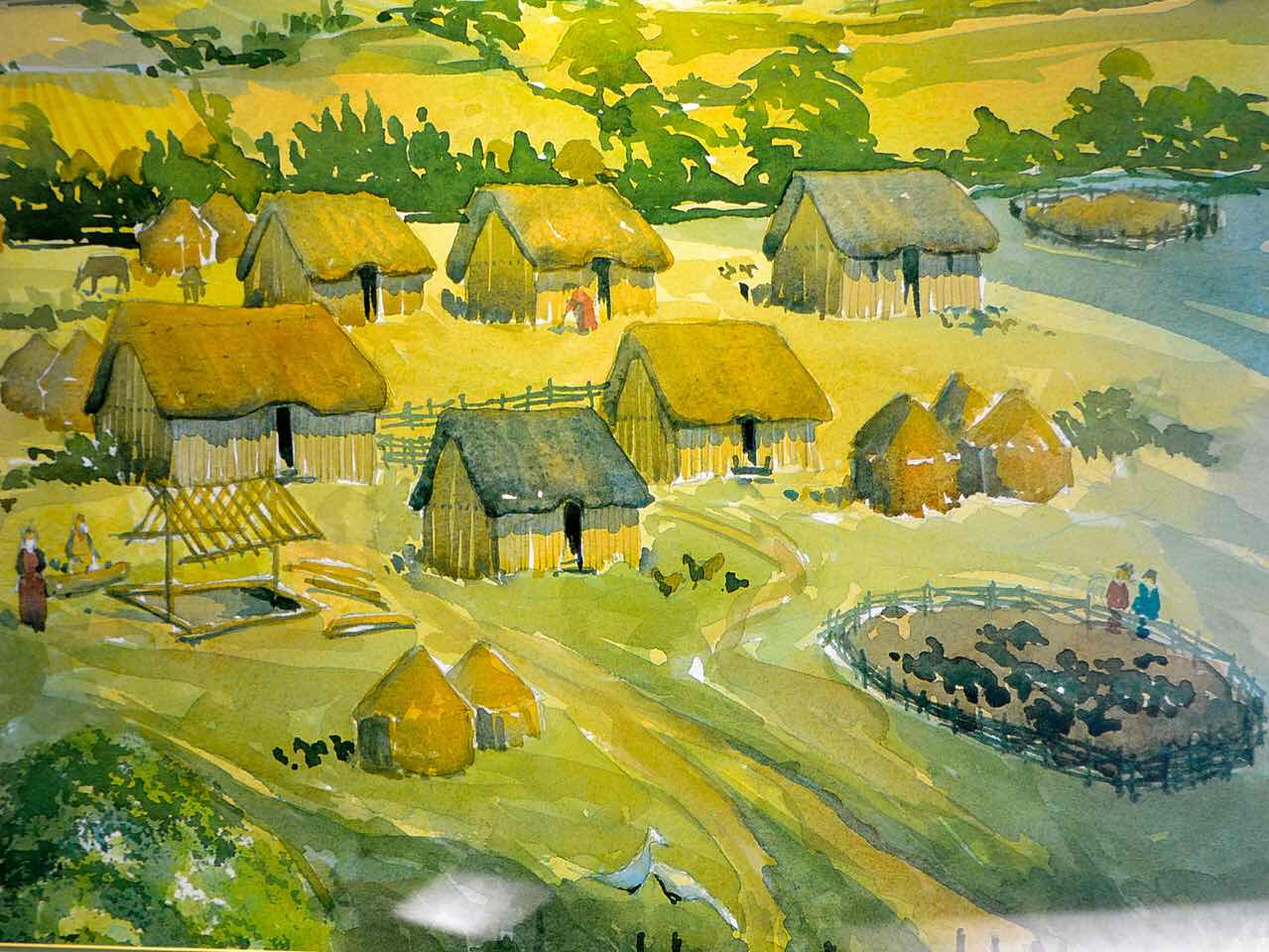


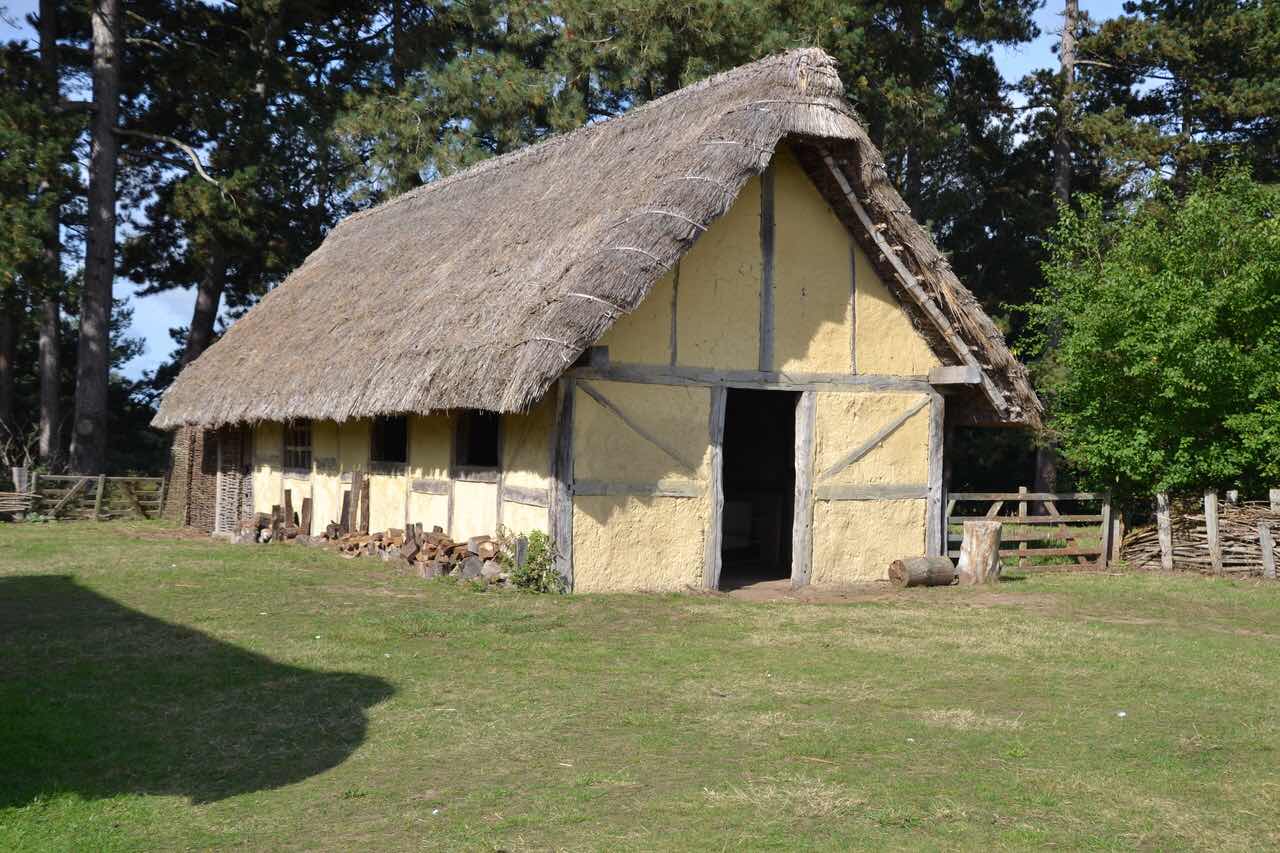
 Each of the main buildings show increased complexity in build and their overall construction is noted at the entrance to each. Having lived in a thatched house of later date (15C) for many years, the construction of these Anglo Saxon huts was of much interest to us. 

View of the workshop. I meant to go back and take a picture of the smaller huts. I forgot…so that is another reason for returning. 


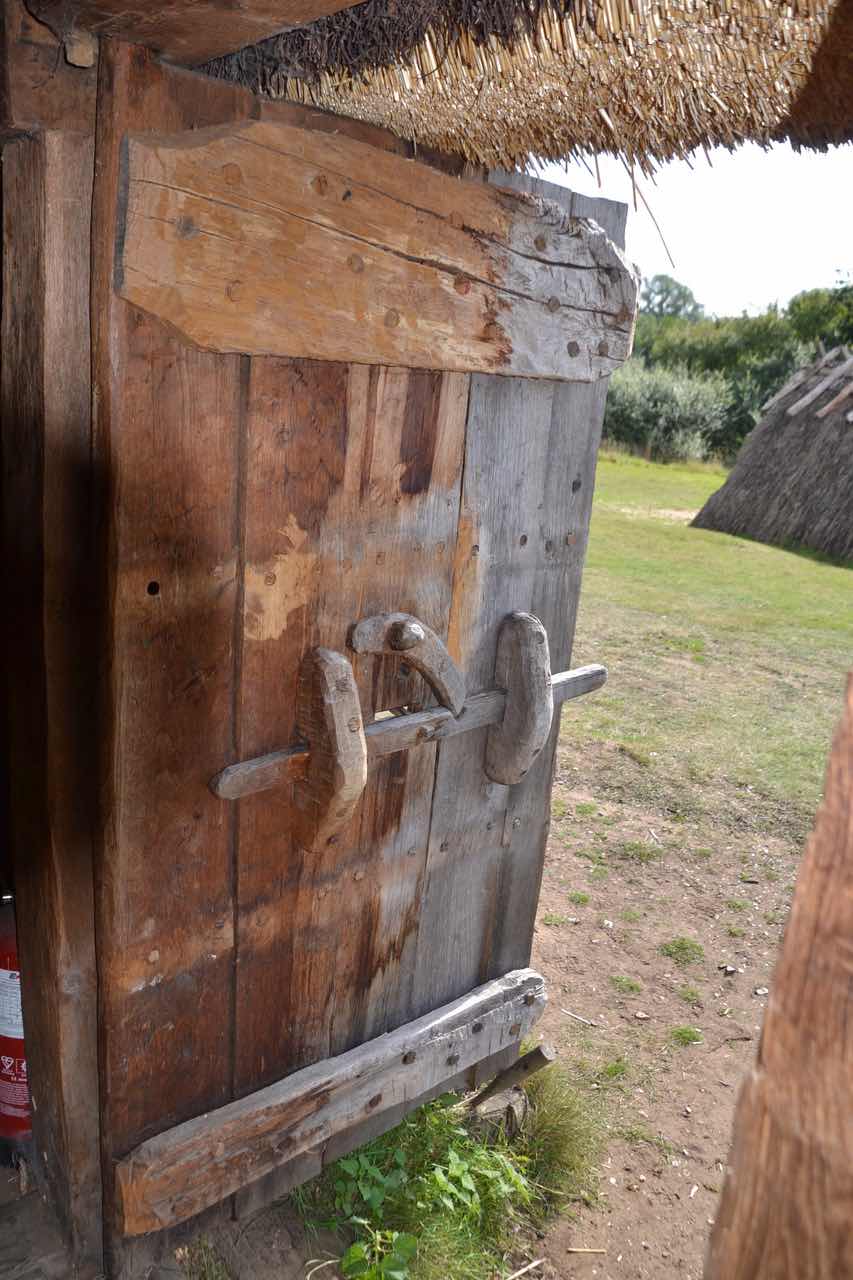
Reconstructed door lock 


One of the huts is called the weaving hut and contained the looms. I was pleased that I knew how these worked, and had woven on one myself, sadly these looms had clearly not been used for some time.


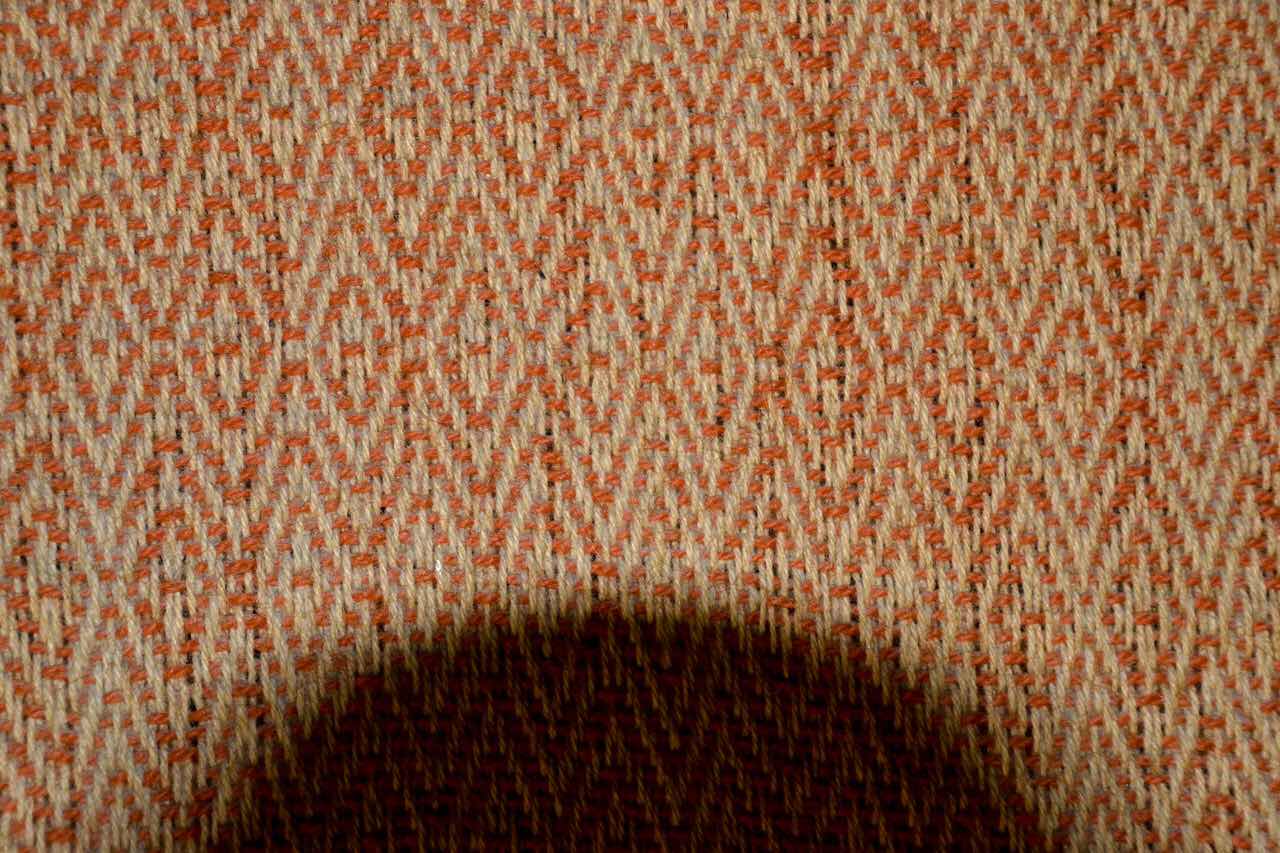
I can understand that they were tied so they could not be tampered with but it is a shame. One loom appears to be set up to be the equivalent of a four shaft loom and this is the weaving on it.

Apologies for my head appearing on this, flash was needed in the dark of the hut! 


However, I became interested in much more than what  was on offer in the weaving hut. The displays in the Anglo Saxon Gallery and Visitor Centre were well presented and more extensive than I expected. 


Thought was also given to the place of the Anglo Saxons in West Stow in relation to earlier peoples, particularly the Romans and also to the  later Vikings. East Anglia is such a great place to find out about the story of earlier inhabitants. 

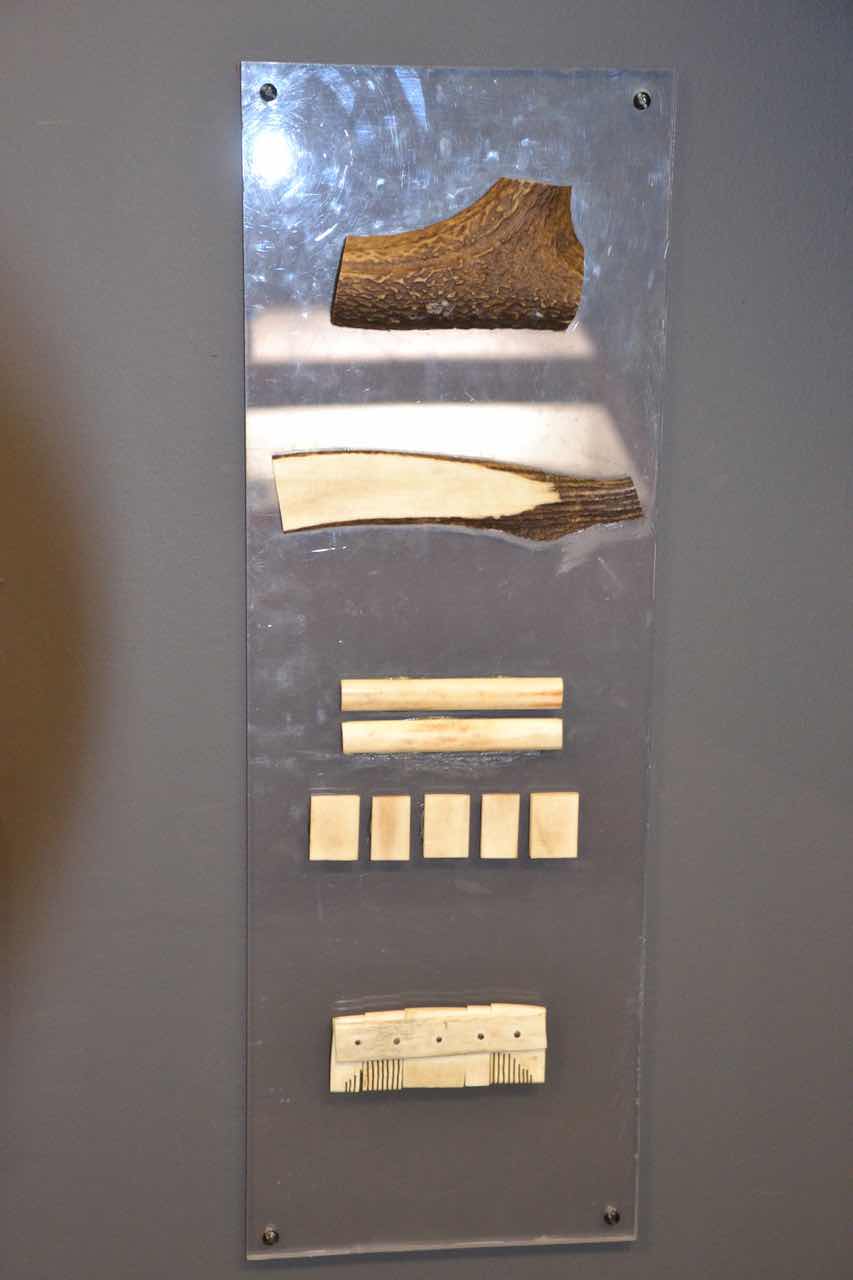
It was actually the clothing and personal accessories that attracted me while I was there. A large number of personal combs (as opposed to combs to be used on fibre) were found- 106 and 120 have both been quoted! 


By studying these it has been possible to work out how they were constructed and this photo shows the different stages.

How the combs were constructed:
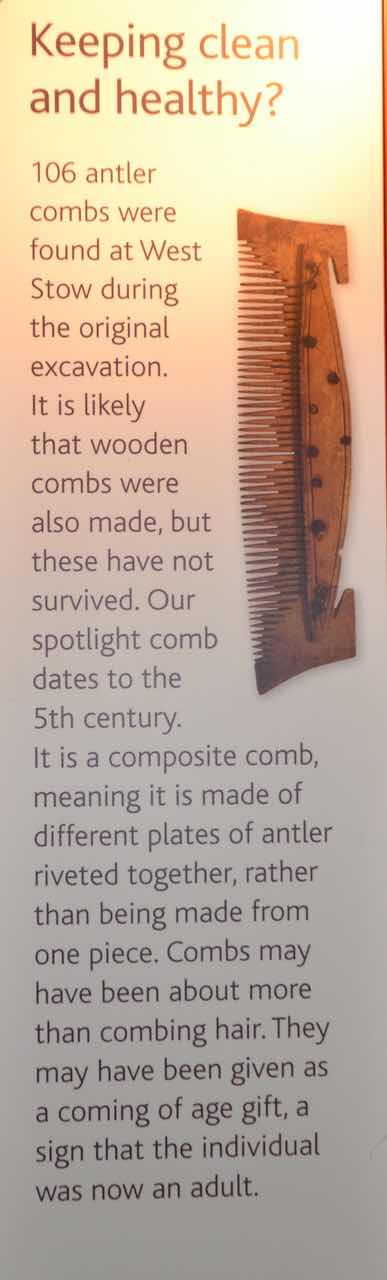


…and visually


For too many years Anglo Saxons have been regarded as ‘ lessers’, certainly in terms of their skills and organisation compared to Romans! It seems to me they were much more sophisticated than they have been portrayed as. The jewellery and skill shown in articles made from wood and metal, pottery, basketry and leather and textile work, to say nothing of gaming pieces, musical and art pieces show they were not just living a subsistence existence. Even from this small settlement in Suffolk, excavations have shown trade with other parts of England as well as the Baltic, Mediterranean and Rhineland !

Besides the usual shop items for the children to take home from a school trip, it was good to see a range of more detailed books. 

As usual we started the day with coffee and cake from the cafe, but had taken a picnic with us so cannot comment on what lunch was like. 


After lunch we took a stroll through the country park to see the River Lark. One could imagine the settlers arriving in their boats. Although I did wonder just how much they brought with them. I can’t imagine them unloading sheep, cattle, goats, pigs, horses etc  that had travelled with across the North Sea and then along this river once reaching Britain. 


The Anglo Saxons who settled in this village very much seem to have used local resources and I wonder if they took over animals left by the declining Roman population. 


All in all a great day out. 


Notes

  1. More information can be found on the website. www.weststow.org including a short video giving an overview of the village.   The site is open  throughout the year but do check details of opening and admission. A Book ‘Understanding West Stow’ is available to purchase at a very reasonable price (£4.50 in Sept 2021, and gives a very good introduction to the site. The first photo is taken from that. 
  2. ‘The Brecks’ is National Character Area number 85, as defined by Natural England and is an area of mainly sandy soil centred around Thetford, Norfolk  and stretching into Suffolk and Cambridgeshire. It is particularly interesting inn terms of nature and archeology. 
  3. This was with Elizabeth Johnston in 2018 It was a superb day  and I have written about his previously, see post of 11Nov18.  Elizabeth has co authored a wonderful book about these with Hildur Hakonardottir and Marta Klove Juuhl. The Book concentrating on the the use of these looms in Iceland, Shetland and Norway.It is called The Warp Weighted Loom and the book itself is a thing of beauty.
Wednesday, 17 February 2016

The Horsey Hat


The Horsey Hat
The story of this hat starts way back - before 2001 when we moved from Norfolk to Cheshire. So let's say it was 15 years ago. In Norfolk, we were living next door to a farm and the owner offered me Suffolk fleece - if not they would be destroyed. I had just started spinning and took one!  This stayed in the paper sack I was given it in until 2014 when the Association of Weavers, Spinners and Dyers had their National Exhibition in Norwich Cathedral. I offered to spin some local fleece - I had Jacob fleece which I had spun already from a friend in Diss but they already had some of that. I was asked if I had any Suffolk yarn that I could contribute to the wall of wool. The answer was that I had some 15 year old fleece and I would see what I could do. This was coupled with the fact that we were having a big house sort out and had the house on the market in Cheshire as we intended to reallocate back to Norfolk.
The story of washing the fleece like this is described here on 8 Feb 2014 (2 postings) as I used my version of the fermented suint method.
The whole fleece looked like this!

I was delighted that the sad looking lump from the bag produced the most beautiful clean fleece, which was quite unexpected by me. I decided to spin the fleece thick for me ( 9-10 wpi). As my preferred spinning gauge is very fine lace this seemed very thick, but I wanted enough yarn to make a show - I had a time limit on producing it. Mary ( Chair of Diss Guild, who was organising this part of the exhibition said I could dye they yarn - if the dyes were native to Norfolk. So I left a skein undyed and dyed a skein with woad, another with nettle and a third with nettle and iron. We had plenty of nettles growing at the back of our garden, bordering on the farm where the sheep had lived, back in the days when we lived in Roydon. I was pleased with the results and the skeins were duly part of the exhibition.

My skeins are in this part of the large Wall of Wool, to the rightof the vivid yellow one - the colours are not very accurate in this unfortunately.


A friend sent me a lovely photo of Horsey beach for my birthday about this time and I mentally noted the colours were very similar.


Fast forward to September 2015 when we had settled back in Norfolk ; I was looking at doing something with the yarn. I decided I would knit a hat, which would be very much in keeping with Horsey beach as my recollection is that it is always windy there. My plan was to knit a fair isle hat as I just love fair isle patterns. But after much sampling and knitting of trial patterns I couldn't get a design that looked neat enough to me. Fair Isle works brilliantly finer Shetland wool of about 4 ply equivalent! I decided this yarn was just too thick for that and another approach was needed.
Then I remembered my Swaledale and North Ronaldsay hat ( yarn bought in Orkney).
This was a modification of a pattern by Elizabeth Lovick ( from Orkney) - the pattern is textured using purl where one might put another colour in Fair Isle knitting.

I used a draw thread so that the hat would double up as a cowl and be dual purpose.


But for the Horsey hat I decided to take another step and use patterns that might be found on North Norfolk fishermen's Ganseys. So more research on their patterns ensued and this proved difficult as quite rightly some of the fishing families are protective of their patterns. In the end I decided to use Gansey patterns that matched my beach theme and are found on some Ganseys.


So the bottom pattern represents pebbles worked in nettle and iron dyed yarn, the diagonal lines remind me of lines along the windswept Horsey beach , worked in nettle dyed yarn and the blue ( woad dyed) waves speak for themselves, the natural coloured yarn topping representing the clouds. I added the reverse stocking stitch ( also in natural) to separate the colours and thought it would represent the foam on the waves.

Another view using it as a cowl


I am really pleased with the result and thought the story worth telling.