Showing posts with label fine lace. Show all posts

Thursday, 9 February 2023

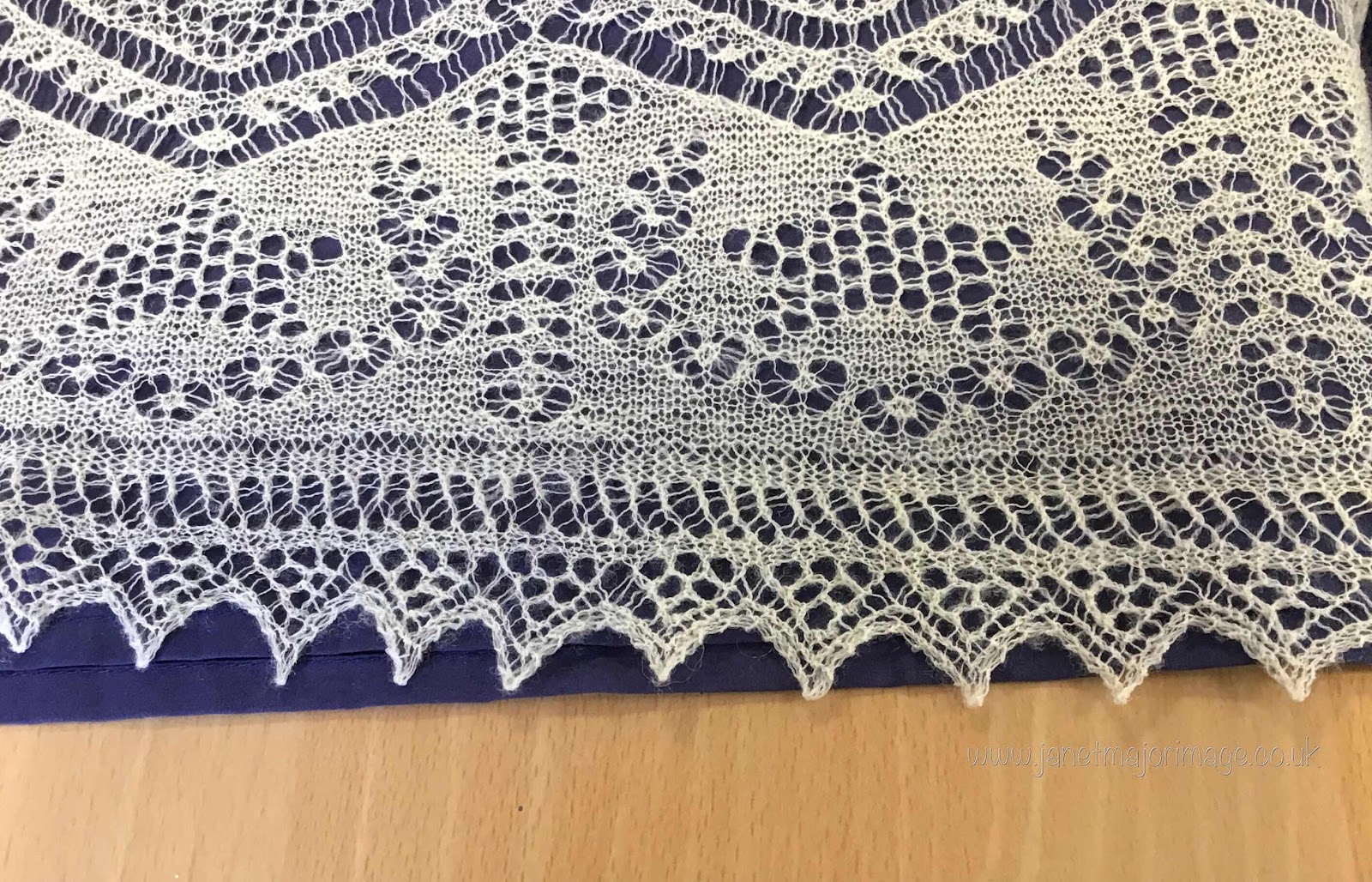
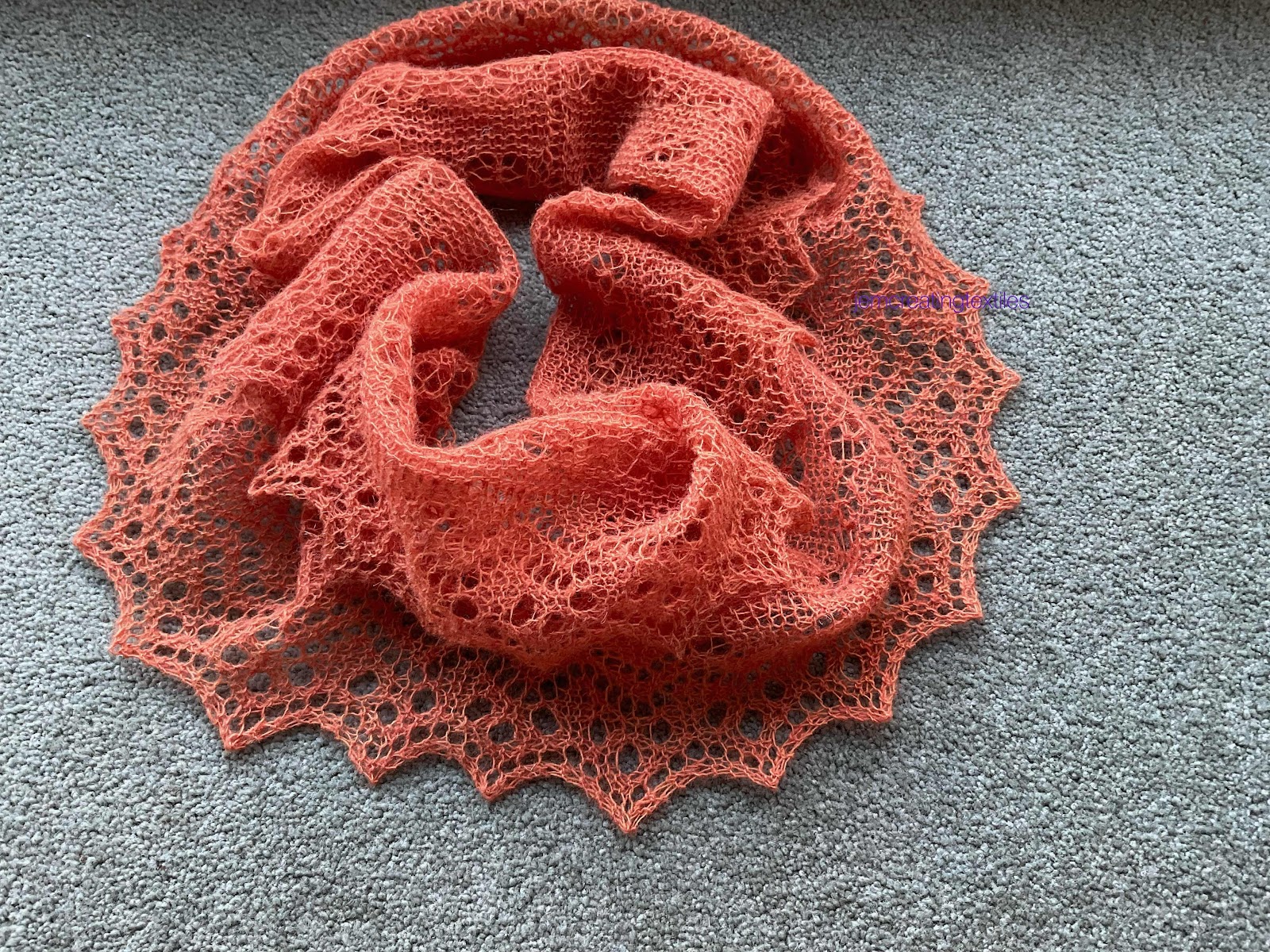
Shetland Fine Lace Cowl 2


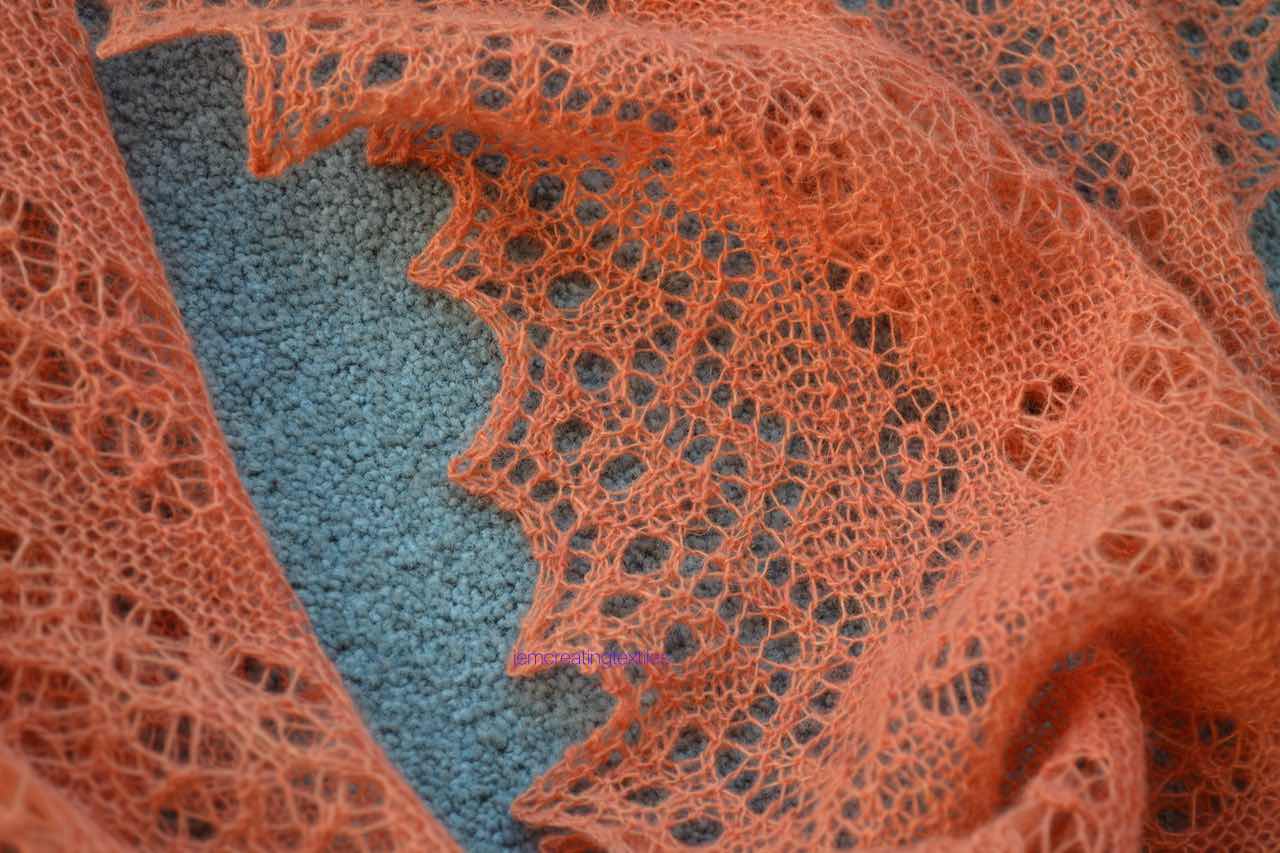
Fine Shetland lace cowl ready to wear


This is as authentic as I, a Shetland lover living in Norfolk England can make it. I have designed the structure of the cowl, based on the ones I machine knit. (1) 
I have machine knit several of these and have them in colours to match all my different outfits. They are technically a challenge to knit as the yarn is very fine, 40wpi approximately. ( 2) 

The yarn used: 
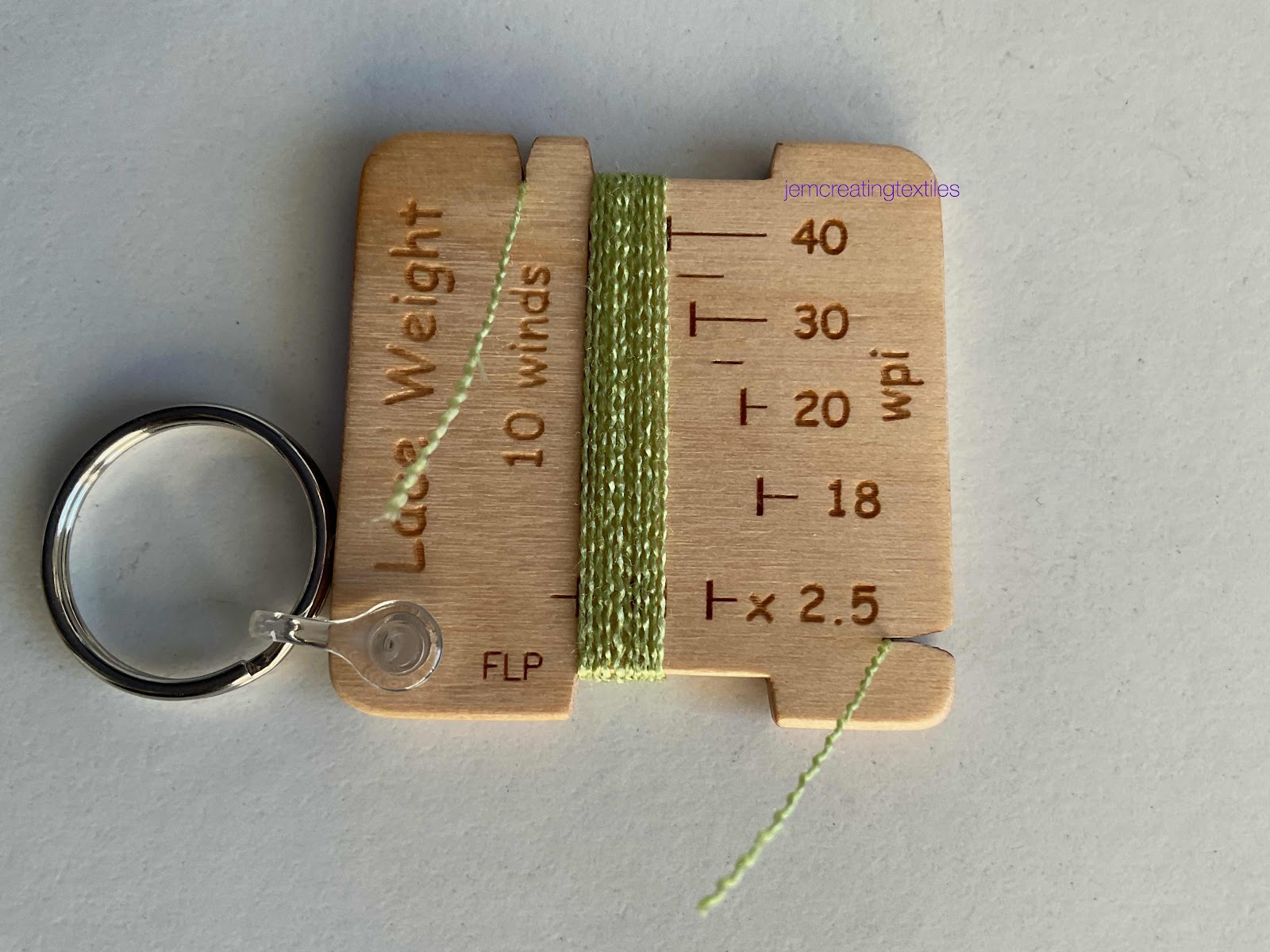


Full concentration is needs for all of the machine knitting time.They are knit in synthetic yarn, which I ‘kill’ as part of the finishing process but they give a super drape and I wear them throughout the year. ( 3)


My first fine hand knit Shetland cowl was inspired by these characteristic cowls of mine, was this one. 


moss green one, see the link below for more details. 
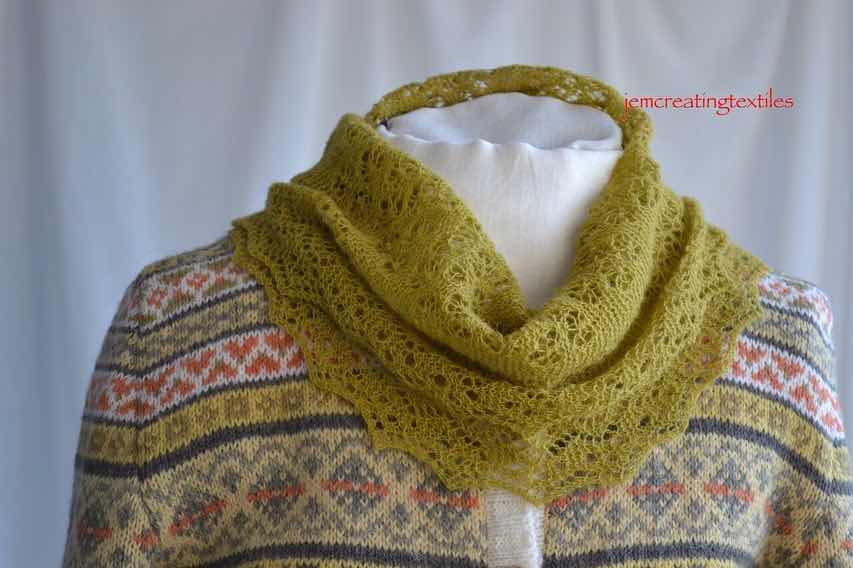


What do I mean when I say it is ‘authentic’ ? I have used individual motifs in the cowl from Shetland, particularly from Unst that have been charted by Hazel Laurensen. Hazel lives in Unst and her and other knitters and spinners of the island meet at the Heritage Centre there and do all they can to raise the profile of the rich heritage of fine lace knitting in the island. Some years ago I took an advanced lace knitting class with Hazel during a wool week and try and meet up with these ladies when we are in Shetland. Do look at this website which will give you some idea of the wonderful items they have there and the patterns that are available to purchase. (4) 


So most of the motifs are from Unst. I also used 2 techniques taught to me by Elizabeth Williamson (5) the Betsy join and knitting on an edging. She is a Shetlander by birth and comes from a long line of Shetland Knitters, she gives online classes where she is actually there in the class with you. So the joining techniques are authentic Shetland.


The yarn I used is Jamieson and Smith 1 ply cobweb. (6) It is strong enough to go through the vigours of my natural dyeing and when dressed gives a wonderful lace structure which shows the design so well. If you follow me you will know I usually dye my yarn with using plants from my garden and surrounding area. This one is no exception and I used golden rod, in the early stages of the plant coming into flower with a madder overdye. Originally the colour was devised to match a Harris Tweed from Harris skirt that I made but I can see it being worn with lots of other items. 

Finished weight is 22g. 


So some more photos of the cowl. 

Dressing- I had fastened off most of the threads, there were only a few. But not cut them off until after the dressing. This spent about 3 weeks on the board. 


The edging was knitted on, the join is between the insertion and the edging. I am very pleased with this technique
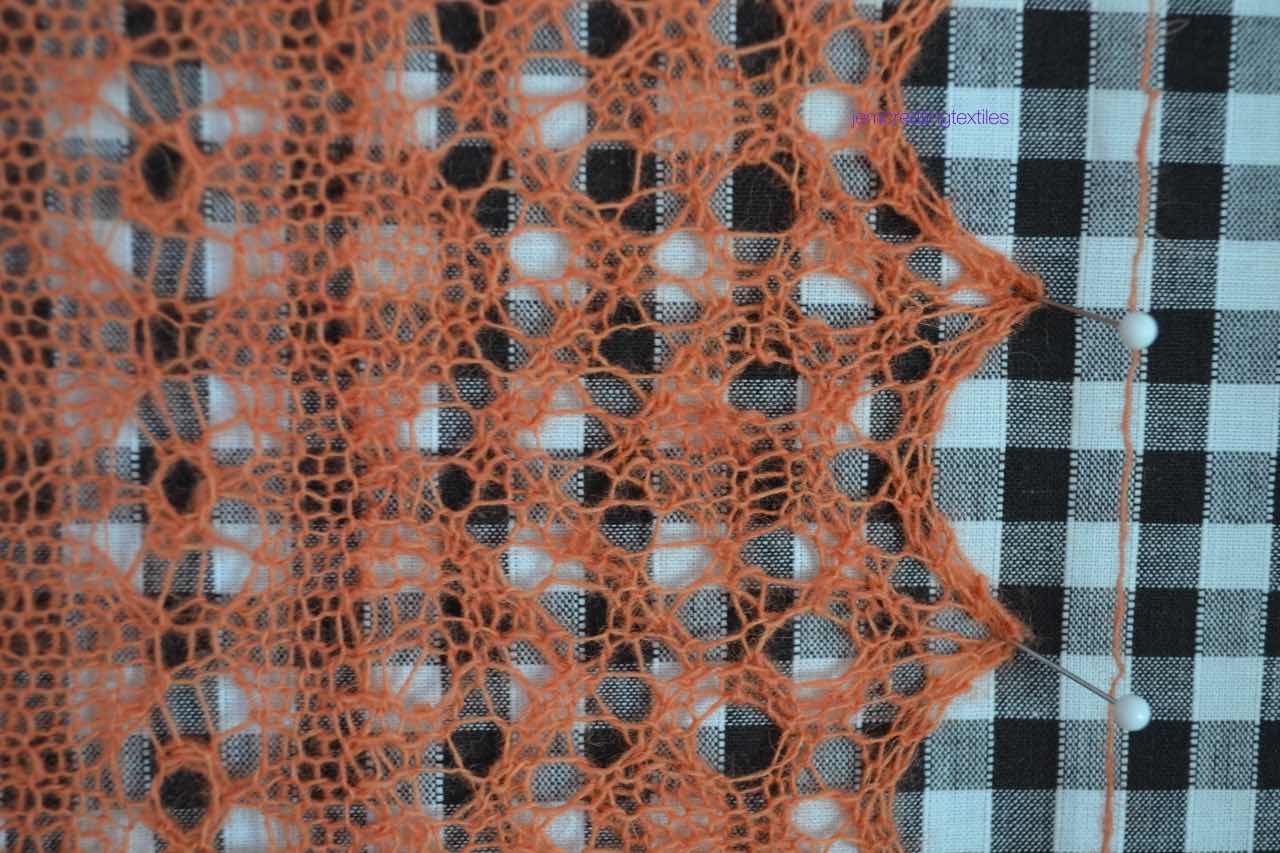


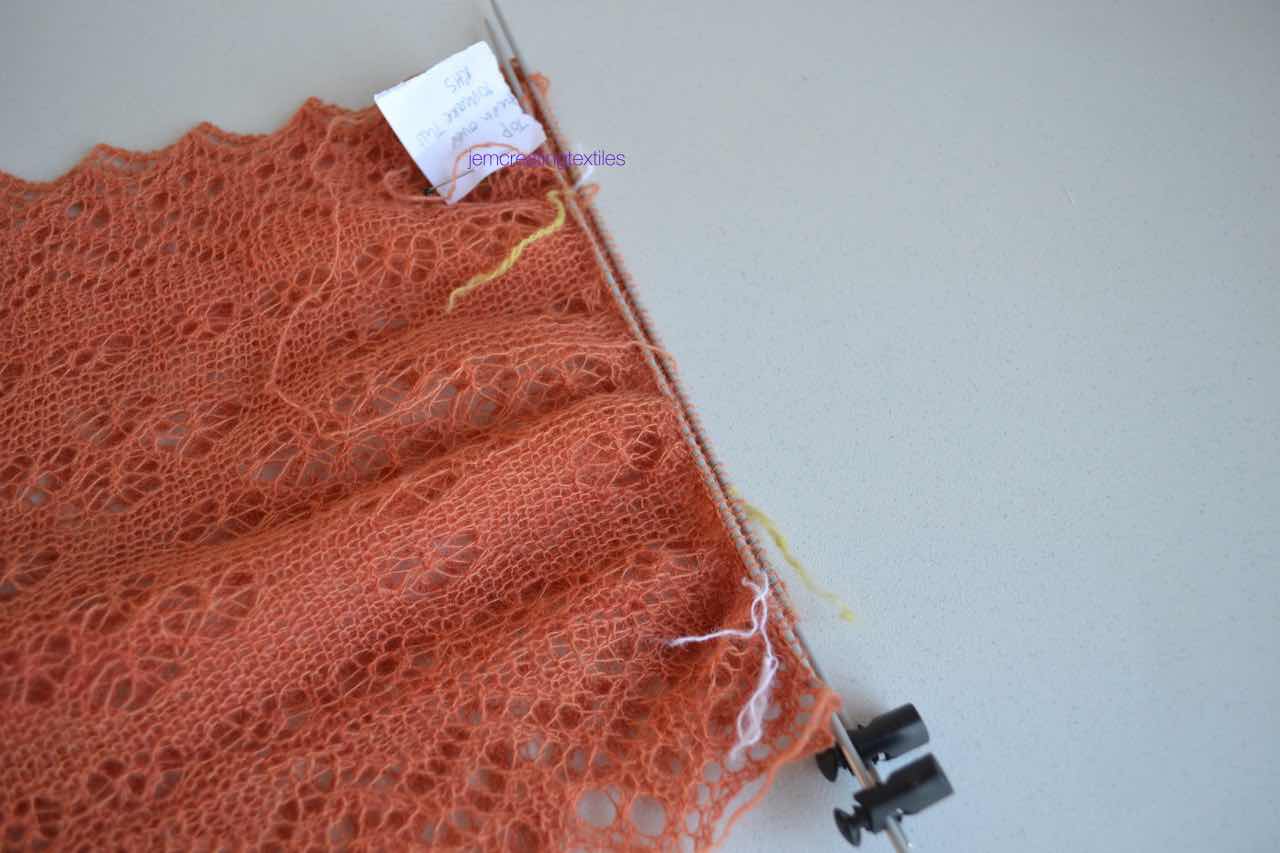
Waiting for the Betsy join
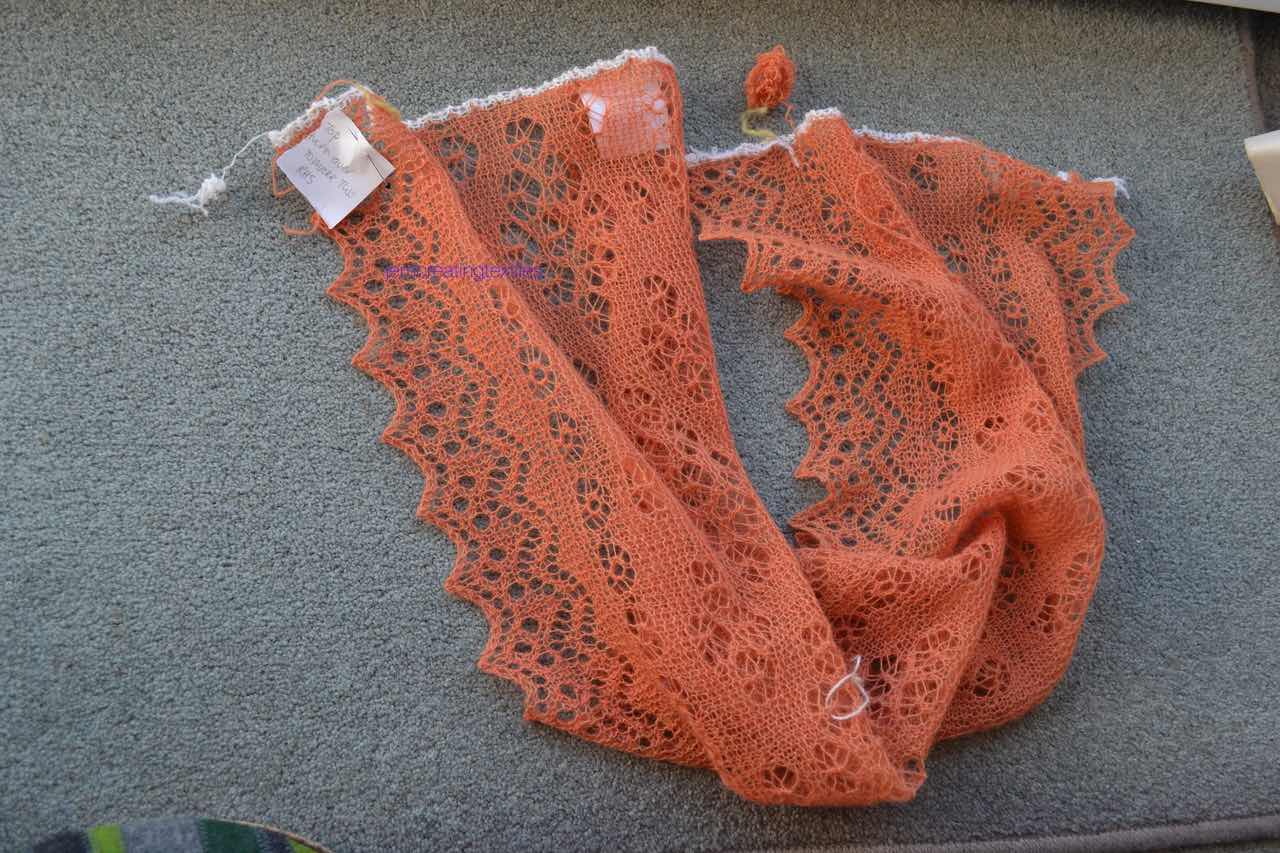


More detail of the motifs I used


Betsy join about to happen, it will be up the centre back and invisible but it deserves  a super join. 


Completed Betsy join, well worth learning as it is so delicate


Completed cowl on my body duplicate as it will be worn. I absolutely love how this has worked out and it ‘sits’ very well around the neck. 


So all in all this is as authentic ‘Shetland’ as I can get for someone who is not a native! I hope it shows how  much I value the skills, techniques and yarns of Shetland and it’s spinners and knitters and hope that by supporting the tradition in this way it can continue, evolve and be appreciated. Thank you Shetland and all who help me on my journey, you know who you are. 


I will be asked if there is going to be a pattern, I always say no but I might say yes this time! 


Notes

  1. I showed examples of my machine knit ones and the previous design for the similar but constructed differently olive lace cowl in this post http://imagejem.blogspot.com/2022/01/
  2. Please email fleecelovedproducts@gmail.com for availability of this super gauge. The other side is for cobweb yarns. The crepe nature of the yarn which you can see is why I say ‘approximately’.
  3. ‘Killing’ this synthetic crepe is a well known technique to machine knitters, it involves steam and patience. 
  4. Unst Heritage Centre http://www.unstheritage.com/web/unst-heritage-centre/
  5. Elizabeth Williamson knitting https://www.elizabethwilliamsonknitting.co.uk
  6. Jamieson and Smith https://www.shetlandwoolbrokers.co.uk


Friday, 24 June 2022

Shetland Lace Knitting : ‘joins’ in a mini hap


I have mainly chosen to knit rectangular scarves/ stoles/ shawls. There are several reasons for this but  the three main ones are: more wearable for me; I first saw the very fine lace Unst examples and wanted to recreate these; their construction with invisible joins appealed to me a lot! I also found that as I became more skilled in the construction and techniques I could personalise these by using my own chosen combination of motifs. 


During one wool week I took a mini hap class (outside to inside)  with Donna Smith so I could become more familiar with the construction of a square hap….. I quickly learned that there were many ways of constructing a hap and doing the joins! It took me a long time to get round to finishing this hap. 


I am a firm believer in trying out a technique first, often using larger needles and yarn and then when I am happy with the different techniques I can scale down the yarn and needle size to suit my preferences for something very lacy. Eventually I finished the hap but was not proud of what I had achieved. 


I continued to knit fine lace and more recently use my own naturally dyed yarn for this. Then I became very fortunate, Elizabeth Williamson, daughter of Betsy Williamson from Shetland, moved to Woodbridge and started teaching lace knitting! This has really broadened my horizons as I have knitted in different yarns, learned to knit different shaped shawls, learnt many more Shetland techniques, many that I did not know I did not know and generally had a great time! 


The most recent project we have been doing is a mini  square Shetland lace hap, again outside to inside. Illness got in the way and I needed to wait for the next stage (we are fortunate in meeting with Elizabeth in person, although her workshops can be taken online wherever you are in the world.) It is a very clever and lovely design. I have posted about it here on 15 June  22. 


I decided to return to the hap I had knitted many years ago whilst waiting to finish ‘Elizabeth’s’ hap. I wanted to try different ways of joining the mitres where the wedges meet  and also joining on the sides of the centre to the two wedges (trapezoids). I ignored the outer lace at this stage and just knitted in garter stitch. Some of the wedges I did the decrease on the outer stitches and some one stitch in. I wondered if I could even tell the difference. One wedge would be knitted first,  before the centre and the one opposite would be grafted on. (I love grafting since I have improved my technique due to following methods given for grafting, including two sided lace grafting, by Joni Coniglio documented in some recent  posts here in this blog). 

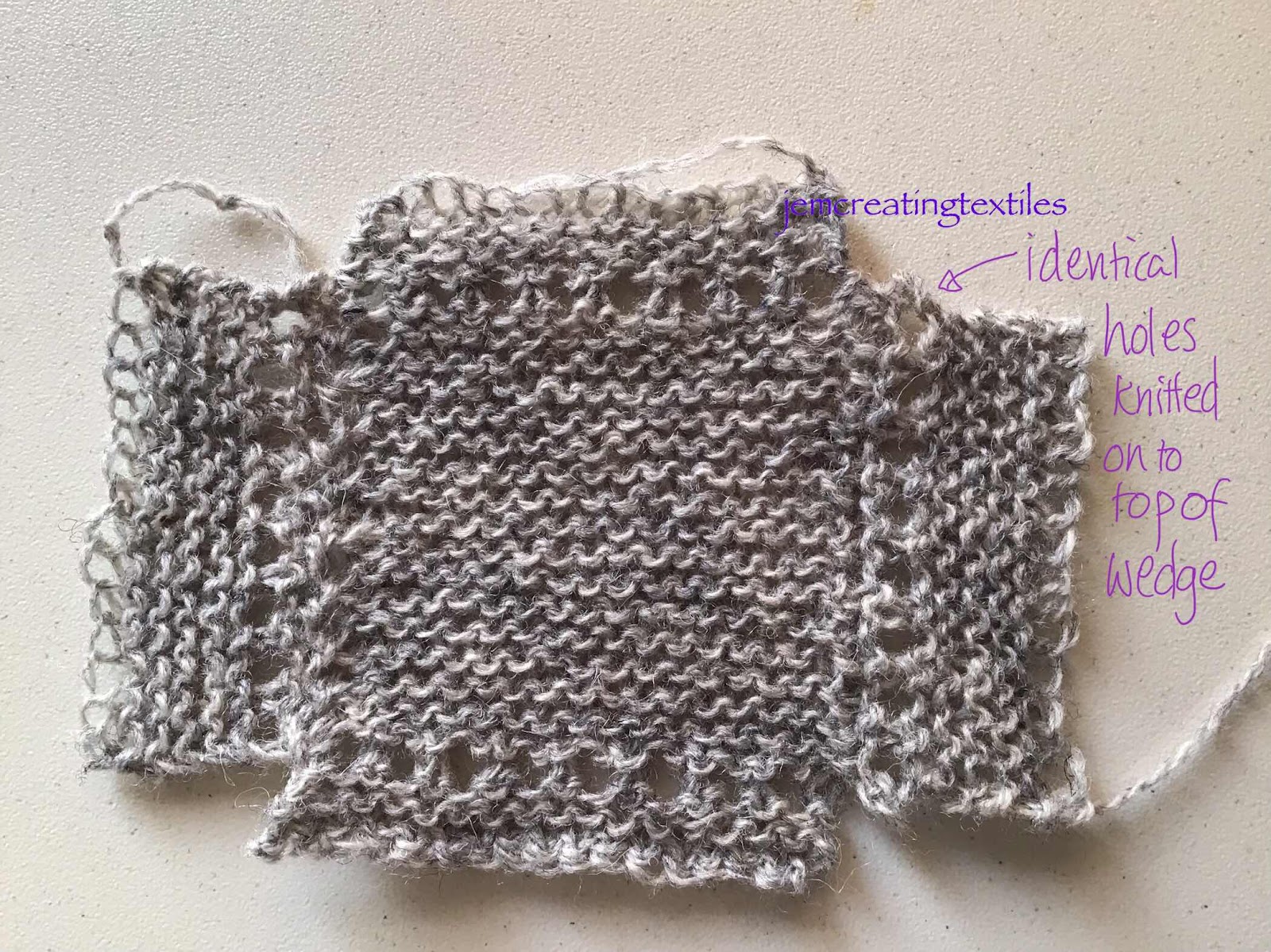
The other important consideration to me was the holes around the centre of the shawl, I aimed for the holes to be identical and the same number on each side. 


Sample one

Hap  with holes on each side and the garter stitch graft on the side opposite where I started.

In this instance I am happy with either a herringbone stitch or whip stitch join for sides 2 and 3 to the centre 


Sample two 

Knitting another sample to see how slipping the first stitch and then doing a whip stitch join can look. I like the neatness of the holes formed and one to add to my repertoire but not for joining the edges of the centre square when I have already knitted the holes around all 4 sides of the square. 


Sample three 

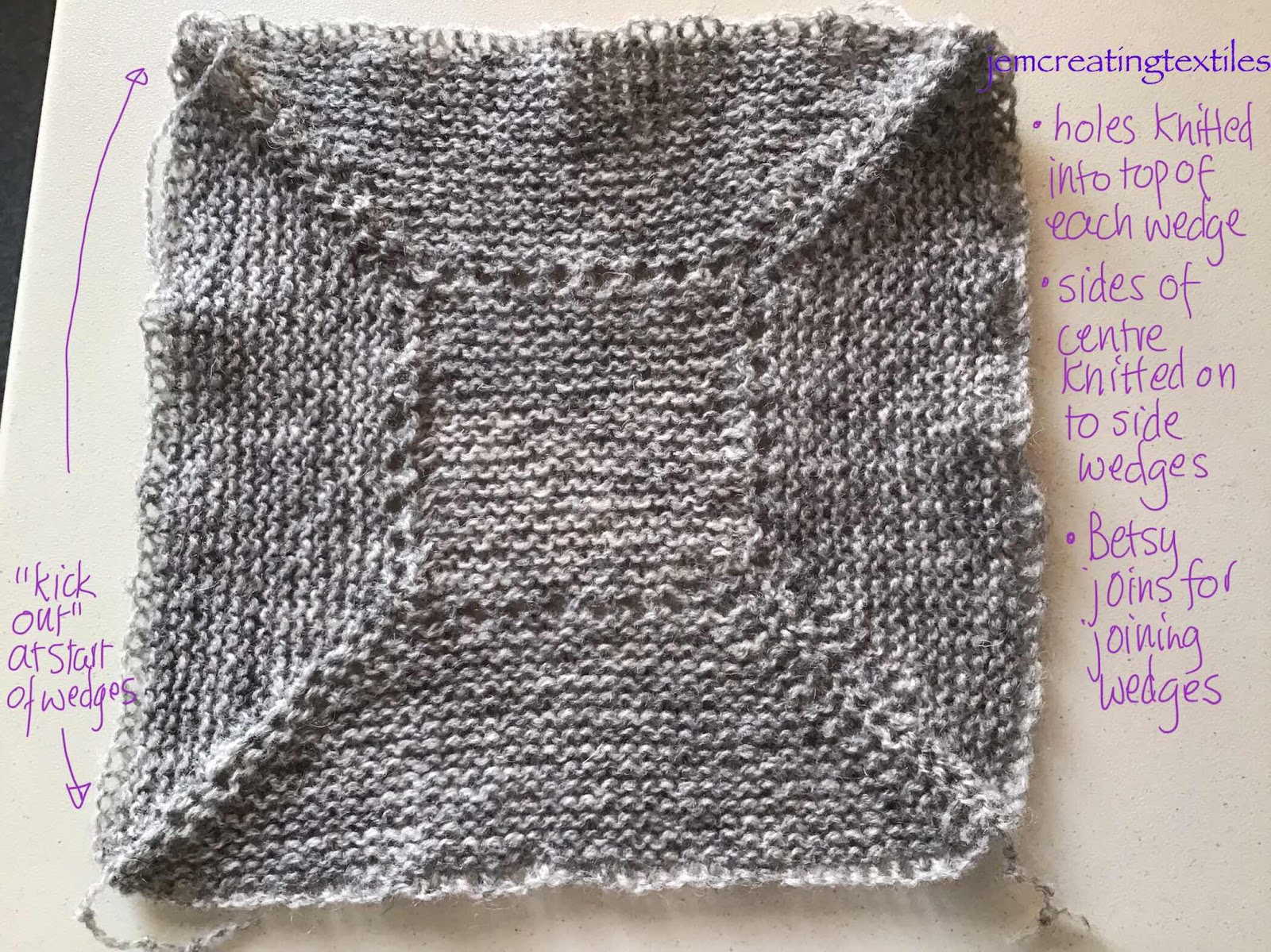
Bigger and with proper wedges. However, I shaped these by decreasing on every  other row from the start, outer edge, and look how they kick out at the outer edges! This must be why Shetland Hap Knitters often / usually  have some straight rows before starting the decreases to make the mitres! 

Happy with the holes and happy with how I joined on the side wedges by joining  them on as I knitted the centre 

Each wedge forming the mitres is  joined to two other wedges with versions of the Betsy join as I interpreted it in 4 different ways based on Hazel Tindall’s  demonstration in the 50 tips from Shetland Knitters  DVDs which she did with Elizabeth Johnston (3). I was waiting for my personal tuition of the Betsy  join for Elizabeth’s hap, which explained and clarified  the method. (The equivalent wedge joins after my personal tuition are shown in a previous blog post Elizabeth’s  Mini hap)


So onto a much changed version of Donna’s knitted hap from the earlier workshop. 

I used Shetland Supreme 2 ply yarn, which I naturally dyed with Alchemilla and Madder. I used size 3.25mm dpns. 

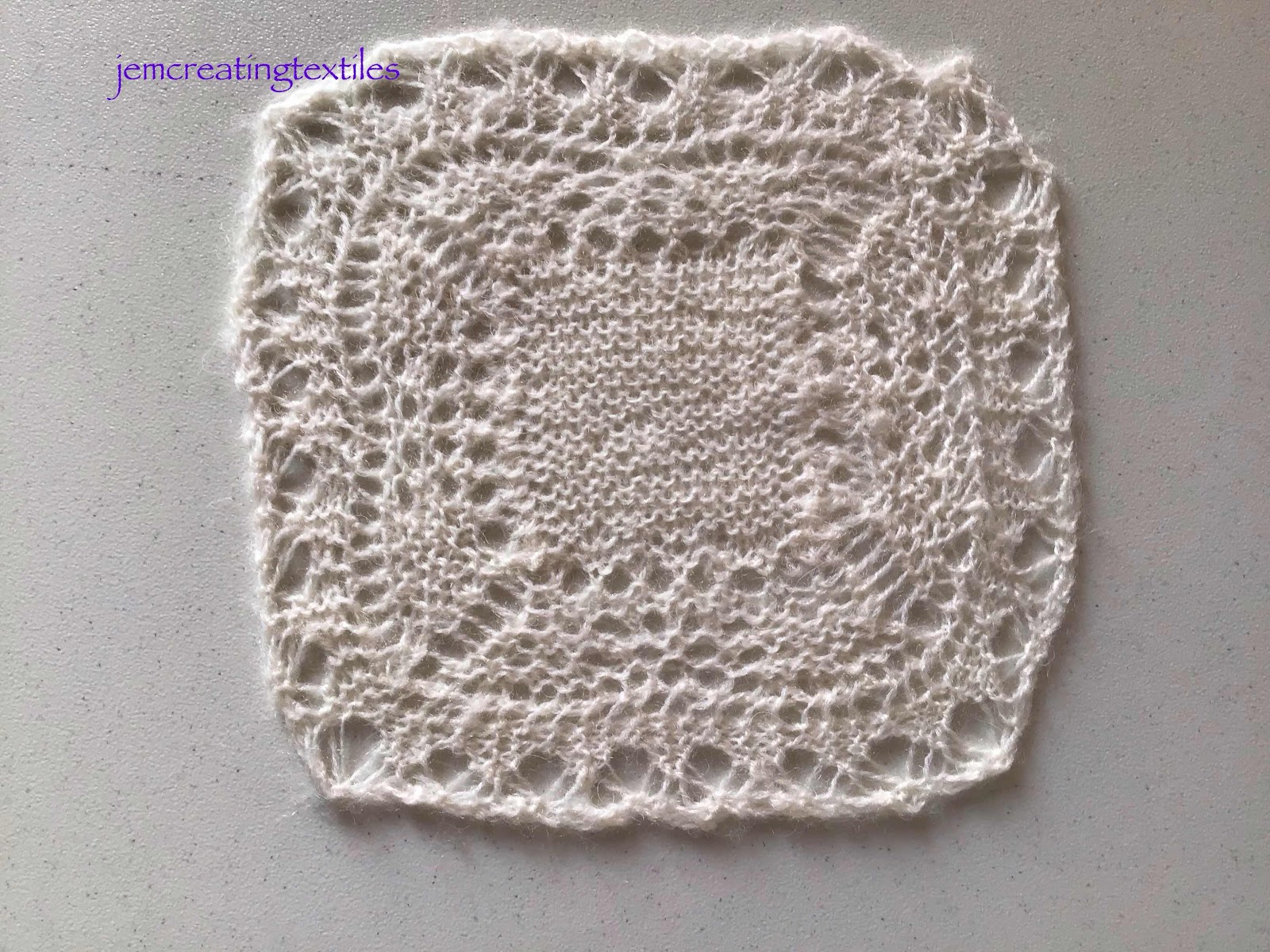
Image of the modified hap 


This has benefited from workshops and discussions with the following Shetland Lace Knitters ( I hope I have not missed anyone out, apologies if I have): 

Kathleen Anderson 

Anne Eunson 

The late Ina Irvine

Elizabeth Johnston 

Donna Smith 

Betsy Williamson

Elizabeth Williamson 


And also Tessa Lorant for the Buttercup Edging in her book  ‘Lace Edgings’ and Joni Coniglio for enabling me to graft lace invisibly


…..but basically the interpretation is mine and I now have managed to work out a variation of the 2017 Mini Hap that I am happy with. 


Order of construction 

Lace edging knitted first, graft completed the Joni Coniglio method

Stitches picked up along a quarter of the peaks, then board/ wedge knitted including the row of holes and return row

3 more boards  completed by picking up stitches along a quarter of the outer peaks for each one,finishing as the first one. 

Returning to the completed first board the centre is knitted picking up one stitch from boards 2 and then 3 on every other row but finishing 2 rows short. The remaining stitch left from each side board is placed on a separate yarn holder. 

The centre is then grafted to the fourth side board including picking up the remaining  st from the side boards to complete the centre section. 


This leaves four  gaps at the mitres which are closed with herringbone stitch after dressing the hap. I felt the herringbone stitch complimented the Buttercup Edging of the lace border.


At last I feel I understand how I can knit a full sized hap, the many alternatives for knitting an outside-in hap and the effect of the different choices made. Planning and making swatches of the motifs and techniques payed off for me. I like to fully understand and be in control of all that goes on in making a knitted item. Perhaps the late Elizabeth Zimmerman should be added to my list above. She certainly encourages this approach! 


Monday, 1 June 2020

Fine spinning and communicating the details


Last summer I started a natural dyeing project, which I am going to write up when it is finished. My current  Fine Spinning project is an unexpected offshoot of this. During the dyeing, for one aspect I needed to dye some silk and wool in the same dye bath and found a blend of the two fibres advertised. The dyeing is being completed under strictly controlled conditions and each different dye bath takes several hours to complete. The silk and merino I had dyed looked marled and when I viewed it under the microscope I was stunned, the ‘silk’ had not taken up the dye at all. In fact the threads looked too smooth to me to be silk. I contacted the supplier who was reluctant to accept my explanation, until the microscopic results were seen. Costs of the fibre were reimbursed but of course not my time. 

So, after this I repeated the dye bath I had been investigating with some hastily spun silk and some separate merino.  As expected both dyed but given the silk was not spun very evenly (1) the colour varied depending on the diameter of the yarn spun. Hence I decided to take upon myself spinning my own fine yarn, both wool and silk as I could be sure of the provenance of both. 


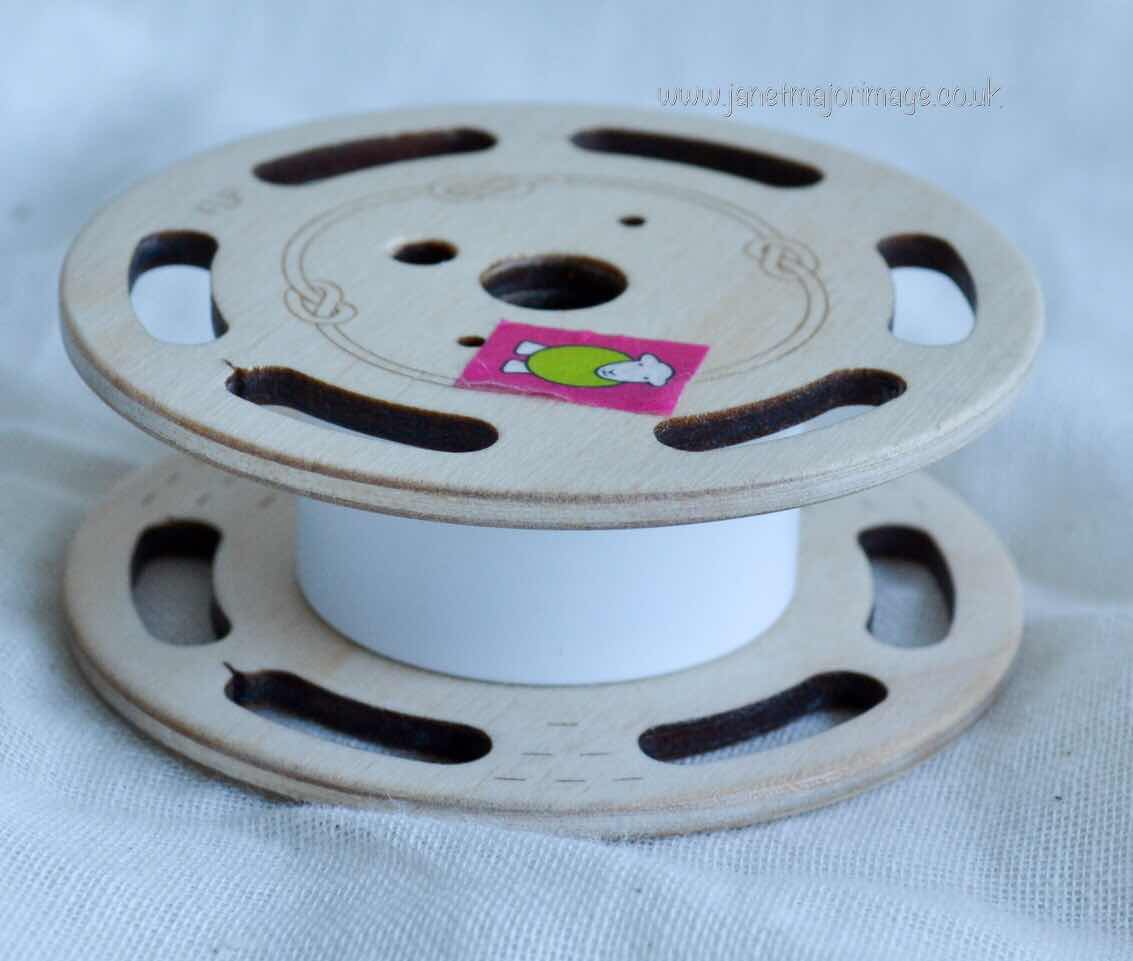
I love fine spinning, in fact that is why I learnt to spin, and I have been a member of the cobweb and gossamer spinning fb group since it started. It was from this group that I came across the  man who runs ‘Fleece Loved Products’ (2) who was developing a custom bobbin for a spinning wheel particularly for cobweb and gossamer spinning. It was great when I realised that he and his wife (a very fine spinner herself ) were to be at Shetland Wool Week. We had some correspondence before we left and decided to meet up at Ollaberry during the week where I could try one of these custom bobbins on my Joy wheel. 


What a real treat that was, sitting amongst the glitterati of the Shetland Fine Spinning ladies and trying out first of all the special bobbin and its support system on my Ashford Joy wheel and then an Ashford e spinner, with custom modifications too. I made some purchases to aid my fine spinning. 


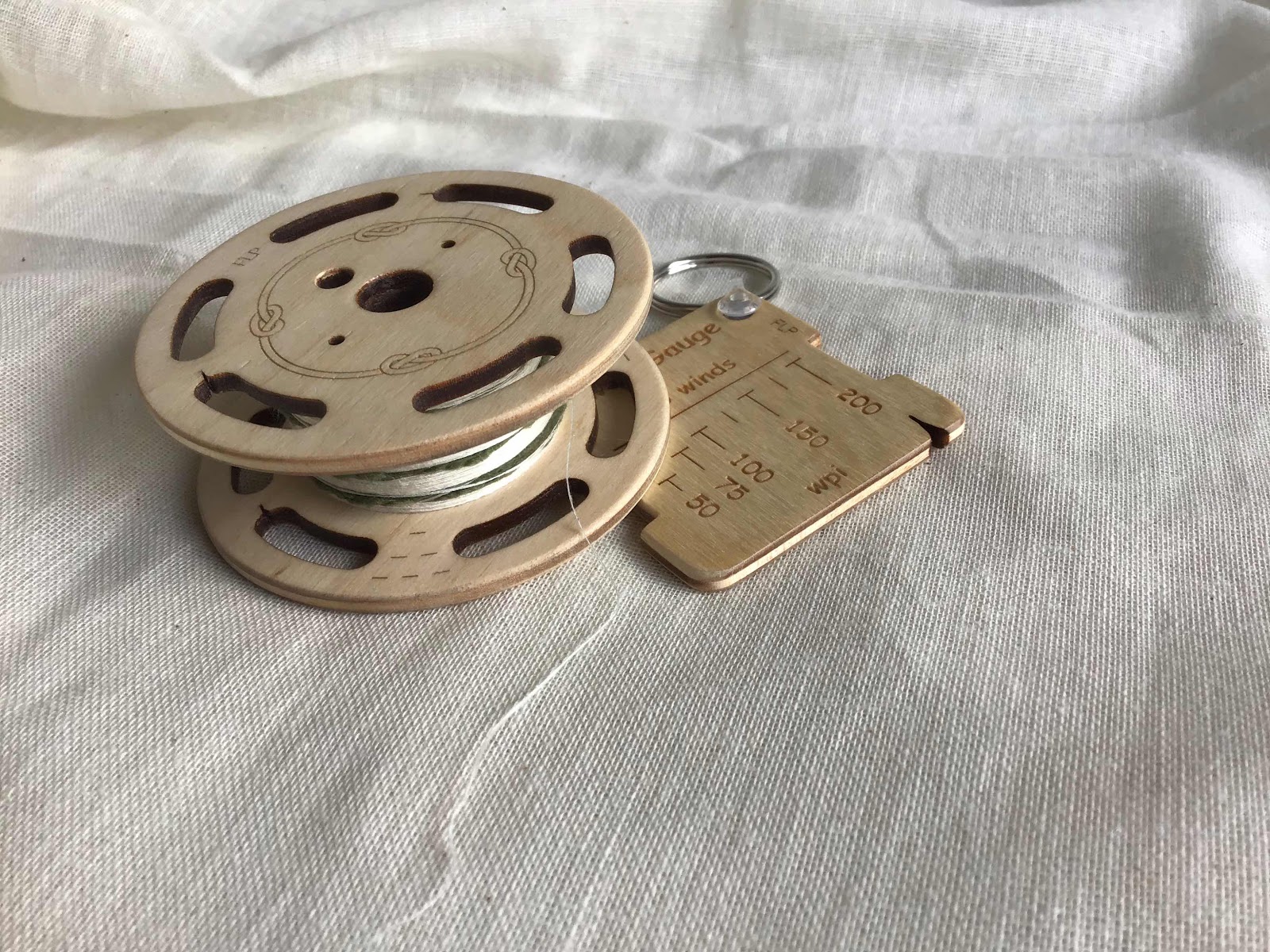
Custom Ollaberry Lace Weight Bobbin, the sheep addition is mine. 


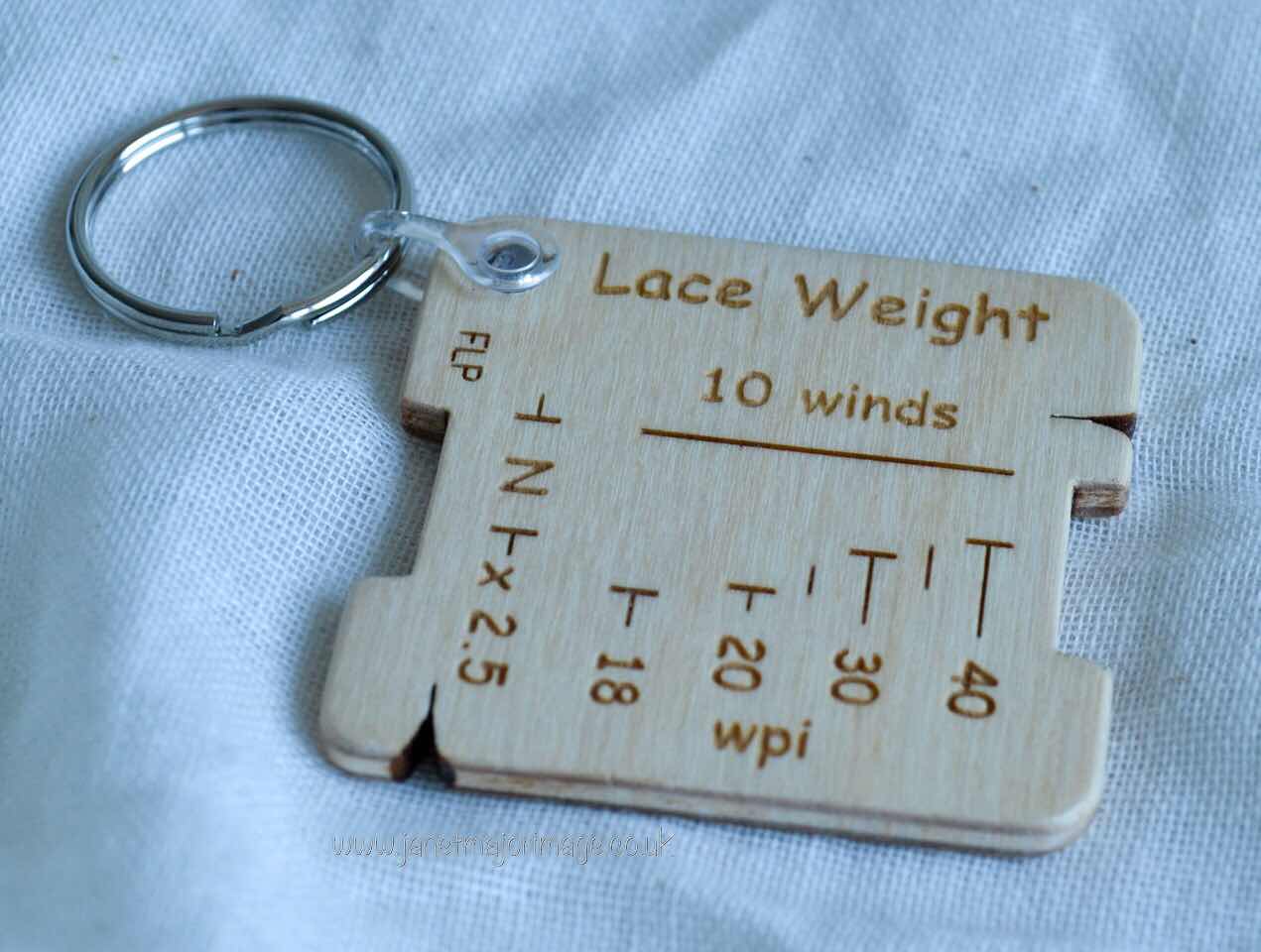
Ollaberry Lace Weight Gauge for Lace and Cobweb Yarns, both sides


So since Shetland Wool  Week I have spun small skeins of fine yarn ready to continue my natural dyeing project. 

So far I have spun: 


Silk

Lincoln Longwool 

Norfolk Horn (3)


I was going to stop there, but sorting out my spinning store I found some cashmere and Cormo so think these will now be added....


During this time I have followed postings in the above mentioned fb page and keep in touch with ‘Fleece Loved Products’ and would dearly love it if we (spinners of fine yarns) could report our spinning results in a standardised format that we all understand. Seeing a fine yarn draped across a coin of another country is not useful to me or I guess most people across the world either. 


Fleece Loved Products have more than risen to this challenge (2) and are developing aids that would really help fine spinners to measure their yarn accurately and also report it in a standard way. 


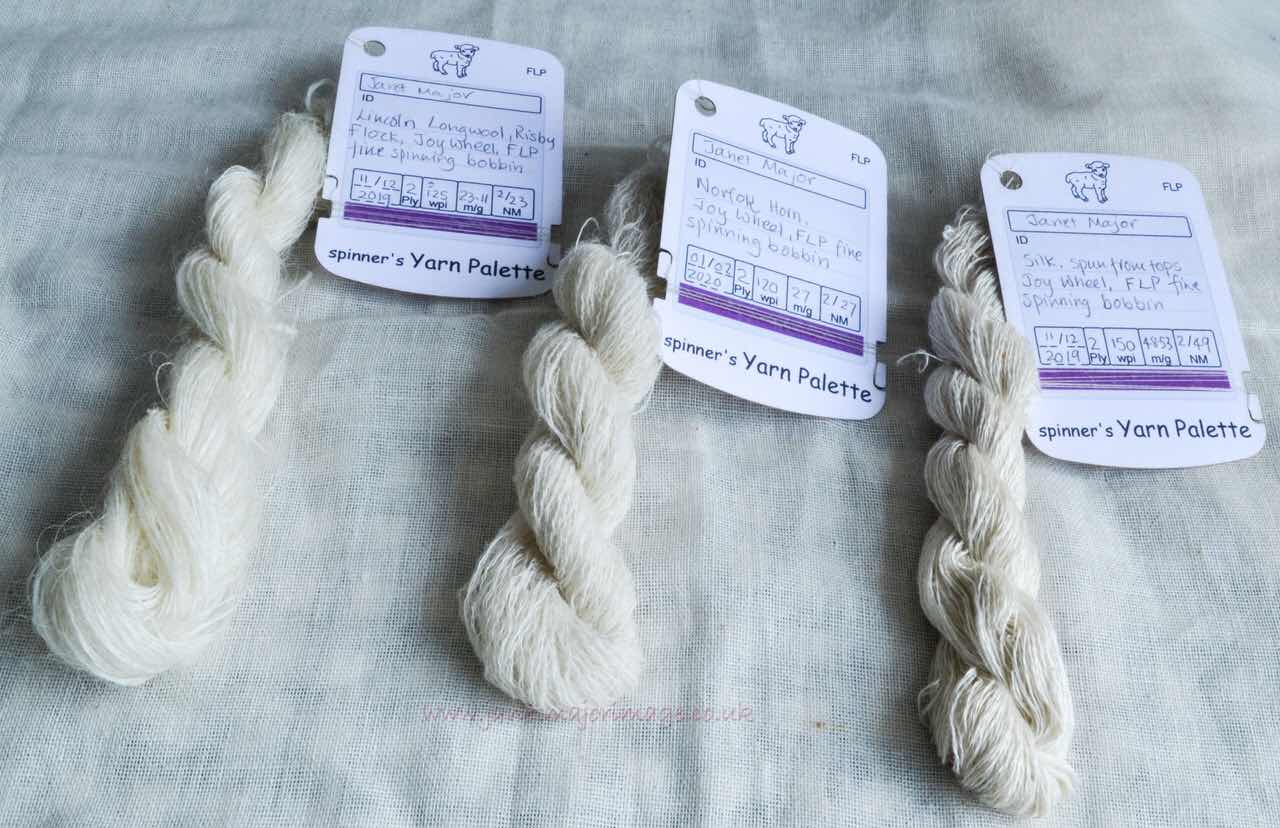
Hence the yarns I have completed follow and I hope provide the information that other fine spinners would want to know. I also have used a microscope and micrometer scale (on a glass slide) to measure the diameter of my yarns and can confirm that the wpi gauge, which is so useful when I spin a fine yarn as I use it, is accurate for diameter when compared with my micrometer measuring. 


You will see I am using a record card called a spinner’s  Yarn Palette. I find it very useful to have all the information attached to the yarn. To me the most useful measure of the gauge of a yarn are m/g and hence the NM number (5). If anyone is interested in trying a sample of this record card in return for some useful feedback I can make a limited number of sets available, just let me know. 


All 3 yarns and their details 


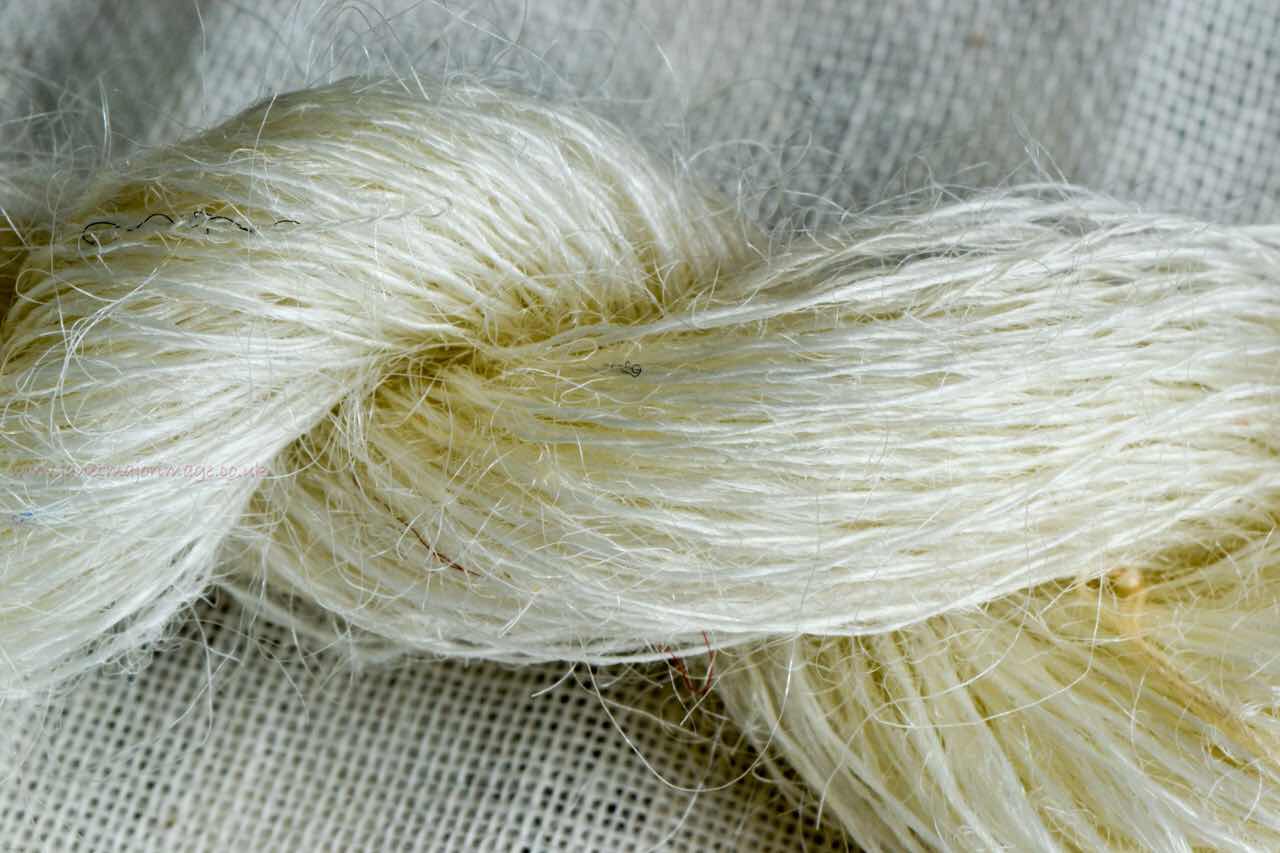
Lincoln Longwool macro


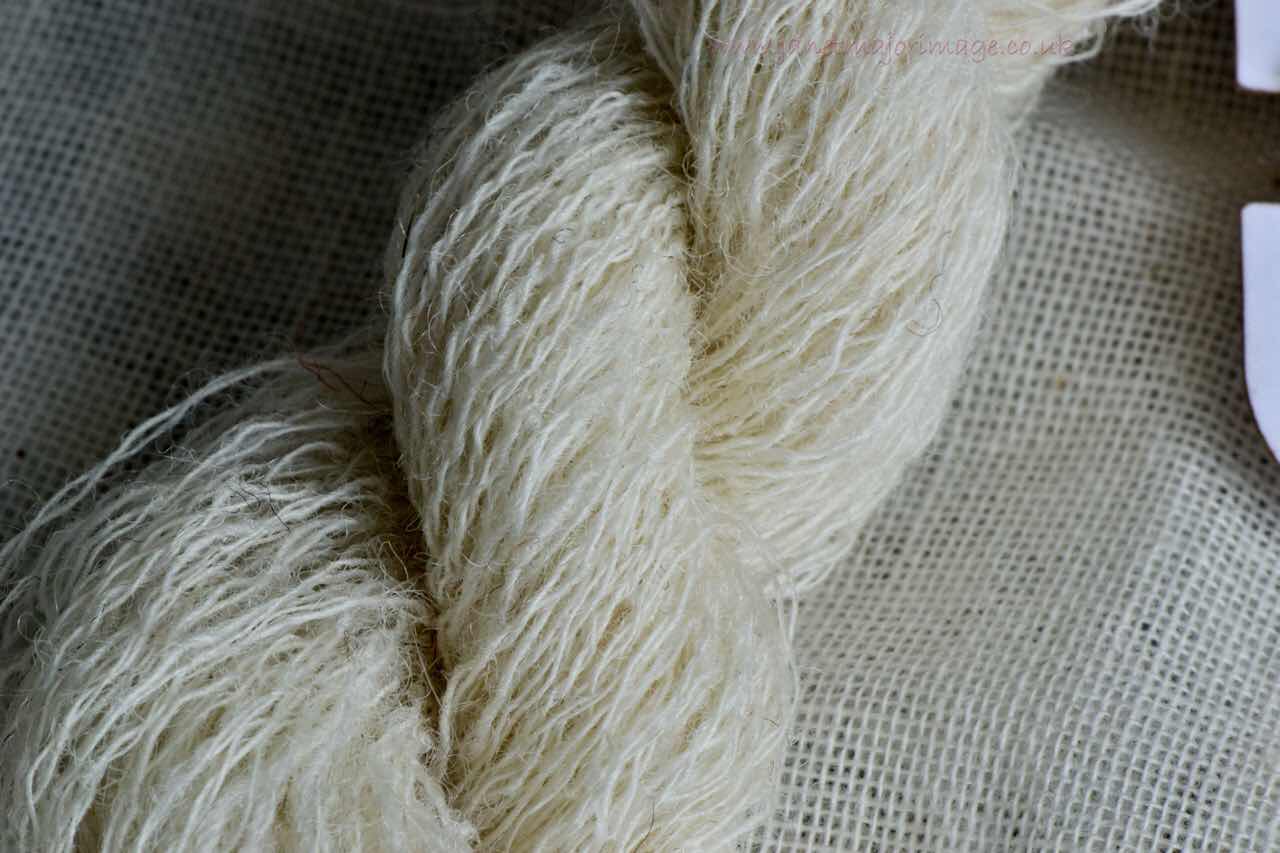
Norfolk Horn macro


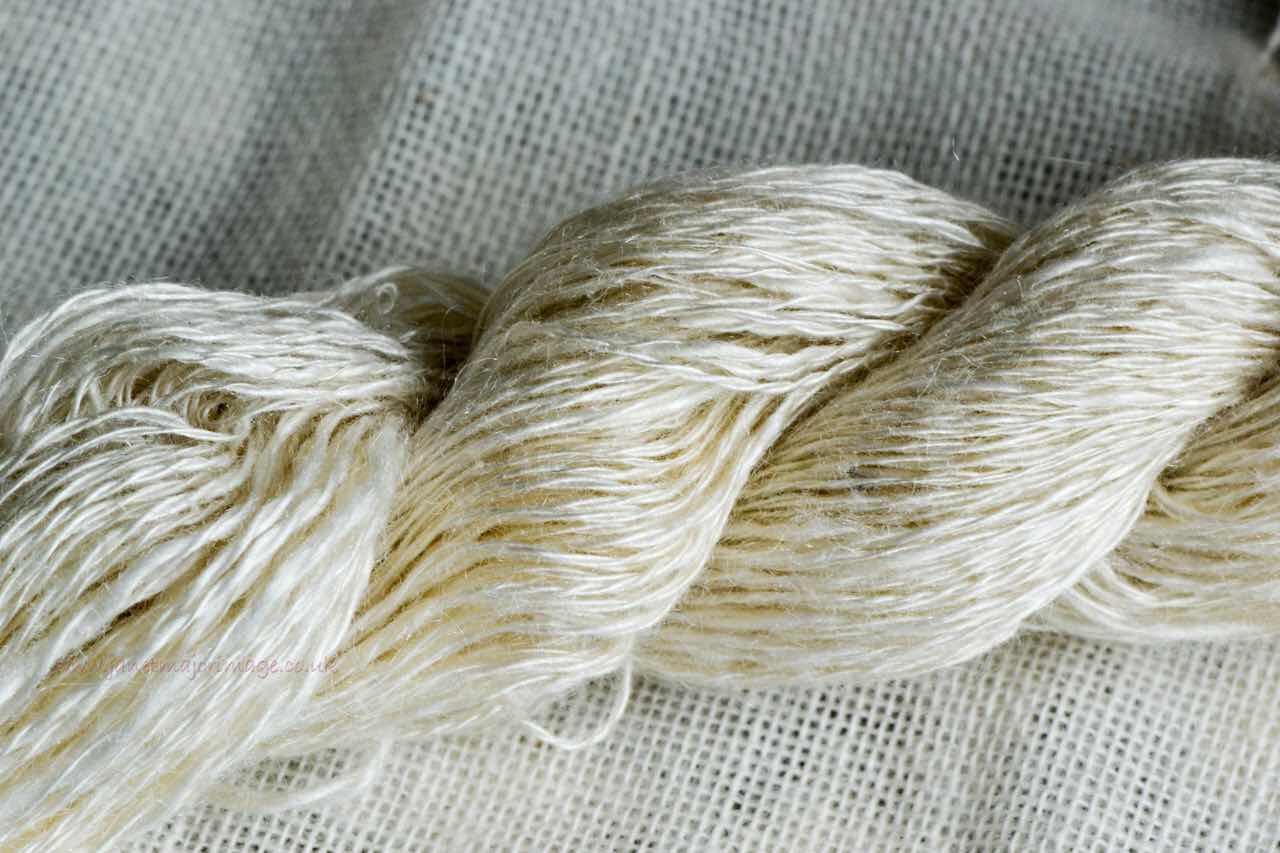
Silk macro 


I am not interested  in entering the Bothwell  Spinin ‘The Longest  Thread Competition’   but others might be and I give a link below (5)


I have just got joyfully sidetracked trying to obtain some fine silk and wool yarns that I can use in my natural dyeing project! However, spinning these  different yarns and comparing them has given more questions for me to investigate later!


Notes:

  1. The thicker yarn gave a lighter colour. 
  2. Fleece Loved Products can be contacted at fleecelovedproducts@gmail.com and their spinning products are stocked and normally available from Jellybeans Yarns on Etsy or via the Beaker Button website
  3. Norfolk Horn yarn is local to me and an historically interesting rare breed fleece. Another post, at least, is needed to discuss the historical importance of the East Anglian Textile industry. This resulted in Norwich being the second city of the land and to the wealth of the region. The breed virtually became extinct and rose from the ashes so to speak by a breeding programme that led to the set up of the  Rare Breed Survival Trust. There are theories and myths about when the breed arrived in this country and much work has been done by specialists in archeological textiles detailing what is actually known.  One excellent more general book about East Anglian Sheep Breeds is Black Faces by Peter Wade-Martins. 
  4. The NM number might look something like this NM 1/49 meaning there are 49 metres per g in the singles, if it is 2/49 it means the yarn has been plyed. Jamieson’s and Smith use this method with their cobweb yarn. I feel it is a good system, one instantly knows the fineness of the singles and hence if it is singles in the photo or plyed. There is an additional Card in with the spinner’s  Yarn Palette which explains and takes you through this calculation. 
  5. The Bothwell  Spinin ‘The Longest Thread Competition  https://bothwellspinin.com.au/the-longest-thread-competition


Sunday, 12 January 2020

Shetland Wool Week 19: 13 Ollaberry plus

Tues Oct 1: Day 16 

This was a day without any classes.  I had planned to go to Isleburgh Knitters and Spinners again this year in the evening, but realised that if I did I would be so knocked up I wouldn’t cope with my classes on Wednesday and Thursday. 


We started off in Mackenzies as we usually do in wool week for our second breakfast. Then it was a quick trip along to Isleburgh. I had arranged with Bunchy that I would pick up my Natural Dye Colours from Shetland book before her class. I knew how frantic preparing for the class might be so I had the money ready in a sealed envelope and all I had to do was swap it for the book. I had followed  the progress of the book on IG and I believe I was the first person to put my name down when Bunchy said she was producing this book. (1) I had seen the book in Unst as Helen got her copy when she was on Mainland and brought it along to our dye workshop  on the Wednesday evening. Taking as little time as possible I got my hands on the book. 

We then parked the van at the museum and went in for a coffee. 

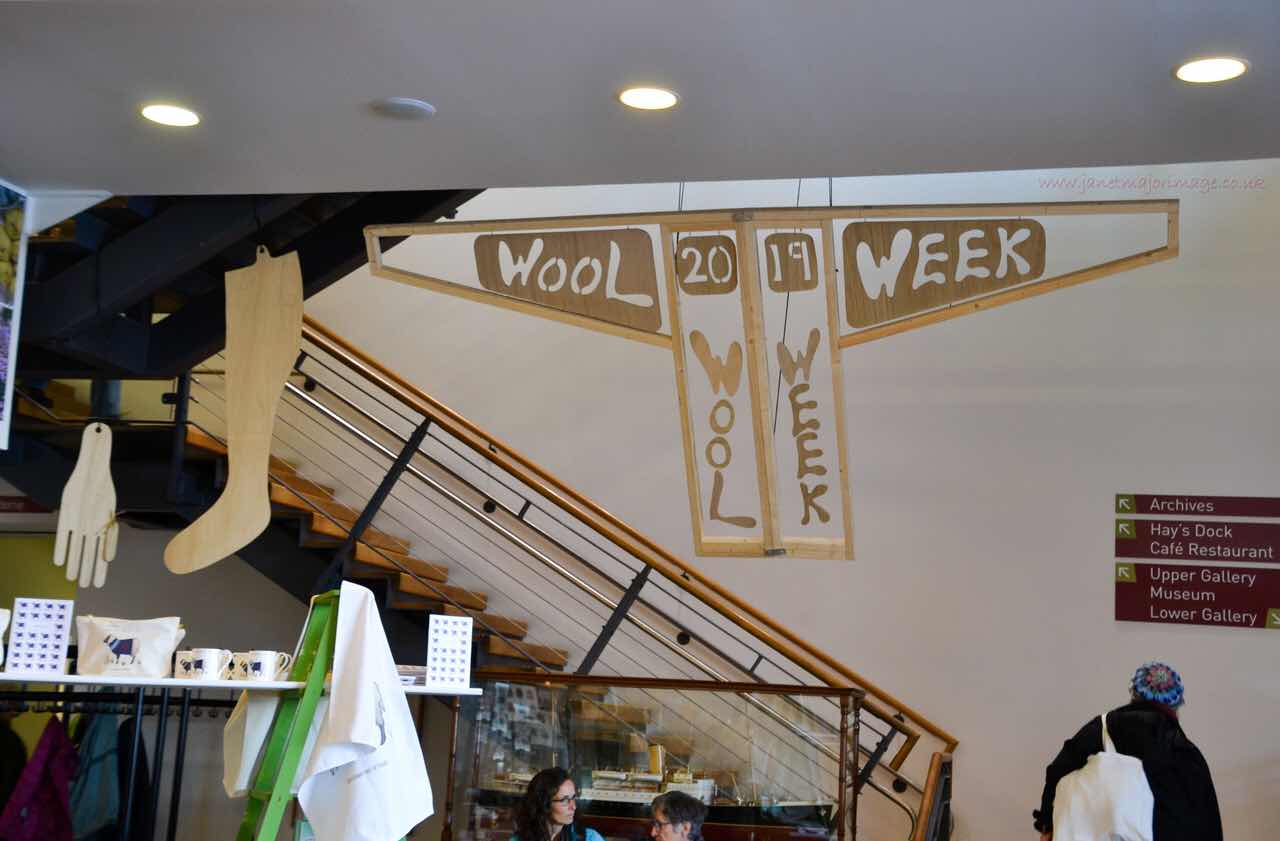
Entrance Hall Of the Museum


This was my opportunity to have a closer look at the items belonging to the patterns in the SWW annual and also to look round the knitwear section of the Museum. It doesn’t matter how many times I look round I always ‘see’ more things. I was particularly interested in grafting in shawls this year. 

So first of all the Hub where the Annual Knitwear display was - it was good to see how Elizabeth (Johnston) had mitred the corners on her shawl pattern in the annual. 

What a mitre! 


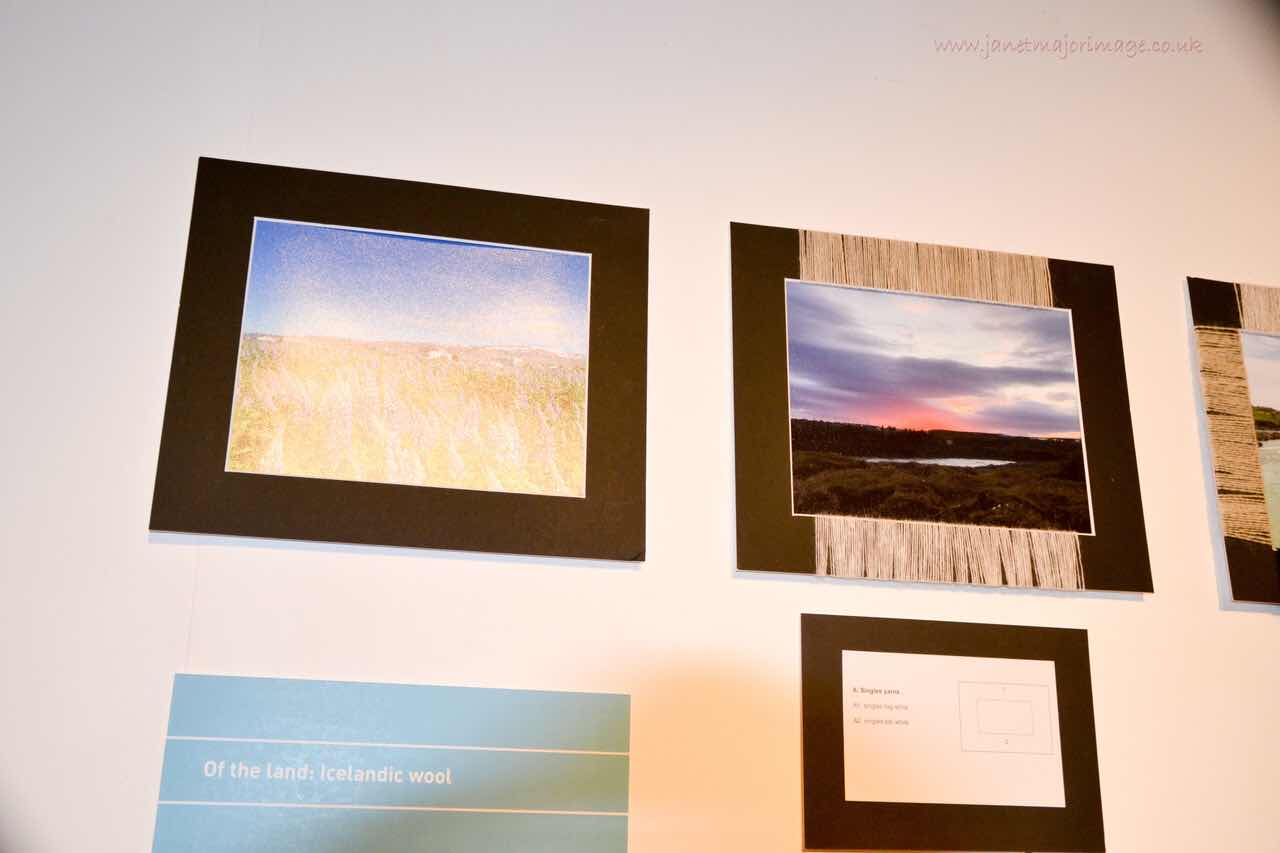
The museum hosts other exhibitions of interest during wool week. One such was from Deborah Gray:  ‘Of the land: Icelandic Wool’ from her time as an artist in residence there. The frames are bound with hand spun wool, naturally dyed. During her time there she explored the differences between the two different wool fibres in the fleece  and the effect of natural dyeing on these. 


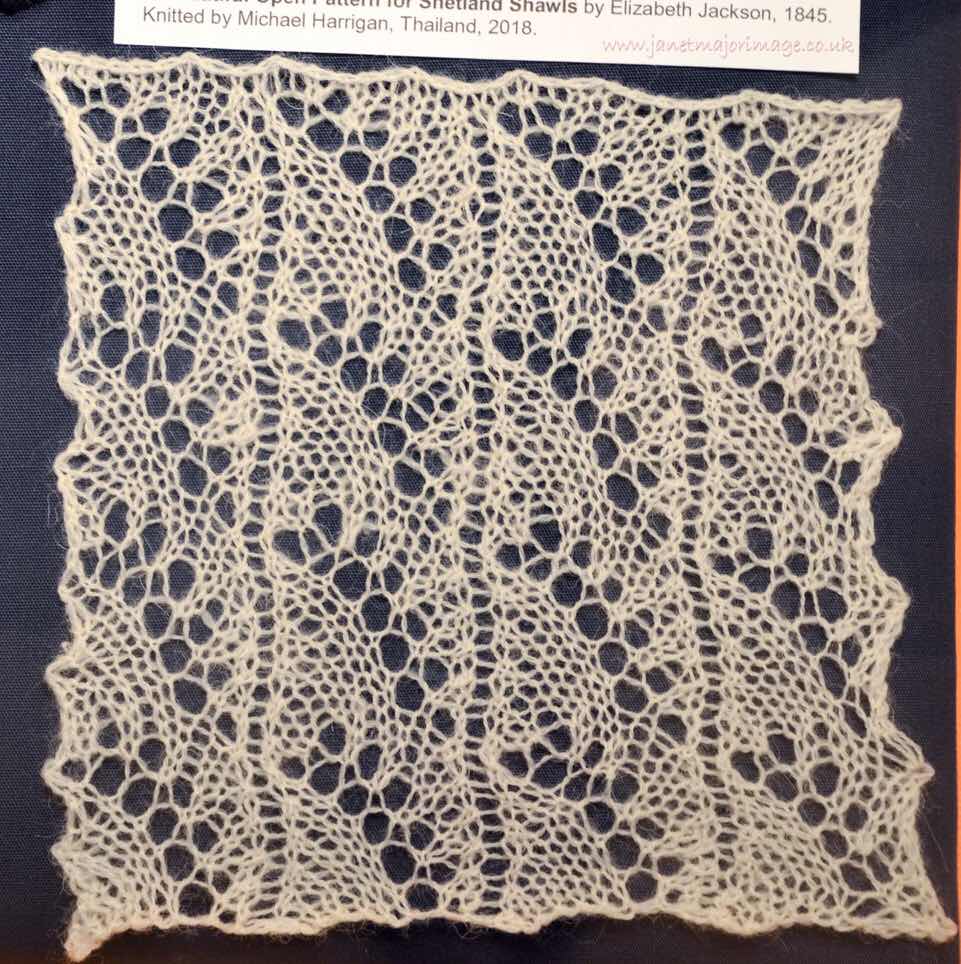
While looking around the knitting section my eye caught a glimpse of a name I was familiar with from a fb lace knitting group. I duly messaged the owner, in Thailand,  who was really pleased that I had noticed this. He had answered the call some time ago to take part in the Nottingham-Shetland Lace Research Project and had sent in his samples in 2018. He did not know they  were exhibited in Shetland Museum and was very pleased to be able to see photos I sent him. Another example of the wonders of fb! (2)


Then I had to return to look at the exquisite examples of the ‘so fine’ lace and tell myself to be patient. I am spinning fine, I just need to do metres and metres more and then design my own shawls just like these truly amazing women did. 

We left at lunch  time and were going to drive up to Ollaberry. The day was warm and bright, what a super journey we were in for. 

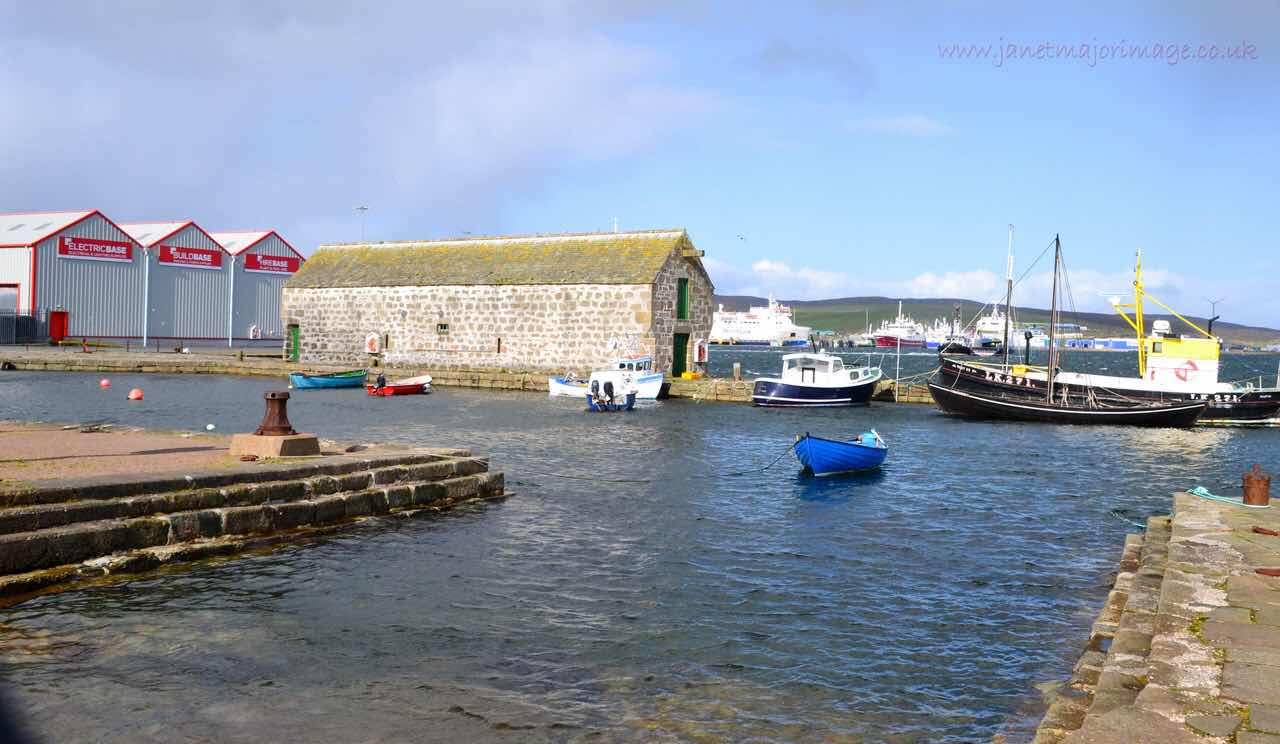
 Hays Dock by the Museum, it was October! 


Ollaberry is special, it is associated in my mind with much marvellous lace, the ability to talk to lace knitters with real expertise and great food. We decided that we would have our plate of food when we got there and call it lunch! 

We were too polite to be the first for the spread, but were encouraged by the ladies serving that this would be good. As we sat down they told us they were expecting a coach tour, this was  one  of the tours put on for wool week and it must have been full considering the number who came in for lunch. As always it was a wonderful spread and after the coach had left more food was added and one would not have known 50 or so people had just been in for lunch. 


We had come to Ollaberry this day in particular as I was going to meet Gordon (Fleece loved products) and his wife Gill. I had been in touch with him before we left home and I was hoping I could buy  one his fine lace bobbins and the brake system that he had customised for my wheel. Kate had told me how great they were and so I was very excited by this prospect. We met and I used the said system on my wheel and was delighted with it. It was great to be involved with these expert fine spinners such as Betsy Williamson who the bobbin, named the Ollaberry bobbin, had been expertly designed for. This was one of the major highlights of my week. I decided to have enough bobbins to spin and ply the yarn this way and also purchased an Ollaberry Lace Weight Gauge (and one for another Shetland Spinner and knitter) who had seen Gordon on Saturday and not acquired one. As a bonus I was able to try Gill’s Ashford electric spinner. I didn’t expect to like it, but I absolutely loved it. DH came back from his bird watching walk as I was using it and I believe I heard him say I ought to have one for Christmas! It was a delight to meet this couple and to feel that spinning as finely as I do in not ‘freakish’. (3) It was lovely to be made so welcome by the local ladies spinning at Ollaberry and to be able to talk to them again this year. 

Fine lace gauge and a bobbin


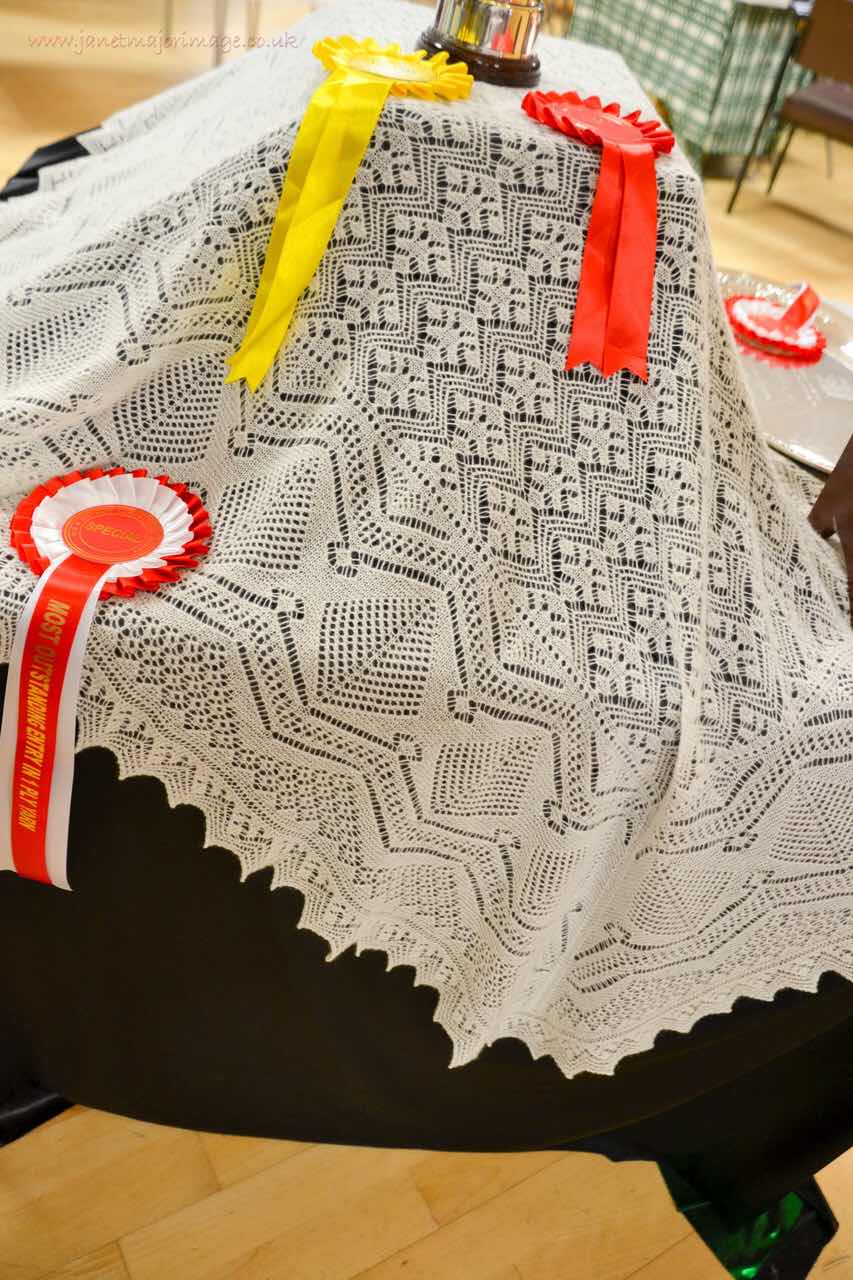
On show close to where we were sitting was displayed the most gorgeous and perfect shawl. This  had been knitted by a young knitter and won lots of prizes. Her name was Lauren Anderson and I heard from one of the ladies (her grandmother) that she had ‘knitting genes’ from both of her parents.(4)

Lauren’s Shawl


What an afternoon this had been, on top of a wonderful morning. It only needed to be finished off by stopping off at Frankie’s Fish and Chip shop in Brae for a very tasty dinner. 


People coming to wool week get upset when they can’t get the classes they feel they ‘need’ when booking. I hope this day will go some way to showing that there is so much wonderful stuff to see and marvellous ‘wool’ people to meet and talk to, that having a day with no classes is nothing to worry about. There is so much to see and do. Everything I did today was free, except for the purchases I made and yet it will be one of my best days in Shetland. Keep your mind and eyes open, talk to people and you will learn so much! 


  1. Again a very good example of social media, Bunchy posts as Spindrift Crafts both on iG and fb and it has been good to follow this publishing journey with her.
  2. Carol  Christiansen mentioned this project on her talk on Thursday. I will be writing more about it then. 
  3. Gordon has amazing skills. An engineer by training he is making a number of laser cut birch products of quality for knitters, spinners, weavers and crochet lovers. It is the ‘cleverness’ of the design which is particularly striking eg on the Ollaberry Gauge just 20 winds of the yarn can give you the wpi down to 200. A very useful tool when actually spinning. If you search for ‘fleece loved products’ you will find Jelly Bean yarns on Etsy and Beaker Button (also both on fb) as some of the stockists or contact directly at fleecelovedproducts@gmail.com 
  4. This is the second shawl of Lauren’s. She was just 16 when she knitted the first shawl and won the children’s section and the judges were so impressed that the shawl was put in the adult section where she won that prize too. She was just 20 when she knitted the shawl in the picture and it won all the prizes possible at the Voe Show. This shawl is just perfect. Lauren was interviewed for the  Fruity Knitting podcast no 87 and  she can be found on iG as laurenclaireart

Wednesday, 8 January 2020

Shetland Wool Week 19: 12 Advanced Shetland Lace

Mon Sept 30 Day 15 

I had been really looking forward to this class for a very long time indeed. 

We were definitely up early and first in to Mackenzies for a bacon bap at 9.00. I would certainly need fuel for today. The class was at  Islesburgh  and Michael was going to have a whole day to himself, although he was hinting about having a rest day. We were just over half way though our month away so a suitable time to have an easy day. 

The class was being led by Anne Eunson and Kathleen Anderson (1), two truly expert lace knitters. I had done a lace grafting class with them before and learnt to do things that I did not even know was possible. That was a half day class and today was a full day so even better. I learnt to spin to enable me to knit lace with yarn finer than Jamieson and  Smith cobweb yarn, which was the finest yarn they sold then.(2) I am confident in designing my own Fair Isle. I don’t feel I have reached the same level with my lace knitting. I can spin finely and knit with fine yarn and make a wedding ring shawl. I can take a pattern and alter all the components (3).  However,  I don’t feel I can start with a blank piece of graph paper (well several sheets) and design a whole traditional Shetland shawl, knitted outside in. I hope to make progress towards that aim today. 

There were 12 in the class and just 2 British, Kate and I. I had previously spoken to the Japanese lady at Terri’s Creative Crew evening on the Saturday. She is also a spinner, which if I understood her correctly is an unusual activity in Japan. She was wearing a lovely shawl she had made. There was also a German lady wearing an amazing lace dress that she had knitted, it wasn’t any simple lace dress, it was completely fitted. Awesome in the true meaning of the word. 


Before the class, Anne and Kathleen unwrapped what seemed like an endless collection of amazing shawls of all sizes and shapes, their only common feature was they were excellent. If my memory is correct, at least one of them Anne had spun the yarn for as well. I think  a question and answer session about these would have been a suitable additional class! 

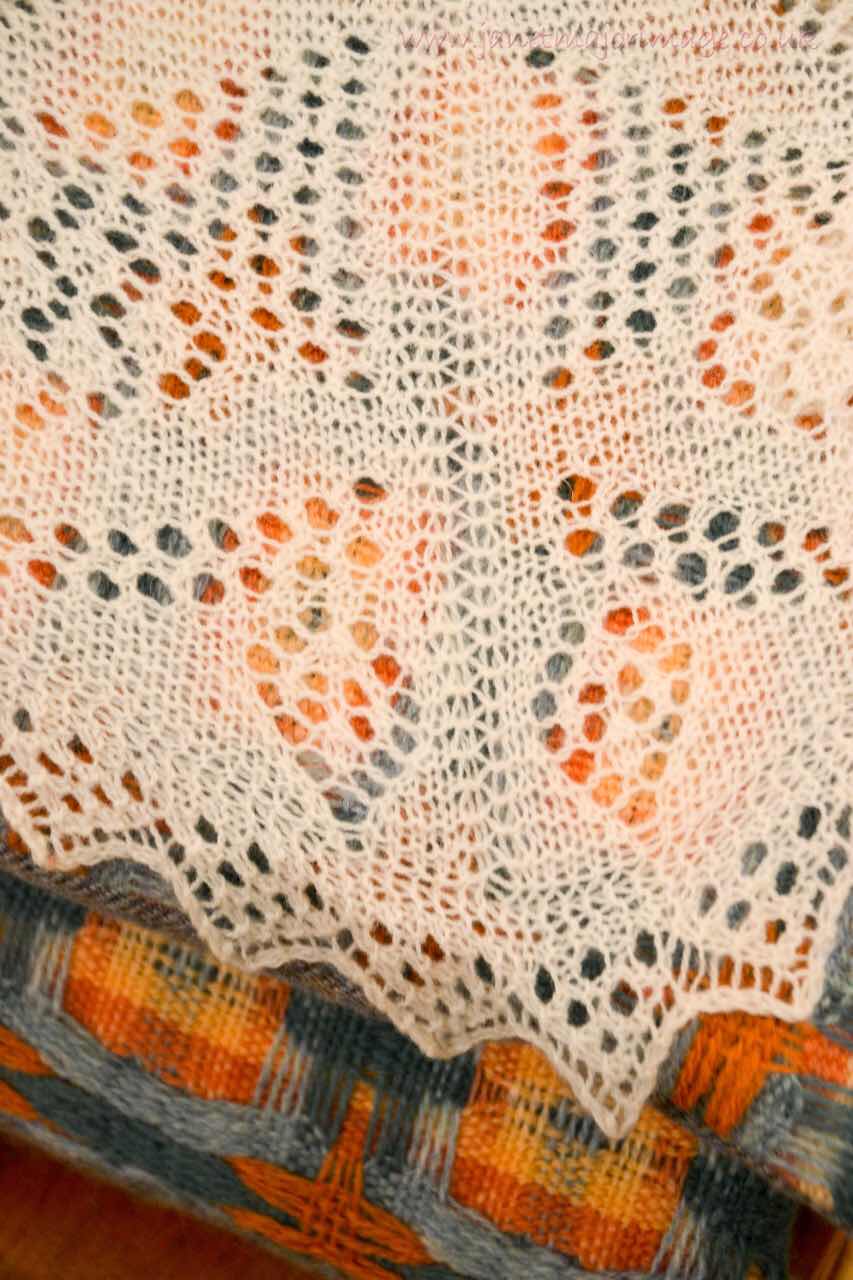
Part of just one of the shawls


Anne and Kathleen shared talking through the construction and what they hoped we would achieve for the day. They talked about favourite books, ways of  designing and planning and some motif designs were available to get us going if we wished along with the blank graph paper. 


It was a great workshop for me, I had thought long  and hard about what I thought I most needed to know to progress my own lace shawl journey. However, as always you learn things that you didn’t know you even needed to know. I had some motifs with me that I had charted, that I particularly liked and thought I would try and incorporate these into my design. I was certainly noticing much more detail than I had previously about shawl construction. 


Naturally, as with any workshop, the participants all start at the same point and all end up in a variety of places having taken different paths. With 2 tutors  there was little if any waiting for help and Anne and Kathleen were brilliant at answering any question that would help us progress during the day. 


Kate had a very specific focus, she is hoping eventually to reproduce her family shawl that is in the Museum. Anne and Kathleen have been working on this and so could help with the interpretation of one of the motifs that Kate hopes to knit first. It seemed a very complex design with very little ground between the motifs. It is a remarkable item. 


Many in the class were knitting early on, I felt I could knit what I had designed and was more interested in doing more of the design and getting the motifs in suitable positions so concentrated on this and in fact did not knit  anything on the day. It was hard mental work but so rewarding and before the class was over I felt that I had got over my hurdle  to this sort of designing.


I was able to think ahead and see what a mammoth job designing a whole shawl is. I never start actual construction until I have the whole of an item planned and each stage will have undergone several trials, that is how I work and it seems to work for me. 


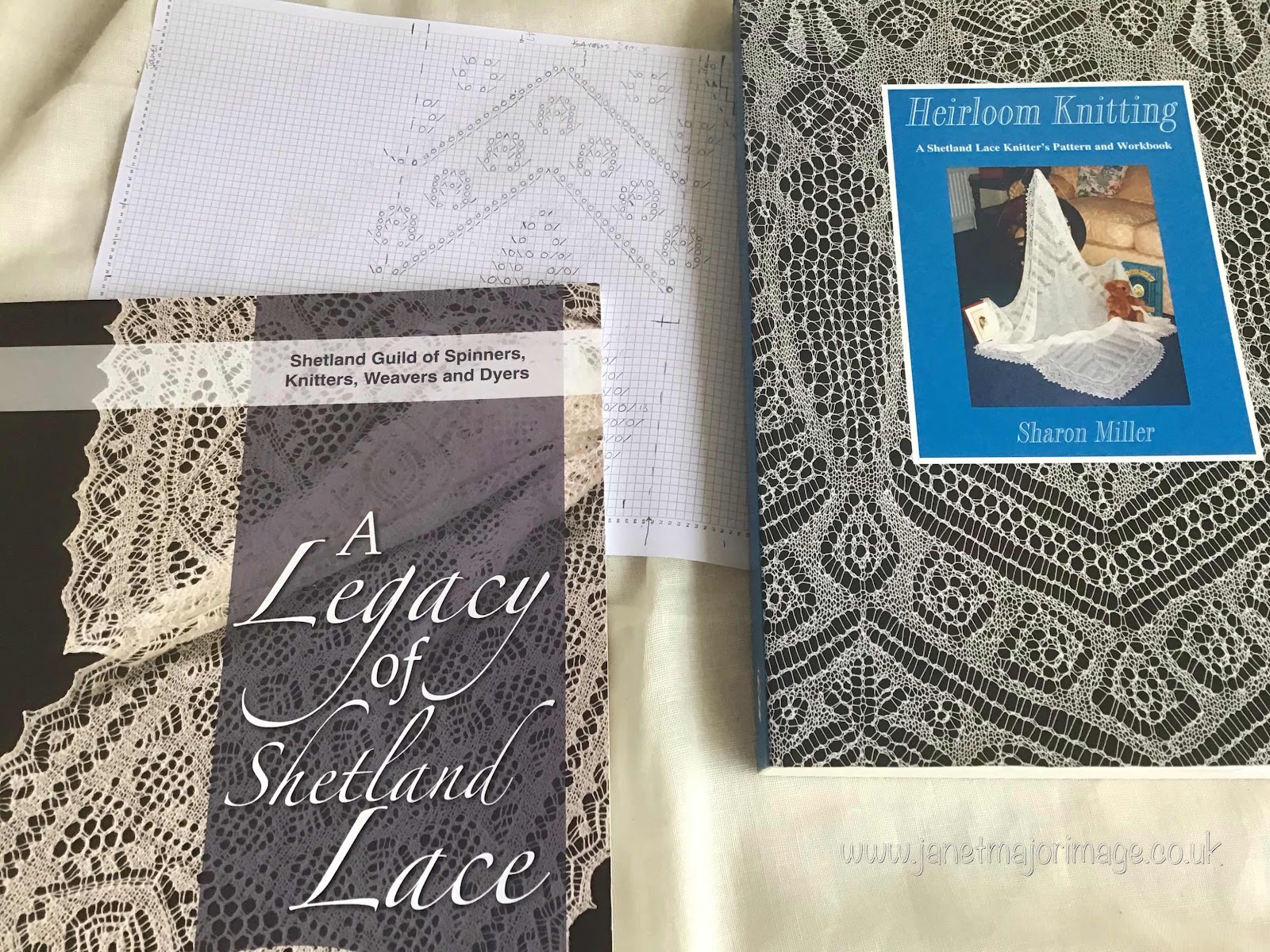
Some of my designing on the day and a couple of great Shetland Lace Knitting  books


It was a great class and I would happily have spent the whole week doing the same class. Now I am home I need to find time for that  the week (or several) to complete the design. 


Soon after 5.00 when the class ended I left my bag of books etc in Kate’s camper van and we walked down to the Dowry where we were booked in for dinner. M was already there waiting for us. We were meeting some friends from a previous wool week and then four of us were going on to Oliver’s talk at Mareel. (4) Unfortunately the friends had to pull out of the meal at the last minute for health reasons. We never did catch up with them last year, so will try and meet up at the next wool week that we are both at. 

Mareel seats more than the lecture theatre in the  museum and this extra seating was needed. Oliver was well prepared and gave a great talk on ‘A Journey with Shetland Oo’. He is an excellent speaker, could be heard easily, kept to the topic and of course is always entertaining. Wool Week would not be happening without him and it was a fitting  tribute that he was chosen to be patron in this 10th anniversary year. 


When we got back to the campsite I got my spinning wheel ready for tomorrow, it was in for a special treat. We decided to attach the thicker half of the quilt to the current layer we were using. Never before have we not used it’s full thickness during all of our time in Shetland in the autumn, it had been unusually  mild this year. 


  1. Anne and Kathleen are heavily involved in the current lace knitting research being carried out at the Museum. More about this in the post about Thursday 3 October.
  2. Jamieson and Smith now sell Worsted spun Shetland Supreme 1 ply yarn 1/16NM
  3. An example of this is shown in one of my shawls I photographed in the Viking Longhouse last Thursday which can be seen in the post of 12 Dec19 
  4. Each year the patron of Wool Week gives a talk on the Monday evening.

Thursday, 12 December 2019

Shetland Wool Week 19: 8, wind, lace knitting and birds


Thurs Sept 26 Day 11


A windy day had been forecast and it was windy in the night but we had experienced much worse during earlier stays. The good news was that high tide was at 9.00 this morning and not during the night. We do worry about a High Tide when there are high winds as we are very close to the beach. I did give a thought to those on the ferry last night, as I know several ‘wool weekers’ do come over a few days early. We know there had been lots of rain in Scotland and further south and thought we were on the edge of the bad storm that was the heavy and persistent rain on the mainland. It was very mild for the time of year and we thought we would probably rest here and in the hostel for much of  today. I had spinning and many photos that were still in the camera. I like to have them in at least two places as an insurance. When it was light M drove the van up behind the hostel, the rain started and it was likely the wind would get up to 54 mph during the day (1) 

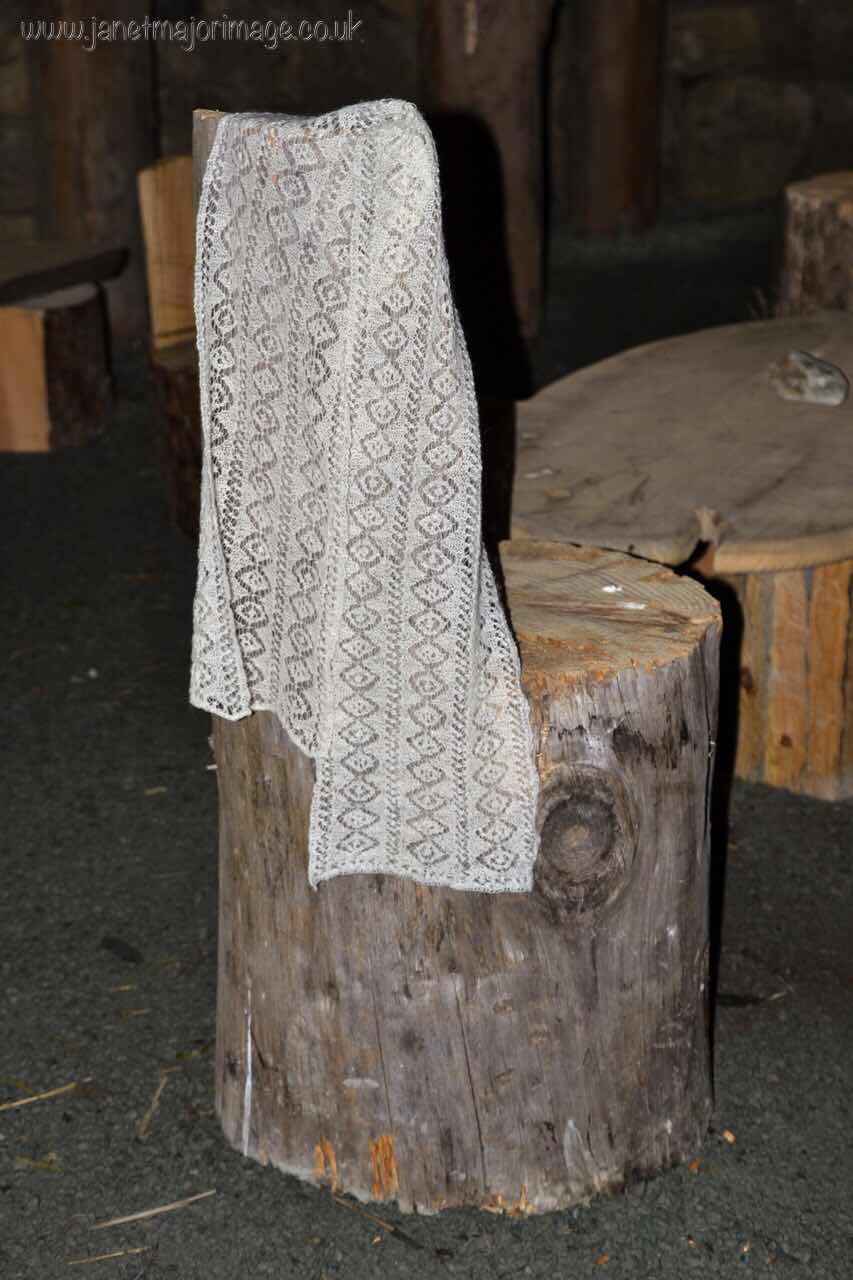
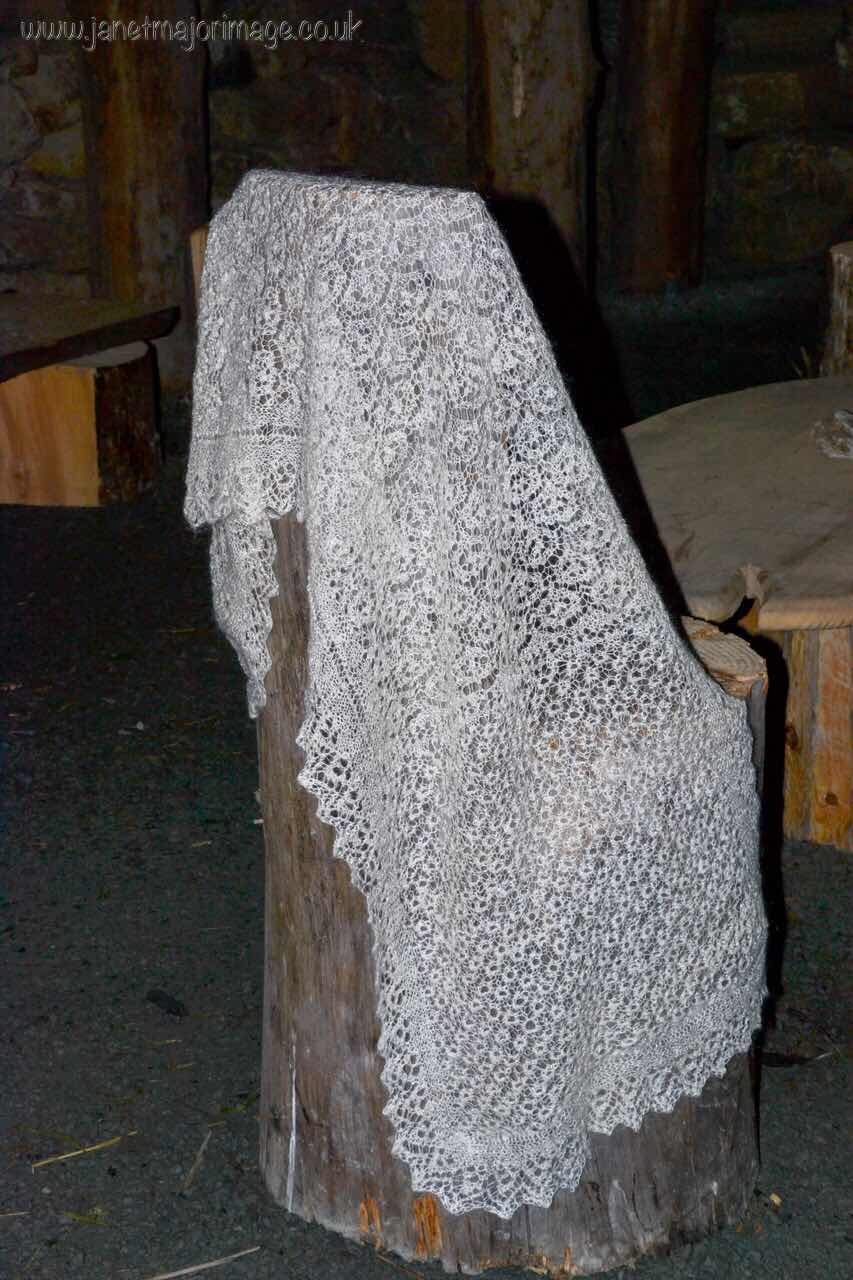
However, we did need to get out as M had to make another appointment for an INR test at the Health Centre, this was made for tomorrow at 9.30. We decided it was definitely a day for a bacon bap at The Final Checkout (2). I thought I recognised the man sitting there drinking a hot drink, and I quickly realised it was Michael who, with his wife Dot, lives at the Zero Carbon House which they run as a B and B. Dot was part of the dyeing group at the Heritage a Centre last year and kindly asked us round for tea. (3). We chatted for quite a time and then left to go to the Viking Longhouse as I was determined to take some photos of the shawl(4).  I had knitted it many years ago and there was also the Dunella scarf that I had completed earlier in the year. It was going to be dark in there but not wet and hopefully not windy. In fact it was windy, but I had taken pegs and string and would be using the tripod so could use a long exposure if I could keep the lace knitting still. One or two visitors turned up as I was doing this and clearly thought I was crazy. 

These are a couple of my shots. 


I had spent a long time on the Dunella Shawl and got thoroughly frozen. I really need to take the bigger shawl back next year and spend quality photography time on this to get a sharper image. 


It had been very cold in there so then needed coffee, we made a quick visit  to Victoria’s and met a Swedish lady who was over early for wool week.

The it was onto Norwick, as we were so close and we made an early lunch of soup. 

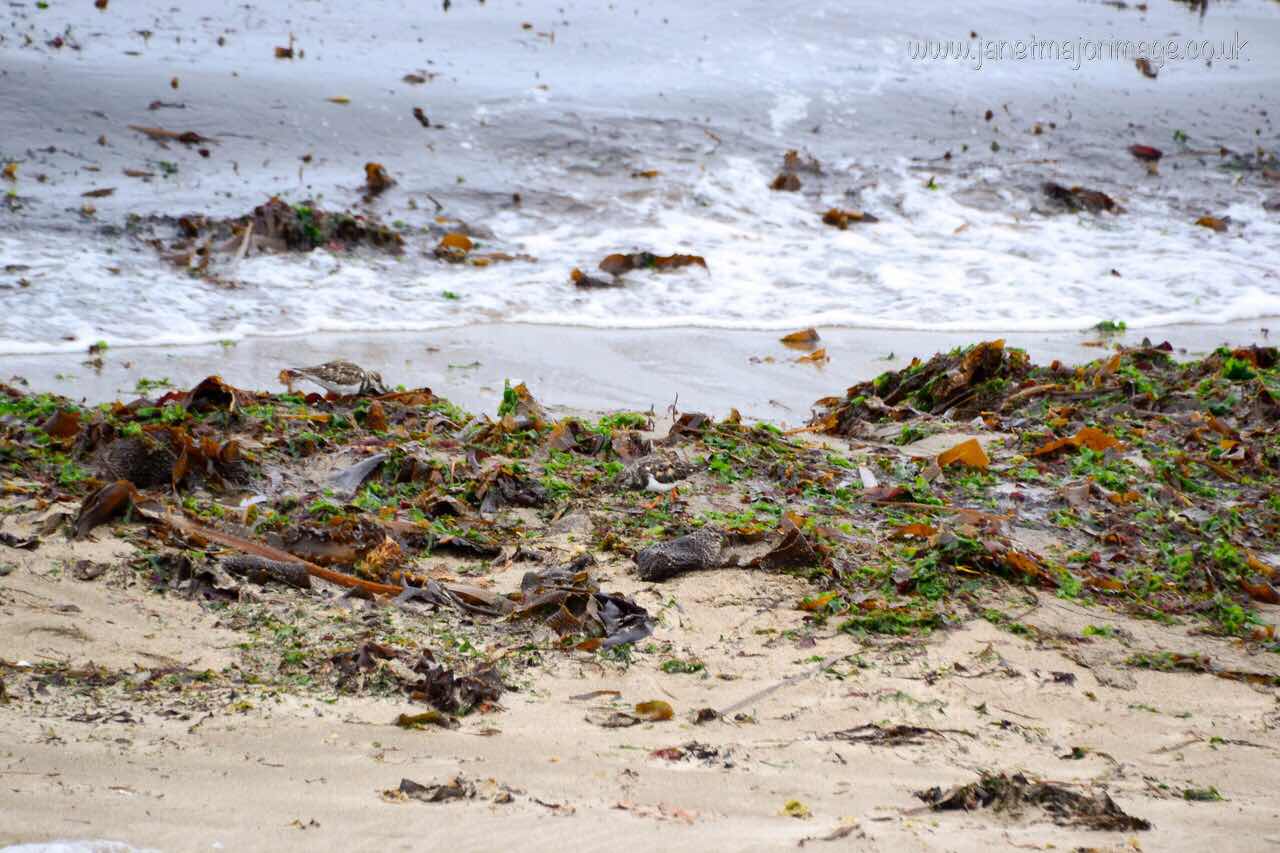
It was great to look at the Turnstones, turning over the masses of seaweed that had been brought in. They are very well camouflaged. 


The Unst  Partnership shop was open from 14.00-16.00 and it would be good to look round a local ‘secondhand shop’. This proved a great place for me. I bought some dpns, some machine knitting cones of yarn (but not all) and some machine knitting patterns that were definitely in the category of vintage and I had never seen any like them before. M got some novels and we decided we would go back to the hostel and warm up and have our afternoon tea there. Yes, this was a day of sitting and relaxing and having drinks and cake. The Swedish lady, Helen, was staying at the hostel for the night and as I chatted to her, as she was here for wool week, I was very envious. She had done 5 day courses in Sweden last year, one on designing and Knitting a yoke for a jumper (that I think was taught by Hazel Tindall) and the second was learning to use 5 spindles for spinning in 5 days. We realised we were both doing Elizabeth Johnson’s ‘Spinning for Fair Isle’ workshop. 

After dinner we moved the van down by the sea, it was getting much windier and was wet, M sloped the van into the wind. 

So now I could semi organise my photos from the week. 

M has written the following about his ‘birding’ when we are in Shetland during this trip. There was little birdwatching today, other than of the gannets plummeting into the rough sea at Norwick. 


From Michael 

People often ask me when on Shetland what do I do while Janet is taking part in  Wool Week.  Well I do have an interest though I have never even learnt to knit.  My Father, like my Grandfather before him worked as a tackler (5) in a Cotton Mill near Wigan in Lancashire.  My Dad in fact was more interested in the engineering side and went to night school in Bolton to get his qualifications.  The mills were closing down and he managed to get a job in Manchester as a journalist on a specialist magazine before being taken on by the Civil Service to work for the Cotton Control during the 2nd World War.  He then became the editor of a magazine for the Textile Industry (The Textile Recorder) until he retired.  I remember as a Chemistry student he would recruit me to read some of the articles on Dyeing  to make sure the Chemistry was correct!

However what I really come to Shetland for are the birds.  I am not an expert or a very experienced birdwatcher but it does give me a chance to see birds that I would not normally encounter.   We always spend our first week on Unst, during which I will go to Norwick or Skaw, my two favourite places, as often as possible while making sure I check out some of the other good spots for example I always visit Halligarth Wood to see what might be there.  This year we were lucky to find the American Golden Plover right by the Uyeasound turn off the main road.  I found a red breasted flycatcher in the Health Centre garden, saw a redstart at Valyie and also at  Skaw as well as a Whinchat and another flycatcher.  I also picked up another bird I have not seen before in the Geo on the other side of the headland to Norwick, an Iceland Gull.  Going back to Valyie later in the week I had my best ever view of a yellow browed warbler.  There is often not much more that a glimpse of one in a bush but this one came out and let me watch it at close quarters for about ten minutes while it moved around feeding.   It is experiences like this when I find a bird by myself and can observe it properly that bring me back to birding again and again.  On getting back to Mainland I heard about a Bee-eater  at Ollaberry.  After dropping Janet at Hoswick for a class I headed North and found the Bee-eater happily using the gardens there to catch insects.  There I  joined about 20 birdwatchers and was able to watch the bird for 30 + minutes.  As I drove a 90 mile round trip to see this bird I am told I was behaving like a twitcher, not really my normal style!

Michael 


Back to Janet......

 ...and so to bed 

I was glad our bed was at the back of the van. The wind calmed down considerably about midnight but it was another night I would not have wanted to be crossing from Aberdeen. 


  1. I have the Unst app on my iPad and we have found this accurate for the imminent weather. 
  2. Victoria’s tea room does not open until 11.00, and the bacon bap at The Final Checkout is very good. 
  3. Post of 4 Nov 18 gives details of this.
  4. This was my first fine hand-spun (88wpi) it is Shetland fleece with some Crookabeck Angora from the side of Ullswater in the Lake  District  added to give lustre. It was knitted in 2003/04.(I first started spinning after a trip to Shetland in 2000). The yarn is 2ply. The shawl weighs 88g, size 100cm x 50cm) and goes through a wedding ring. I combined motifs from Sharon Miller’s first Heirloom Knitting book (pub.02) and knitted this, in the Unst traditional way. It is not very fine compared to my spinning now! 
  5. A tackler was someone who could tackle anything.  When the looms broke down, as they often did, it was his job to get them going again.  With the weavers on piece work it was important to be able to get each loom back working as quickly as possible.

Tuesday, 5 November 2019

Shetland Wool Week 19;1. The journey to Shetland part one


16 - 18  Sept: Days 1-2 


We were glad to be starting the journey to Shetland which would take in the 10th Shetland Wool Week. This would be our 5th Wool Week and our 8th trip to Shetland. We left on Monday 16th Sept and planned to cross from Aberdeen on Friday 20th. (1)


I will split the journey into two posts as we stopped to visit the V and A in Dundee and that is worth a post in itself. 

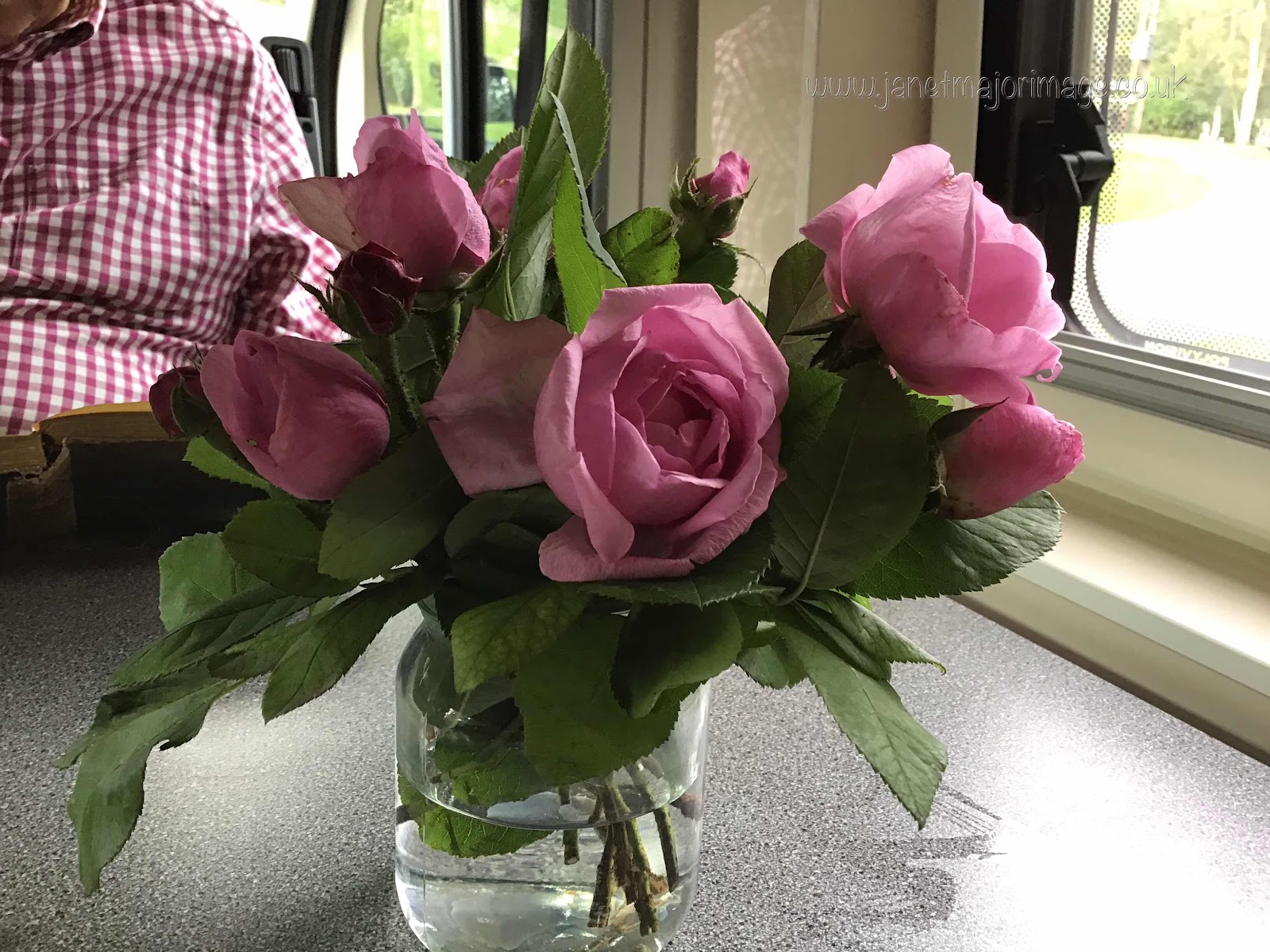
We took the last of our lovely fragrant roses with us. (However on our return some were still in flower and as I write this at the beginning of November we still have lovely roses in the garden.)


We were more organised that we are on some trips and were only going as far as Clumber Park, a lovely campsite in part of Sherwood Forest for the first night. We were surprised when we found a local road near home closed and had to detour around places we did not know. With the hindsight we now have this was just one of the ‘hiccups that happen’ on this trip. Fortunately with M map reading  we reached the A11 and the dual carriageway. The diversion signs were incomplete and this was another example of a human brain and road map triumphing over the SatNav ! After that the journey was uneventful and we arrived at about 16.00 having had a couple of decent breaks. 


I was looking forward even more to Wool Week - if that is possible- due to online conversations re spinning fine lace and seaming methods in Shetland shawls and trying to arrange meet-ups with some experts in each. 

I started re knitting  a sample lace shawl from a previous class with Donna Smith so I could have 4 lace shawl border corners to practise a different joining method. (2) The shawl was an ‘outwards in construction’ and after a trial at home before I left I would attempt to join these corners by knitting on as I knitted each border.  More about this later. 


The following day we had a longer journey over to Hoddam Castle in Dumfries and Galloway. It is another lovely stop, well off the motorway and very spacious. However the journey up the A1 was not pleasant, there were lots of heavy lorries and we again pondered whether going up the A1 was a good choice. The alternative is the A14 and M6. However on balance we put up with this stretch to gain the glorious views from the A66 across from Scotch Corner to Penrith. 

We detoured slightly to stop at Bowes Museum, parking was easy and we knew there was a nice cafe. However, we have been increasingly disappointed in the refreshment offering and the service here recently. Today it reached the lowest point and from being loyal customers we are now looking for an alternative stop. Briefly, I felt ignored as I had to wait for general non food chit chat between 3 behind the counter. There was some inviting cake on the counter and I asked which one was gluten free. (3)The first answer, after a long silence was ‘we don’t know’. The second answer without any checking was ‘there isn’t any’. I clearly looked upset and was then told that I could have a packet of biscuits or bread. My reply included the word ‘boring’ although I remained polite. I won’t go into any more detail but let’s just say we did not receive good customer service which is such a shame given the wonderful views and location. Perhaps someone reading this has had better service. 


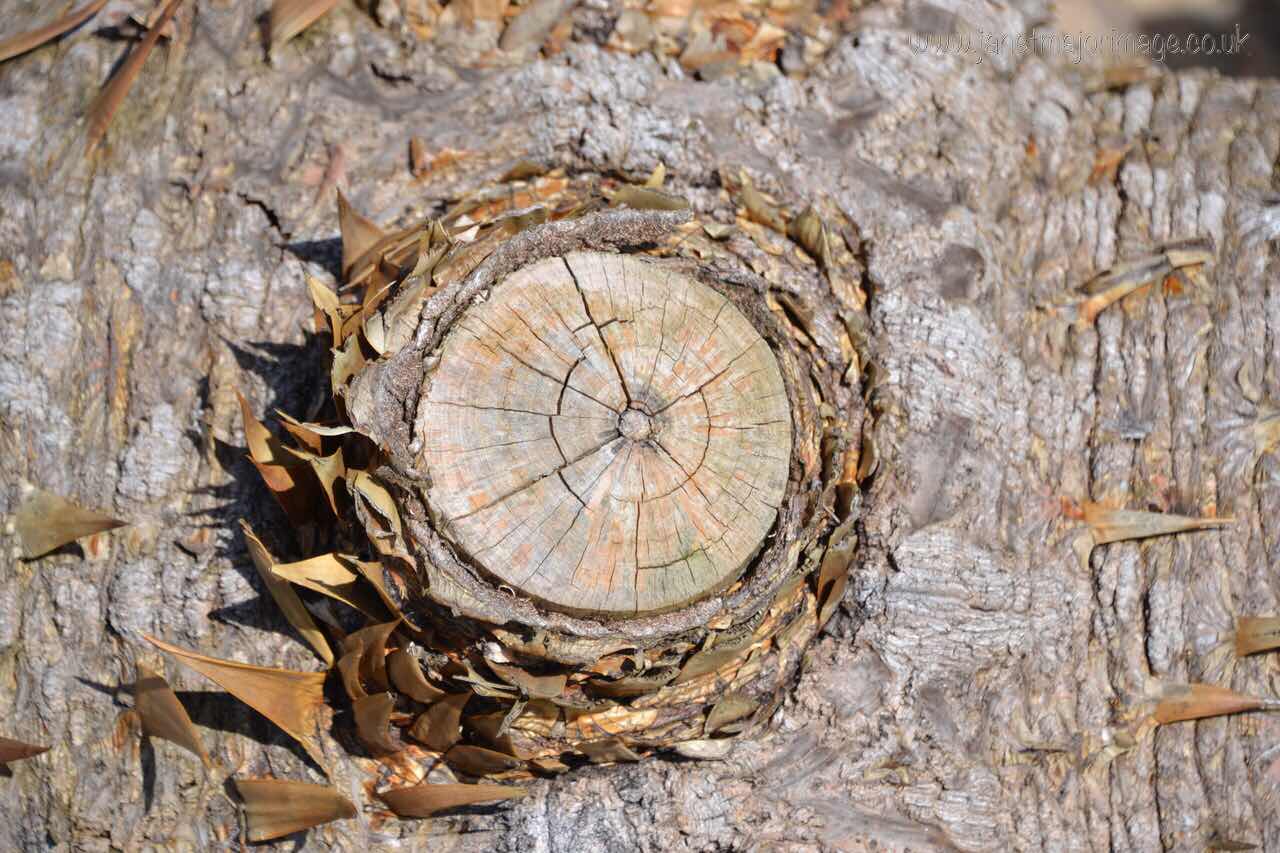
I could see this inspiring a naturally dyed jumper or cardigan. part of a large monkey puzzle tree recently felled at Bowes Castle. 


It was a pleasant drive up the A74 to Hoddam Castle and as an added bonus the new 4G WiFi  worked very well there. I was able to add the post to the blog and IG about our Wool Week hats. The downside was that our fold up step for the van broke. We were pretty confident we would get another in Lerwick. We had reached Scotland and had one more stop before reaching Aberdeen. 


Notes

  1. For those of you who do not know we travel in a super medium sized motorhome. It just about fits into a space on a supermarket car park but is bigger than our initial VW T5. This one has the luxury  of  top of the range insulation, central heating and a wonderful  bathroom with a great shower plus room for a spinning wheel and other fibre essentials. 
  2. I am a member of the Shetland Fine Lace fb page catering for those of us that like to knit with ‘frog hair’ in what is regarded as Shetland Lace.  It is wonderful to see very fine Shawls and to be able to discuss construction details with the owner. My  attempt at knitting up the corners on an outwards inwards shawl came about as a member posted a shawl she had constructed with knitting on a border onto the next but by working outwards. Social Media has many pluses, not least enabling individuals (who are often geographically isolated) to be inspired by others around the world. 
  3. Following severe food poisoning in 2007 I spent many years being gluten, wheat and dairy free on the advise of consultants and their associated nutritional experts. I was told my digestive system would recover eventually. However no one thought it would take 7 years to virtually recover. I have learnt to live with it now and try and reduce the gluten and lactose in my diet.